Barcelona (Spain). The summer months bring their share of tourists in the Catalan capital. The streets are crowded, the beaches covered with parasols, the overcrowded terraces. However, there remains a place where the walker can breathe without queuing: museums. An anomaly, in this city where we exceed crowds each year. But the figures are there: in 2024, the 21 main museums in Barcelona welcomed just under 5 million visitors, according to figures from the Barcelona cultural data observatory, including around 3 million tourists, or less than a quarter of their total estimated at 15.5 million.
Apparently dynamic (around fifty places), the Barcelona museum offer suffers from a certain fragmentation. Few large reference institutions, a majority of small private or municipal museums with limited means, and a lack of museographic ambition in recent projects. Unlike Paris, where national museums play a structuring role, or even in Marseille – which stains it in terms of number of inhabitants and has some international influence establishments, including MUCEM -, Barcelona is struggling to impose itself on the European museum.
Among the major museums of the city, the National Museum of Art of Catalonia remains focused on regional collections, while the Museum of Contemporary Art (MacBA) is in search of repositioning: none is now authority in the field of international contemporary art. “The cultural offer is good but is not in the lead: it is not the engine factor of attraction for tourists. Regarding museum establishments, we are not at the level of the capitals that are Madrid, Berlin or Paris ”, Analysis Eugeni Osácar, professor at the Barcelona Tourist School CETT. “You will never see a“ Véronèse ”type exhibition here (currently shown at Prado de Madrid, editor’s note). It is also because it is not a capital. »»
Party tourism
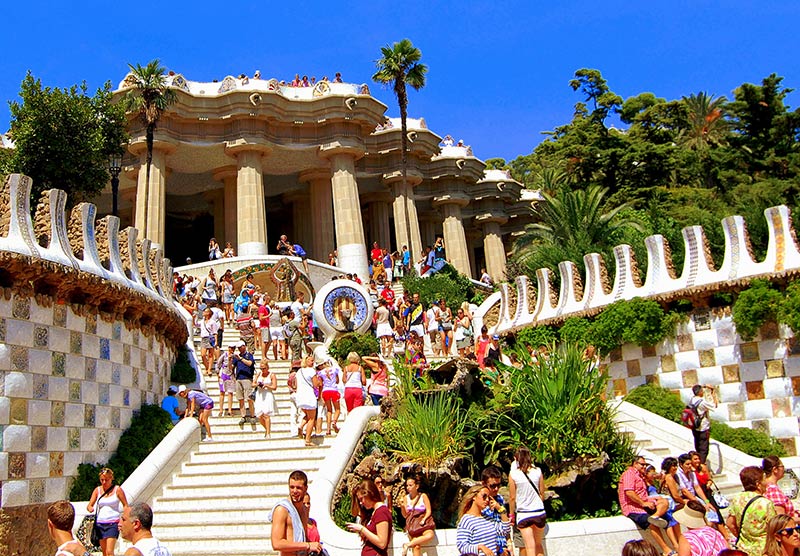
Meanwhile, tourism that dominates in the county city is still and always that of the party, with for example its very (too?) Many burials of life as a girl and boy from all over Europe. A form of inexpensive mass tourism which leaves visible traces in public space: nocturnal noise, material degradations, crowded transport, conflicts of use on beaches and in central districts. Above all, this type of public is concentrated in the city center and the spaces already very frequented such as the Gothic district or the Park Güell, creating a surpoury, which is not defined by “The number of vacationers but by how many of them go to the same place at the same time”specifies Eugeni Oscar.
The Catalan capital is not the only one to suffer from this problem and try to redefine its tourist profile. In Amsterdam, the municipality broadcasts advertisements summoning revelers not to come and has established quotas for hotel rentals. Venice, for its part, has set up a paid booking system at the entrance to the city – with a limited success. Like these two European metropolises, Barcelona seeks its balance. She who generates 14 % of her GDP thanks to tourism cannot necessarily raise her foot in the sector, but she must most certainly reorganize if she does not want to become – even more – victim of her success.
Towards a cultural barcelona?
To reorganize is precisely the objective of the city, which wishes to go from the capital of the party to the cultural capital. “We don’t want more tourists, but the best”declared Mateu Hernández, Managing Director of the Tourism Consortium (Public-Private Status) of Barcelona in December 2024 during the presentation of the tourism program for 2025. Among the projects aimed at developing a “Best tourism”, The “Barcelona Art Season” program was particularly highlighted. He is supposed to promote coordination between museums to attract exhibitions “Premium”.
For Maixaixa Taulé, director of the Egyptian Museum of Barcelona, present at the conference, the day of this announcement is to be marked with a white stone: “There is an important paradigm change: culture has always tried to attract tourism, and now it is tourism that will seek culture. »» The objective, ultimately, is to make the museum offer a lever for tourism repositioning, like what Bilbao could do with the Guggenheim or Málaga museum with its antennas from the Pompidou center and the Russian museum. But reproducing these models in the Catalan capital will not be so simple. “For me, the cause and effect relationship between cultural tourism and quality tourism does not make sense, nuance Eugeni Osácar. And despite this program, I do not believe that cultural tourism of museums can grow. »» Maixaixa Taulé is more enthusiastic, believing that this tourism/culture alliance will attract “Tourism different from that of the beach and the party. We will appeal to cultural tourism, which wants to come here to amplify its relationship to the world ”.
But apart from this announcement conference of the “Barcelona Art Season” and a symbolic presence at the Contemporary Art Fair Arco 2025 in Madrid, no concrete measure has yet emerged. Faced with criticism, the director of the Egyptian museum recalls that Rome was not one day, and Barcelona either: “It all takes time, we cannot transform everything suddenly. Currently, we do everything to make these changes come true. But you can’t change everything in six months. »»
There is also another obstacle to the transformation of Barcelona into a city of museum heritage: its very identity. For Eugeni Osácar, “Here the engine factor is rather the architectural heritage, which is one of the best in the world. Modernism makes it a real open -air museum. If we add the climate, it is the paradise of those who like to walk, that’s why people are very numerous in the street and less in museums. ”
A surcourism that has become unbearable
COMPANY. Like other major European cities, Barcelona underwent on the full whip of surcontarism. This word, invented by the media to define the too high concentration of tourists in specific areas, is used to describe the stifling atmosphere from which certain places in a city suffer. In Barcelona, which welcomed more than 15 million visitors in 2024 for 1.6 million inhabitants, the phenomenon is particularly visible in neighborhoods such as Gòtic or Barceloneta. This pressure causes increasing exasperation on the part of residents, who are increasingly manifesting their annoyance, in particular by spraying tourists with a water pistol or blocking buses. The municipality multiplies the measures to limit the influx: prohibition of airbnb type tourist housing by 2029, the end of the tours of organized bars, or even ban on the sale of cannabis products. Objective: to scare tourism deemed harmful. But the effects remain limited so far and tourist attendance continues to increase. Barcelona is now even on several lists of cities to avoid in high season.