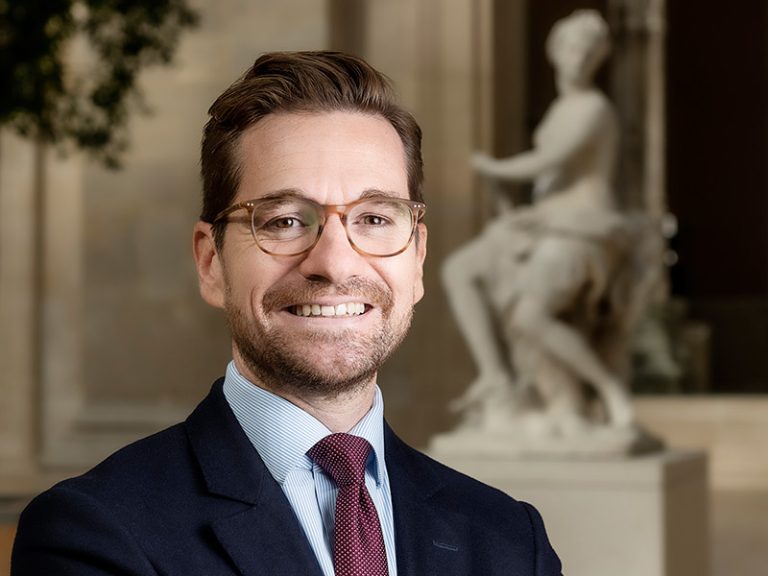
The challenge was to grow while preserving the privacy of the place. After five years of work, the money collection – this “Museum house” Along the 5ᵉ avenue de New York, a former home and the case of the collection of Henry Clay Frick (1849-1919), bequeathed to the city when it died – reopens its doors today April 17. “The money is back”exclaimed Axel Rüger, its director since 2025 during a press conference.
The renovation, at a cost of $ 330 million (around 310 million euros) and carried by the architect Annabelle Selldorf, was not easy. Questioned in 2014, the project had aroused strong protests, in a context where the enlargements of museums are multiplying, sometimes to the detriment of the architecture of origin.
The neighbors had mobilized against the first proposal of the architect David Brody Bond, which involved the destruction of the garden designed by the landscaper Russell Page in 1977, and the creation of a wing of six floors covering 12,000 m² – of which only 1,000 m² intended for exhibitions, the rest being planned for a shop, a cafe, a amphitheater … “The architectural integrity of money as a whole”.
The Frick Collection had then renounced this plan, while retaining the ambition to undertake renovation work in 2017. In 2016, the enlargement project was officially relaunched, and the Annabelle Selldorf project unveiled in 2018 is validated by the City Historic Monument Protection Service. The former director, retired in 2024, Ian Wardropper, had assured that the project would be respectful of the building designed in 1914 by the American architect Thomas Hastings.
It was in 2020 that the work started, thus marking the first major transformation of the building since its opening to the public in 1935.
Among the significant transformations, we note the restoration of the spaces on the ground floor. New temporary exhibition galleries have been added to the first floor. A space dedicated to education has been created. The second floor, formerly occupied by the family and then by administrative offices, will be open to the public and transformed into galleries. Some facilities pay tribute to the personal tastes of the FRICK family, such as the former room of his daughter Helen, which will be devoted to the Renaissance panels.
In the basement, a modern auditorium with 218 places, called Stephen A. Schwarzman Auditorium, was built. Building infrastructures have also been modernized to meet current standards: new mechanical systems, specialized spaces for the conservation of library works and archives. The facade of the building has also been the subject of a meticulous restoration, as well as the textiles and the interior decorative elements, recreated by the same craftsmen or factories as those asked by the FRICK family originally. The renovation also includes the restoration of the garden. In total, 2,500 m² of surface are added to the 5,574 m² of existing spaces.
It is thus again possible to discover the collection of around 1,800 works, from the Renaissance to the end of the 19th century, signed among others by Bellini, Rembrandt, Vermeer, Gainsborough, Goya or Whistler. During the work, the collection had been presented in the Breuer building, located at 945 Madison avenue in New York, which the Frick Collection sublets to the Metropolitan Museum of Art.
The inaugural exhibition entitled “Vermeer love letters” will open in June.