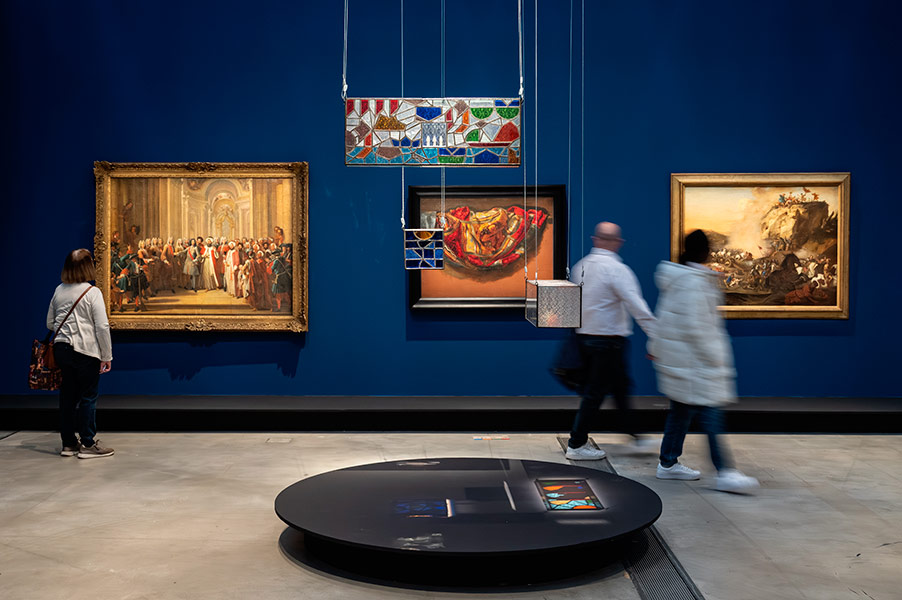
Lens (Pas-de-Calais). The tales of Arabian Nights still constitute today a subject of fantasies about the Orient, in the same way as belly dancing, Persian carpets and odalisques. The Louvre-Lens places these themes in a long history of relations between the East and Europe. The construction of stories about oriental countries also occupies an important part of the exhibition, as indicated by its subtitle, “Histories of Orientalisms”. According to Annabelle Ténèze, director of the museum, “Beyond the Thousand and One Nights” addresses its subject “by objects and not only by works of art”in particular numerous objects of popular culture (porcelain figurines, automatons, costumes). Orientalism remains known to the general public through the painting of the 18th and 19th centuries, the exhibition of which also presents several masterpieces by Delacroix, Gérôme, Chassériau and Ingres. The Louvre has loaned a third of the 300 works on display, which mainly come from French museums. The scenography designed by Philippine Ordinaire and Bertrand Houdin alternates geometric patterns of Islamic arts and draped curtains, which delimit the sections of the route: this choice of the curators aims to link the exhibition to “a world that constructs images” and therefore fiction, as explained by Gwenaëlle Fellinger, chief curator of the department of Islamic Arts at the Louvre Museum.
View of the exhibition “Beyond the Arabian Nights” at the Louvre-Lens.
© Frédéric Iovino
A journey punctuated by contemporary works
After a preamble on commercial exchanges between the Middle East and medieval France, the journey takes place more thematically than chronologically. The embassies of Charlemagne and Haroun al-Rashid in the 9th century occupy a large place there, as well as subsequent interpretations of these political contacts (see the work on paper by Achille Devéria, 1839). It is the context of the Crusades which then frames relations in the Mediterranean, even in the trade in religious objects manufactured in the Middle East for French dignitaries: reliquaries and a Byzantine cross illustrate cultural syncretism here. The other themes are accompanied by a map and a short chronology, and punctuated with contemporary works or film extracts (Wael Shawky, Sara Ouhaddou). Thus, in the section devoted to Arabian Nights and literary fiction, the exhibition shows both a series of works by the artist Katia Kameli (born in 1973) on oriental fables, printed works of the first French translation (early 18th century) by Antoine Galland of Arabian Nights [contes issus de traditions indiennes et persanes, transmis en arable au IXe siècle, ndlr]and costumes from the Ballets Russes by Diaghilev (1872-1929) who adapted the story into a ballet.
Some sections are devoid of contemporary works, such as that devoted to science in the Arab world and that where the collections of Goupil and Delort de Gléon, two collectors from the end of the 19th century and great fans of Islamic art, are presented.
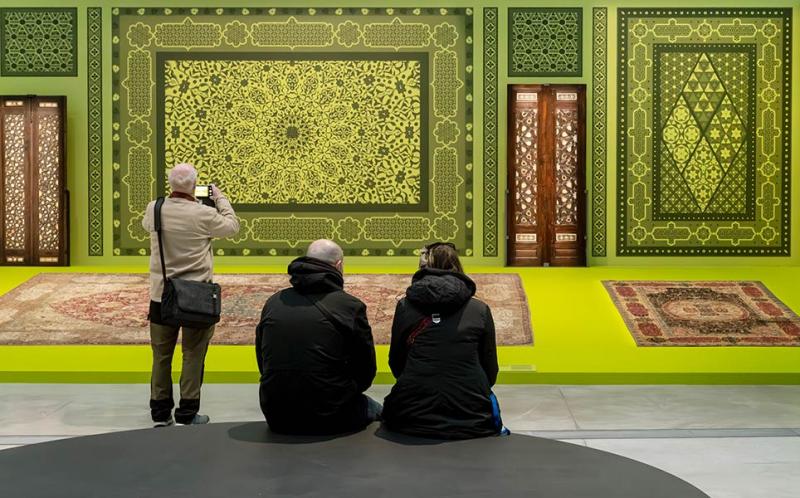
View of the exhibition “Beyond the Arabian Nights” at the Louvre-Lens.
© Frédéric Iovino
From southern Spain to eastern Iran
Several masterpieces from French collections are placed in historical perspective. The Great Odalisque and the Bathers of Ingres or the Women of Algiers by Henri Fantin-Latour inspired by Delacroix coexist here with Matisse and contemporary works. Room texts explain, for example, how the turban became a typical element of portraits of “oriental” women, whereas it is a masculine attribute in the Middle East. The painting by Rayan Yasmineh (born in 1996) created especially for the exhibition takes up these orientalist codes and modifies them, representing a shirtless young man with a turban, languid in a refined setting where objects from the Louvre collections appear. It is therefore a question of showing how orientalism infuses the visual arts until today where it is reinterpreted by artists themselves from this vague Orient. Because the Orient in question covers an area which goes from the south of Spain to the east of Iran via Turkey, as recalled by the commissioners who cite the case of the “Turkeries” of the 18th century in France. This fashion gave rise to the production of porcelain figurines in French factories: sultanas and eunuchs in turbans were then objects prized by the bourgeoisie and the aristocracy, who also appreciated them depicted on engravings and tapestries.
At the end of the course, two stubborn stereotypes are addressed, the belly dancer and the oriental magician, Western cultural constructions whose diffusion coincides with the Universal Exhibitions. According to Gwenaëlle Fellinger, “there was no such thing as a belly dancer” In Arab countries, this character was invented by Western travelers and colonizers, taking inspiration from prostitutes. Egypt and the Maghreb countries then created a belly dance for this foreign audience, with success. Show posters, cabaret costumes and a feminist video by Nil Yalter (born 1938 in Cairo) complete this section. One of the last rooms offers a reflection on the constitution of the collections of French national museums, with archive photographs and some objects from the Louvre, but the whole only scratches the surface of the subject. This exhibition therefore allows the public to deepen their knowledge of Orientalism beyond painting, by discovering its diffusion in French popular culture until today.
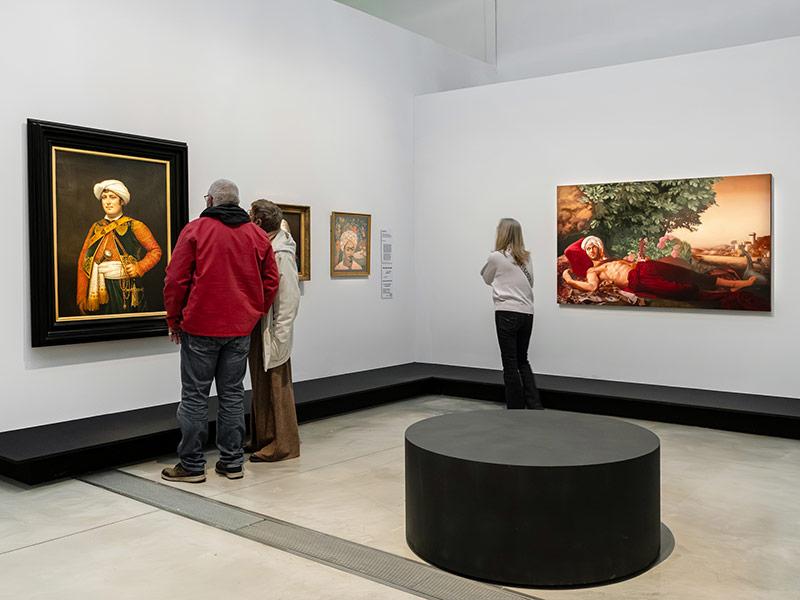
View of the exhibition “Beyond the Arabian Nights” at the Louvre-Lens.
© Frédéric Iovino