Madrid,
After its passage, in summer, through the Musée de L´Orangerie of Paris, and before its exhibition in Barcelona, CaixaForum Madrid hosts the exhibition “Defined. Another vision of art”, which offers a thematic tour -and non -chronological, although it begins with Monet -by the blur as an artistic choice and aesthetic resource from the end of the 19th century to the present.
It is a peculiar exposure: in itself it is a thematic proposal, but not focused on an iconographic motive, but on that notion of the constant indefinite in contemporary creation. Especially since 1945, although at each stage its use responds to different purposes: from the realistic representation of altered perceptions, and the plasma of what cannot be perceived more than in a cloudy way, to the claim of the diffuse as a condition of the look and thought in our time (in which in which in which The solid fades in the air) or as a tool to impose distances against issues that can be difficult to address.
They make up this project, which has been introducing some modifications in each of its locations, works of fifty artists in all kinds of techniques: from painting to video, through engraving, photography and sculpture. A dozen of these pieces come from the funds of the “La Caixa” Foundation: Boltanski creations, Richter -impressible talking about this subject -Roni Horn, Hiroshi Sugimoto and the Spaniards Pedro G. Romero, Eulàlia Valldosera, Soledad Sevilla and Perejaume.
Claire Bernardi, director of the Musée de L´Orangerie, and Émilia Philippot, conservative of the French patrimician Institut National Du Patrimoine, would commission the sample, which arose in a first term of the finding that when the public contemplates the Nenufares of Monet, in the large circular room they occupy precisely in the Orangerie, it really does not see anything. Nothing defined, because we perceive, however, much: colors and shapes that raise impressions.
We can try to differentiate willows, trees around the pond …, but in reality these compositions are fundamentally blurred. That inaccuracy, in intentional, is constructive, although we usually define the blur for the information that does not provide us, in opposition to Cartesian confinement of objects. If we think slowly, the evanescent gives the viewer a central role: to interpret the not evident.

Why start with Monet? It would be possible to think that the Sfumato Leonardesco can be a distant relative of this resource, but the reasons for its use by Vinci’s are radically different from those that lead us to understand as inflection points, in this area, both Giverny and impressionism and World War II.
If an artistic discipline incorporated the blur since its very beginnings that was the nineteenth photography: in its earliest manifestations, linked to pictorialism (Steichen and Julia Margaret Cameron have arrived in CaixaForum), contours were softened precisely to approach the painting and distance themselves from the industrial aspect of this medium. The debate about whether the photo documes the world or offers him a subjective and potentially poetic vision.

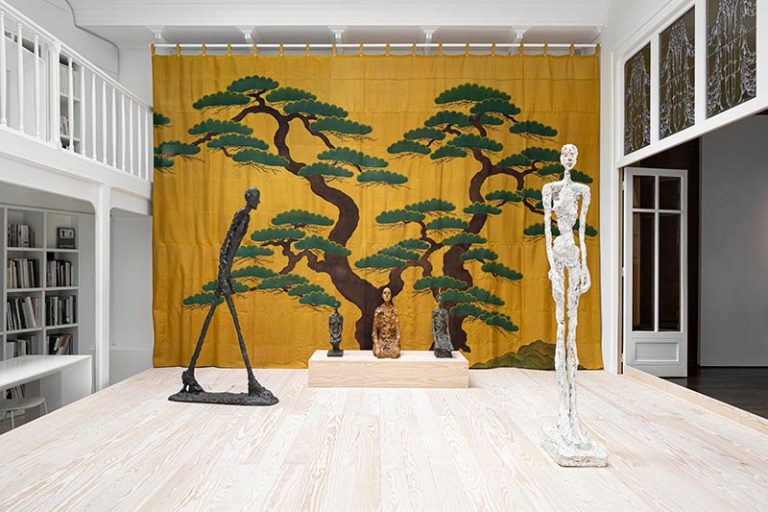
This exhibition does not raise, the commissioners have insisted today, closed readings about the issue of blur, but rather offers interpretive clues, it allows the viewer to establish relationships between the pieces. And in the First Chamber some of those links begin to be outlined: among those images of Steichen and Cameron and a blur portrait of Eugène Carrière; with one of the sculpted faces of Medardo Rosso, who presented at the same time as finished works that were previously work in intermediate phases; With the fragile Men underway from Giacometti; And especially with very subsequent compositions in which, in a fruitful coming and going, painters will work from photographs. It will happen especially in the second half of the twentieth century (and Richter is a paradigmatic case, much less unique).
It is worth remembering, likewise, that if World War II left its clear mark on many artistic processes, Monet had taken refuge in his water lilies in the hangover years of the Great War. And other social conflicts and seizures, not necessarily warlike, will be noticed in the sample: the blur alludes to them with crudeness, but with the distance of a certain modesty; We refer to the lost lives in the Mediterranean or the border between Mexico and the United States, to the atomic bomb, to the September 11 attack or the children marked by the Holocaust whose faces has taught us again and again Boltanski. Krzysztof Pruszkowski synthesized several photographs to create the image of the surveillance tower of an extermination field.

Politics and social history on the margin, the artistic expression of the blur has also evolved in the hands of the findings associated with the scientific image, in particular of the use of X -rays or infrared that, while demonstrating that it was possible to penetrate the matter thanks to the technique, underlined the limits of the human eye. Of that reality that, without the mediation of other devices, escapes us they have sought to appropriate, and continue to do it, certain authors whose compositions the reference points seem to be lost (despite being, paradoxically, objectives). Dove Allouche portrays gases on the surface of the sun; Thomas Ruff, the floor of Mars.
We can have the feeling that the formal vagueness of these works fits very naturally with the liquid condition associated with the contemporary world and the theoretical instability of their subjects (that supposed fluidity of identities). Other times, these blurred images will perhaps reflect on what the unconscious refuses to contemplate.
They can get away from the real, sometimes from rejection, or propose to deepen our gaze and try to discern what exists beyond. Or both options, leaving open field to our positioning.
It demonstrates this exhibition that would be viable to establish an alternative history of contemporary art structured from this notion of the blur, which transcends figuration and abstraction and fits both. In Caixaforum the bases are sitting.

“Defined. Another vision of art”
CaixaForum Madrid
Paseo del Prado, 36
Madrid
From September 17, 2025 to April 12, 2026