Perpignan (Pyrénées-Orientales). As early as the 1930s, the Catalan painter Joan Miró (1893-1983) cherished a dream: to have a studio in which he could concentrate. It was finally in Palma de Mallorca that he settled. He moved to the Son Abrines estate in 1956 where his friend the architect Josep Lluís Sert built a workshop in 1957. In 1959, Miró acquired an 18th century farmhouse, Son Boter, where he set up a workshop for sculpture. His creativity was released and he notably painted the triptych Blue I, II and III (1961). Having stopped working, in 1981 he donated his workshops and their contents to the City of Palma: “I want everything to remain behind me as it will be when I disappear. What interests me is not that the painting remains there, but its influence, its message, what it will do to transform people’s minds a little.” he confided to the art critic Georges Raillard in This is the color of my dreams (Threshold, 1977).
Around a hundred works and objects
In September 2024, Perpignan and Palma de Mallorca became twinned and Pascale Picard, director and chief curator of the Hyacinthe-Rigaud Art Museum, in Perpignan, approached the Pilar-et-Joan-Miró Foundation in Mallorca to program an exhibition dedicated to the Catalan master. The Foundation lent half of the hundred works and objects presented, the other major lender being the Galerie Lelong, to which is added the collector Marc Larock who owns magnificent stoneware and terracottas by Miró and the ceramist Josep Llorens i Artigas. “This exhibition and the accompanying catalog allow us to measure the path traveled by Miró since his beginnings and to better understand the internal mutation taking place in Majorca to reach a profound point of inflection where the apparent poetry of color confronts existentialist tensions,writes the commissioner in the catalog. The irreducible deadline of death catalyzes Miró’s creative energy, while imposing on him the question of the posterity of his work. »
The tour begins with a presentation of the workshop as it remained when the artist died, thanks to a large photo and some objects that belonged to him. In the adjacent room there is another photograph, Joan Miró in his studio in Son Boter, Palma de Mallorca, 1968by Francesc Català-Roca. He poses in front of the graffiti with which he covered the walls and the reproduction of a Sumerian prayer that he pinned there. With the small terracottas typical of Majorca presented in the first room, this document shows the plastic references with which Miró surrounded himself in Palma. The proofs of the “Fundació Palma” series (1978) evoke the future chosen by the artist for his work.
The visitor is then invited to discover Miró’s journey until his installation in Majorca. The curator was unable to obtain anything from the “detailist” period (1920s) and the years 1930 to 1950 are illustrated by works on paper. A little Mobile (around 1936) by Alexander Calder, owned by the museum, evokes the companionship in which the two men engaged. This sculpture and the canvas A beach with a boat (Berck) (before 1873) by the master of Miró, Modest Urgell i Ingladaare the only two works by other artists present in the exhibition.
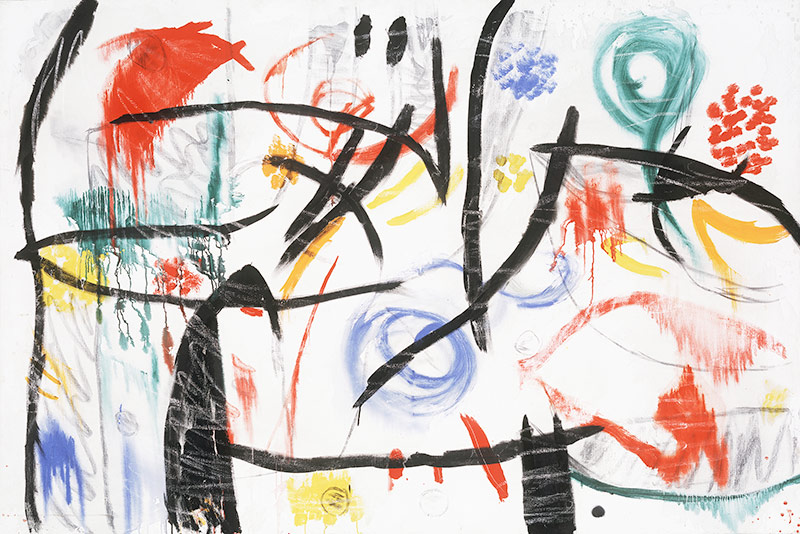
The rest of the tour retraces the evolution of Miró in Palma in around fifty papers, canvases and sculptures. The National Center for Plastic Arts lent its prints on parchment with watercolor highlights (untitled and undated), a series published in 13 copies in 1963 by Aimé Maeght. They sit alongside seven dazzling models for the “Els Gossos” series (circa 1978). This exploration of the Majorcan period ends with a masterful set of eight quasi-abstract canvases surrounding a copy of the sculpture Solar bird (1966-1997). The exhibition’s guestbook testifies to the pleasure of visitors. Some point out that it is not necessary to “understand”: Miró, the curator emphasizes, wanted his work to change the way the public approaches art. It’s done here.