Madrid,
Restless man, but always moderate, of typical Fauve origins and forays into the abstract, whose search has led to an urban, linear, detailed landscaping, with naive contiguities, but impossible to be conceptualized as totally naïve in a painter as experienced as he has proven to be.
Gaya Nuño thus referred, in 1970 and in her classic volume dedicated to 20th century Spanish painting, to Fernando Delapuente, an artist from Santander (1909-1975) whose early death is now half a century ago; These categorization difficulties have long since ceased to be understood as problematic among artists who neither worked from a vanguard desire nor reduced their sources of influence to specific movements, but rather opened their references to those authors and scenarios, contemporary or not, that responded to their searches. In the case of Delapuente, these had to do with simplicity and expressive freedom and with the desire to reach the essence of his motifs, fundamentally urban and natural landscapes, but also still lifes and portraits.
Until next January, the Illustrious Official College of Physicians of Madrid, very close to the Reina Sofía Museum and the Paseo del Arte, is hosting an anthology by this author organized by the Methos Foundation and curated by Andrés Barbé Riesco. It consists of seventy works, structured in half a dozen thematic and chronological sections, which allow us to review his evolution in the free but careful handling of drawing and in the use of color and light, from his first academic portraits and his views of the newborn Ebro in Nestares to his latest paintings, dedicated to a calm or angry Cantabrian Sea, even in its tones.
The tour begins with two self-portraits with a Fauvist imprint and a similar background, separated by just under twenty years; They advance what, as Puerta López-Cózar pointed out in the presentation of the exhibition, will be fundamental notes in his production, beyond his genres: the colorist vigor, which was installed in his work after a decisive trip to Italy between 1949 and 1953 and after contemplating in various exhibitions, both Italian and French, works by Van Gogh and Matisse, Derain and De Vlaminck (in these weeks, also, neighbors at CaixaForum); expressive freedom, a hallmark of the aforementioned painters that he noticed especially in the latter; and that search for essentiality that, more than as naivetywe can understand it as a desire for simplicity.
The first views that will meet us will be, precisely, those of various Italian cities, scenarios built from chromatic planes in free tones: mimesis was not intended, but the capture of emotional and own landscapes.
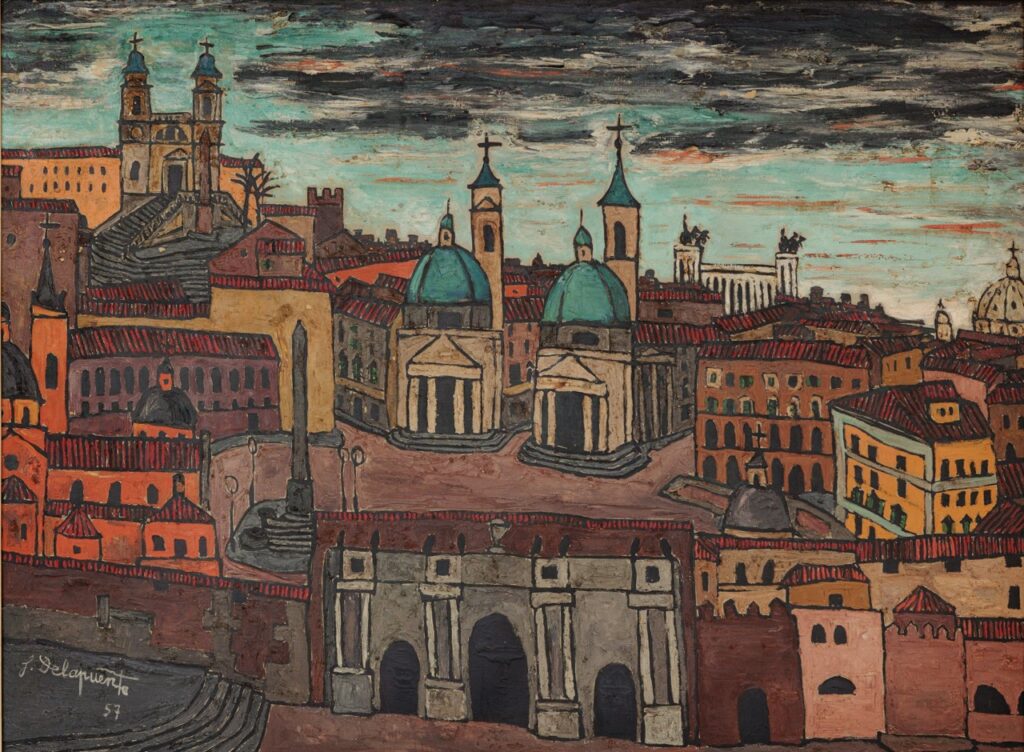
In that way of working, the contemplation of the Byzantine mosaics of the temples of Ravenna had weight, where he noticed the possibilities of the vibration of flat color, of widening or dislocating chromatic areas; also his role as an engineer: more than portrayed, these cities seem built in the paintings. This profession will also have to do with the fact that, with humor (and discipline), he numbered all his compositions: more than a thousand, although his life was not long.
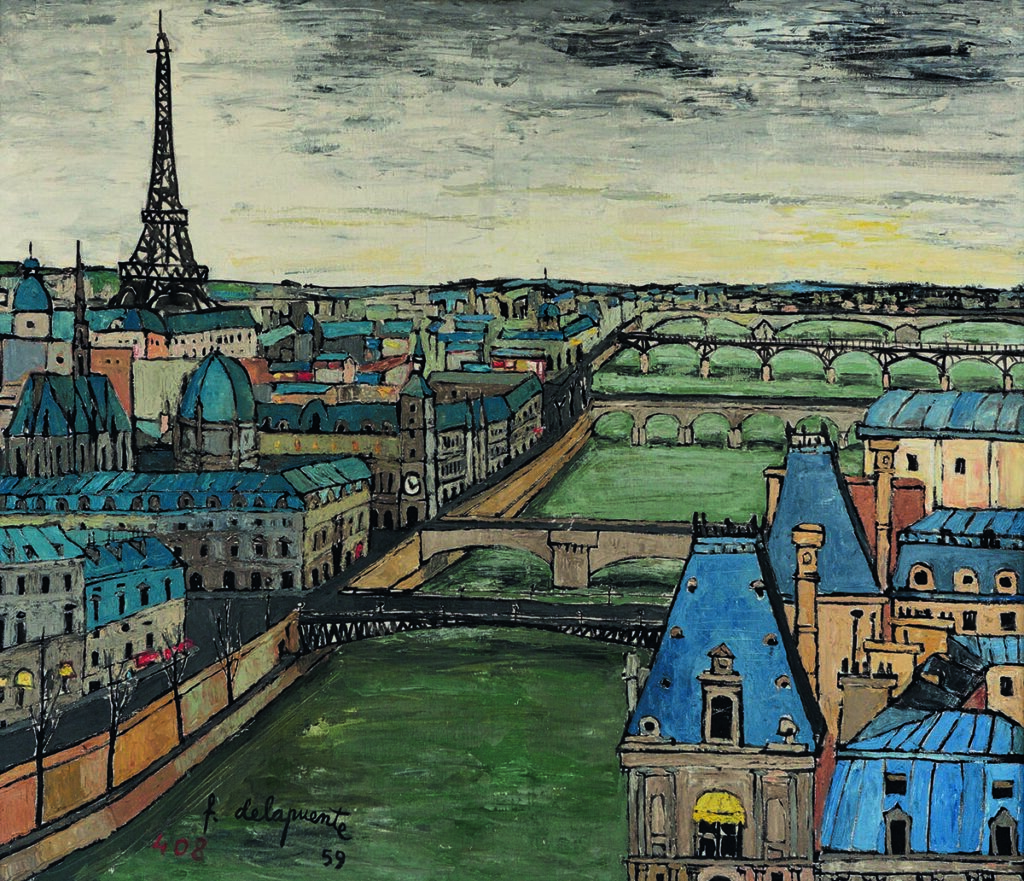
We will then contemplate its Parisian views – luminous despite the gray that sometimes dominates the skies and architecture -, the young people and the suits that converged under the awning of Les Deux Magots; and a first set of material landscapes, which refer to a telluric vision of the countryside (Bare ground one of them is titled) and that clearly express their desire for purification, now in the form of earthy textures, natural works that seem to contain what the primary environment is made of.
One of his most forceful and poetic Castilian landscapes in the exhibition takes its title from a fragment of the Trip to Alcarria from Cela (in Brihuega: The traveler, once again on the road, thinks about what has already happened, closes his eyes for a moment to feel the movement of his heart.); In it, grooves that seem to extend to infinity share yellow and orange tones with the sky, reminiscent of Van Gogh. Between the two large extensions, a small church completes the scene: a compendium of substance in basic strokes that seems closer to the fields that he drew around Pavarolo Casorati, the painter of silence, than to the much more ocher fields of Spanish painting at that time.
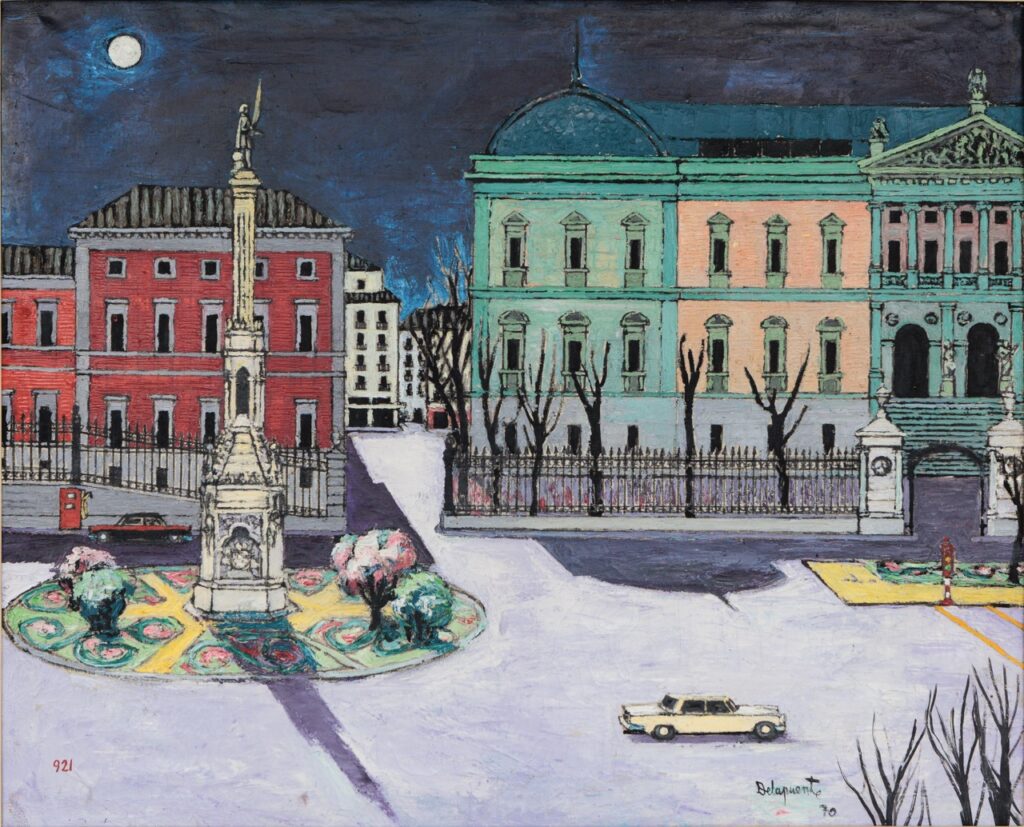
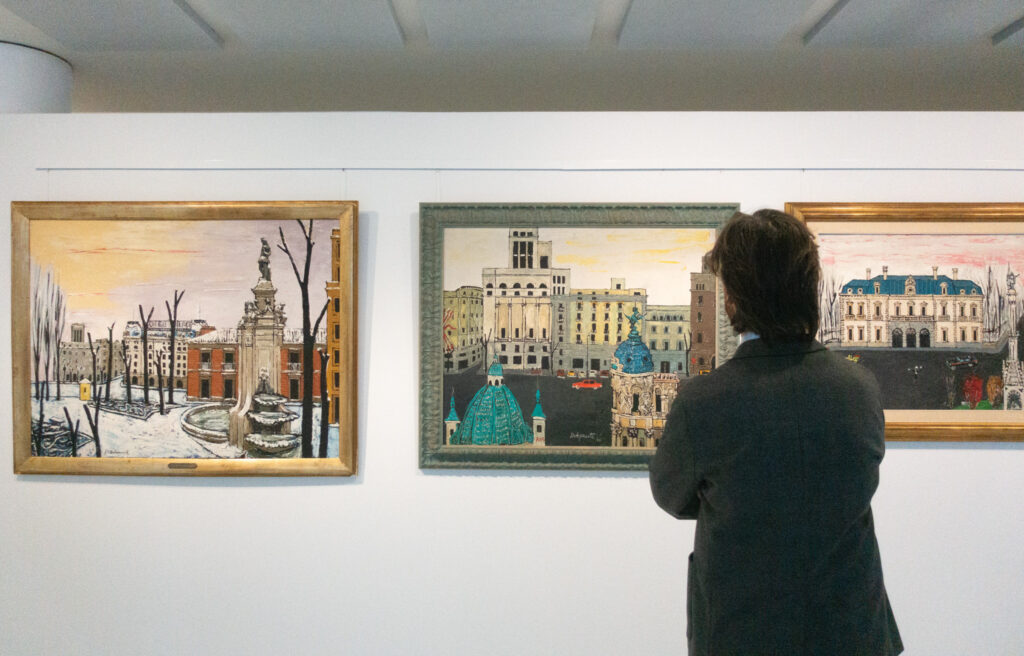
Another important chapter of the exhibition is his Madrid landscapes, day and night: Delapuente dedicated nearly one hundred and twenty works to the capital. He represented both traditional squares and streets – with very bright tones – and its monumental areas – with greater sobriety – in fundamentally cheerful compositions that were, along with those of the Madrid realists, among the first paintings focused on the urban life of the city and not on the surrounding areas, which had a long tradition. Contemplating the images of one and the other together would allow us to examine the diversity of approaches from which Madrid Villa arrived on canvas in the 1960s.
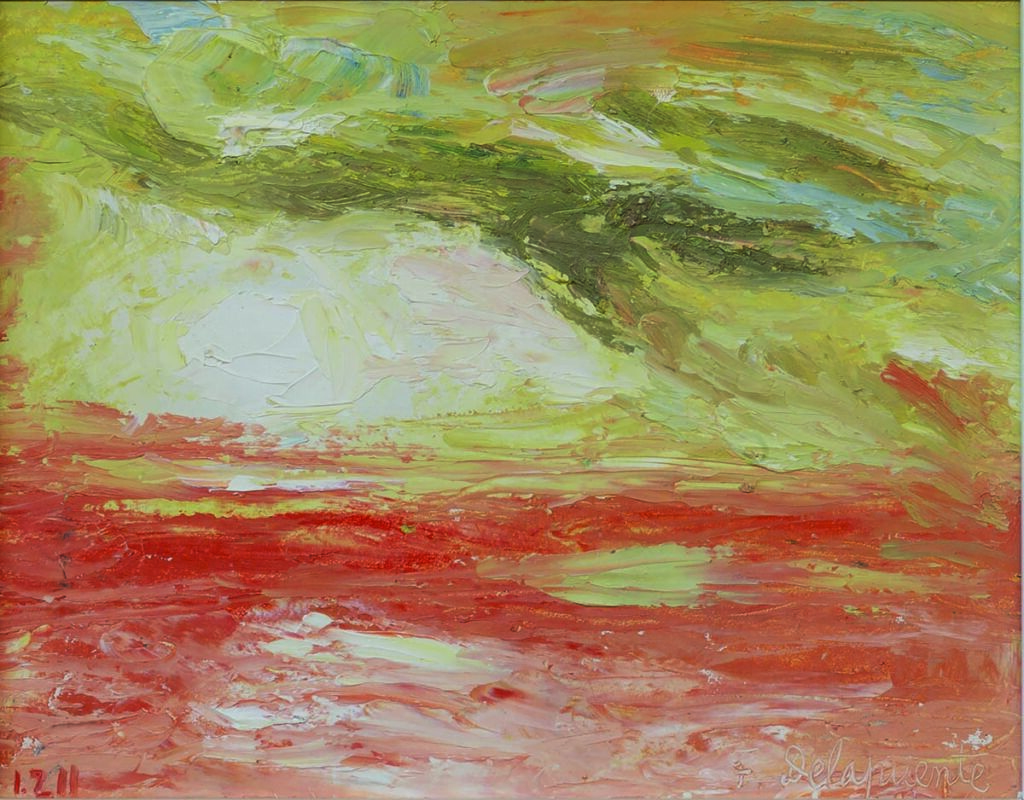
The exhibition culminates with those ultimate views of the Cantabrian Sea under the seagulls. This sea became the center of his work since 1967 and allowed him to approach abstraction, sometimes along the path of Turner, while he condensed into simple planes of color his conception of painting as a horizon or puzzle in which emotionality, faith and rigor fit.
Fernando Delapuente
ILLUSTRIOUS OFFICIAL COLLEGE OF DOCTORS OF MADRID
C/ Santa Isabel, 51
Madrid
From November 19, 2025 to January 17, 2026