Genoa,
There were those who wanted to call him the Italian Andy Warholbut the stage in which Mimmo Rotella was influenced by Pop Art was only one face of the several that articulate the complex trajectory of this Calabrian artist, who became an emblematic figure of New Realism in France and is internationally recognized for his collages, which he referred to as double décollage and that he created from the many worn posters that he ripped from the walls of the old town of Rome.
He had worked on them since the fifties, and was not a pioneer in the creation of works of that type (Hains and Villegle, both French, had already started similar projects in collaboration), but he did not show those papers in the galleries as he had extracted them – torn and without intervention on his part, as those contemporaries did – but he applied pictorial materials to these surviving fragments of the urban hustle and bustle and, on some occasions, ripped out other fragments. The three authors, together with François Dufrene, would become known as The Affichistesfor converting that support into the basis of its production.
The fruit of that work process, and his initial paintings, were fundamentally abstract, but Rotella’s course changed when in the sixties he began to incorporate images of consumer objects and actors and actresses into his work, experimenting with photography, audiovisual techniques and visual production methods. He was interested in the mass media and reflected on its growing power after World War II, which is why Pierre Restany invited him to join these new French realists, a group in which by 1960 other creators who worked with posters were already involved, such as Tinguely, Yves Klein, Spoerri or Arman, all of them explorers of the artistic possibilities of everyday instruments.
Furthermore, Rotella was not only a painter: he cultivated an experimental poetry based on the power of phonemes that he called “epistaltic.”
From next April 24 until September, the Doge’s Palace of Genoa offers you a retrospective exhibition that covers, through a hundred pieces, more than sixty years of the artist’s career, from that period after the Second World War to his New Icons finals.
Two decades after the death in Milan of this author born in Catanzaro, the exhibition, curated by Alberto Fiz and organized in collaboration with the Mimmo Rotella Foundation, aims to restore complexity, internal coherence and validity to the creations of an artist very often pigeonholed, but who had the ability to radically intercept and interpret the transformations of the image society and highlight the very profound relationship between art, visual communication and consumption in the final stage of the 20th century.
The exhibition itinerary is based, as we said, on his research in the 1940s and 1950s, when Rotella addressed abstraction and surrealist proposals, experimenting with formal solutions that already revealed his desire to overcome the traditional limits of painting. It was in these years that a critical attitude towards image and matter emerged in him, which would reach its full expression in later years.
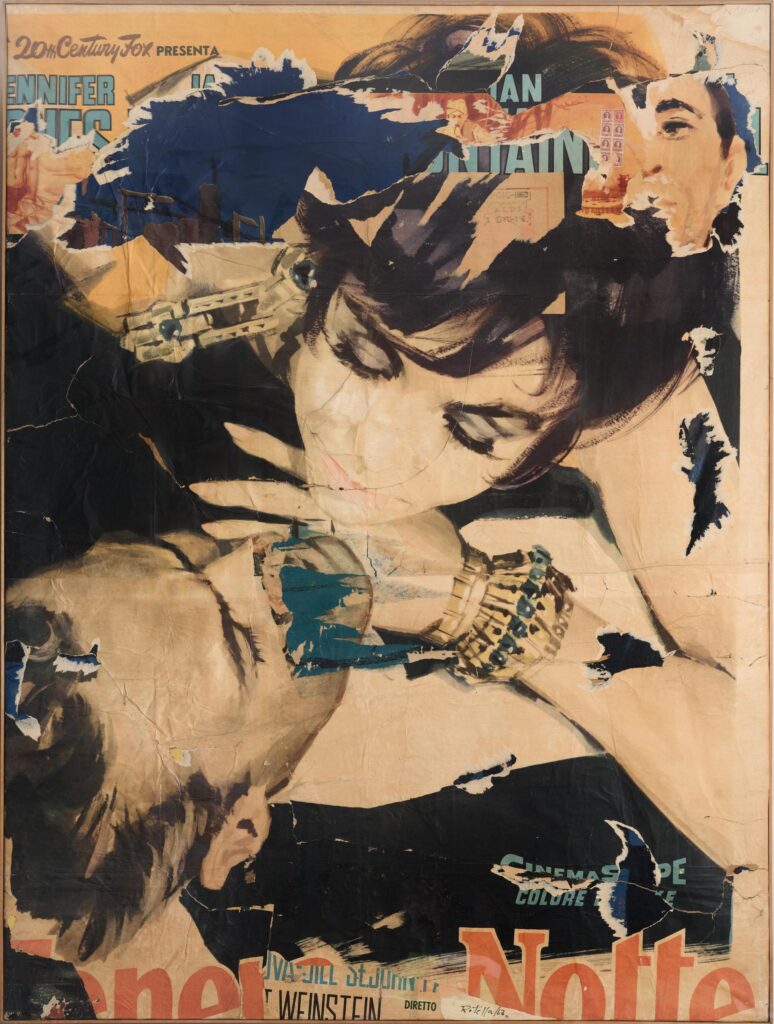
The heart of the exhibition will be dedicated, as expected, to décollagethat gesture that, more than any other, made Rotella a relevant figure of the European avant-garde. He turned the tearing of advertising posters taken from the street into an aesthetic and, at the same time, political act; in an action capable of disrupting the original meaning of the image and transforming into artistic material what was conceived for consumption without digestion. As curator Fiz points out, “what counts is no longer what is on the surface, but the fragmentary and fragmented aspect of a real dimension destined to change under the complicit gaze of the observer.”
Through the décollageRotella seemed to intercept the babblings of media society and unmask its mechanisms, revealing the fragility and transience of the images that populate it. These consciously torn posters, superimposed and consumed by time and human action, become the scene of the gestation of a new aesthetic, in which disorder and stratification become instruments of knowledge. In that sense, breaking up is never a destructive gesture, but, in its case, an act of revelation that can reveal the truth hidden behind the seductive veneer of mass communication.
The exhibition also includes some of the artist’s most emblematic works, which mark the fundamental stages of his research. Among them we can mention Naturalisticfrom 1953, a collage on canvas with mirrors and glass that attests to his vibrant material experimentations; The tiger from 1962 and The point and mezzo from 1963, two of his first direct interventions in the world of advertising; and Tenera è la nottefrom 1962. Special attention is also paid to the works dedicated to Marilyn Monroe, an icon par excellence of the media imagination at that time, whose image is reiterated, lacerated and exalted as a symbol of mass culture, also by Rotella.
The anthology continues with a selection of works from the following years, which attest to this author’s constant ability to renew his language without ever giving up coherence. Among his later pieces in Genoa is a large décollage untitled on sheet metal from the nineties, which vindicates the monumentality and physical force of the gesture; and Attentihis last production of that type, extreme testimony of a practice that he kept very alive until the end.
Along with this procedure, the exhibition will explore those other disruptive techniques developed by Rotella throughout his career: artypo to the effectof the frottage to emulsified canvases, from photographic drags to extroflexions. These adventures, far from being mere formal variations, reveal his continuous interest in the material, the fragment and the processes of image transformation, and confirm his role as a lucid witness of the technological and media revolution linked to social well-being.
In the eighties, this technical tension led the artist to overpaintingwhich he developed in parallel, but autonomously, to the return to painting promoted by currents such as Transavant-garde. Even at this time, Rotella maintained an independent role, without becoming programmatically involved in any movement; In fact, his interest in graffiti demonstrates a continuity with the love for the street and urban languages that he had already dominated in his early years.
The tour will be completed with archival and audiovisual materials that will focus on the vital links between Rotella’s work and the historical period in which it was developed.
For the Palazzo Ducale in Genova, commemorating his figure twenty years after his death implies the possibility of rethinking the role of images in contemporary society and their capacity to influence collective perception. In an era dominated by social networks and the endless circulation of visual content, his legacy continues to provide us with critical tools to interpret reality, understand the fragility of memory, the power of the fragment and the possibility of transforming disorder into a valid aesthetic form.
“Mimmo Rotella 1945 – 2005”
PALAZZO DUCALE
Piazza Matteotti 9
Genoa
From April 24 to September 13, 2026