Madrid,
Closed until 2030 for renovation works that the museum itself calls “metamorphosis”, the Center Pompidou in Paris has launched the program until then Constellationthrough which it will make its collections (and its spirit) known in various spaces inside and outside France. In addition, it has renewed its collaboration agreement with the ”la Caixa” Foundation, an institution with which it maintains a long alliance, and the result of this is the exhibition that opened its doors today at CaixaForum Madrid, and which in 2026 will travel to Barcelona.
“Chez Matisse” pays tribute to the creativity and industriousness of the author of The joy of livingwho was born in 1869 in northern France (Le Cateau-Cambrésis), but painted again and again under the influence of the light of the south, of Nice, where he died eighty-five years later. A colorist par excellence and a believer in a celebratory use of tones, without mimetic justification, his creations are as theoretical as they are sensitive, as Aurélie Verdier, curator of this exhibition, has emphasized today: while he seduces the viewer through his palette and the usual sinuosity of the lines, he interrogates the condition of the painting, as we will see very clearly in what Louis Aragon considered (rightly) one of the most enigmatic works in the history of this discipline, French door in Collioure (1914).
In addition to showing us some of his fundamental compositions, the exhibition links him with creations of contemporaries with whom he maintained obvious ties -Picasso, Fauves such as Derain, Kees van Dongen, Maurice de Vlaminck or Albert Marquet-, with those of other contemporaries who displayed a fundamental interest in color, and with later authors, whom Verdier has referred to as imaginary friendswho shared with him innovative conceptions of the relationships between drawing and chromaticism – whose constant dissociation frustrated Matisse – or the reformulation of the organization of the canvas from a critical approach, from the Russian neoprimitivists to Support-Surface, Anna-Eva Bergman or Daniel Buren.
The curator has referred to these artists as “imaginary friends” and a curatorial discourse has been structured around them aimed at rethinking the concept of influence based on the notion of hospitality. Whoever was the soul of Fauvism pointed out that he did not paint objects, but rather their relationships: here, cross-links are also proposed between pieces from the beginning of the 20th century and the beginning of our century. In its primitive or sophisticated side, in its purified or wild one, and even in its approaches to abstraction, links are suggested between Matisse and Bonnard, Braque, Larionov, the Delaunays, Lipchitz, Nolde, Kirchner, Natalia Goncharova or Barnett Newman.

“Chez Matisse” is structured in eight chronological sections, beginning in the year 1900 and showing us a sober self-portrait, a Parisian landscape and two still lifes with a chocolate pot and coffee pot that still reveal the weight of the teachings of his teacher, Gustave Moreau. It marked an obvious change of direction Luxury, calm and voluptuousness (1904), a piece that draws on the pointillism of Signac, his friend, and whose title comes from the poem L’Invitation au voyage by Baudelaire, of whom Matisse was a reader.
This work, in the collections of the Musée d’Orsay, is based on the harmony between the theme (a lunch in front of the sea) and the beauty of the forms, on the fragmented treatment of light and the brightness of the palette, and embodies the vision that the painter would have of Arcadia, closer to spontaneous subjectivity than to realistic hedonism.
Around 1910, Matisse, a son of his time, would approach primitivism and African art: this love of exoticism had to do with a certain repudiation of the figurative tradition of Western Europe, but also with the aspiration for a state of purity and the desire to find a virgin language, alien to contaminated traditions and officialism.

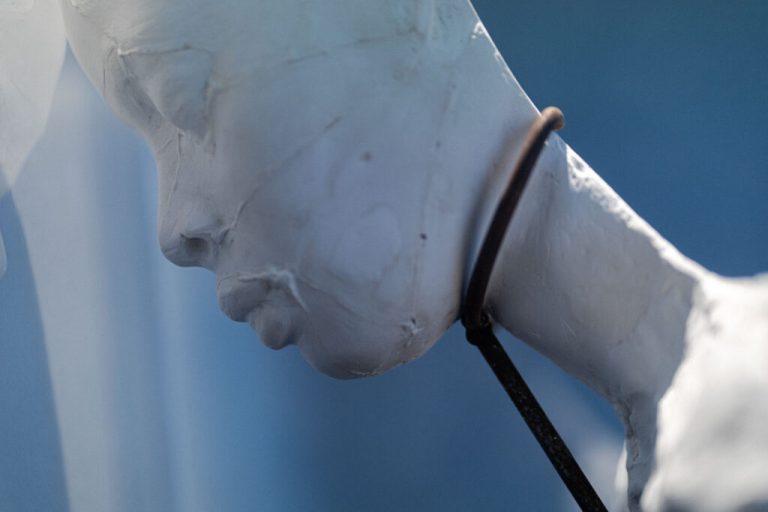
In this section we will see some of his sculptures confronted with The abduction of Europe by Lipchitz, the beautiful and Picasso The luxury Ihis portraits along with those of Jawlensky and Chabaud and the celebrated edges linked to the black and archaic art of Kirchner or Nolde. Since in Russia, and at this time, Matisse’s production was exhibited alongside that of Larionov and Goncharova, they also accompanied him in Madrid.
World War I left an obvious mark on the Frenchman’s work: a mark of darkness. He brought a retreat towards the interior in many ways: it was then that the motif of the window, or that of the balcony door, as thresholds, proliferated in his work, which converges with the contemporary of Van Dongen or Kupka. That framework was the basis of the aforementioned and mysterious French door in Colliourevery close to abstraction.

He did not finish it, but it reveals his treatment of the concept of black light and chromatic planes that have a lot to do with both the vertical bands of the aforementioned Kupka and the aura and orthogonal structure with a Cubist imprint of the portrait of his daughter Marguerite. Other portraits, of almost Byzantine hieraticism, of the actress Greta Prozor and the collector Auguste Pellerin date from the same phase.
Another vital change would come for Matisse in 1917, with his move to Nice: next to the Mediterranean, he abandoned his inclination towards experimentation in favor of interior scenes in which he studied the links between figure and space. The southern light seduced Marquet or Van Dongen in parallel, in the same way that the archetype of a woman with a mantilla (the artist visited Spain or the Maghreb at this time), decorative and static, we will also see in Goncharova.
Travel would be another common impulse for him: in the thirties he traveled to America and Oceania and gradually his drawing became simpler. We will notice it in still lifes that are related to those of Picasso and Françoise Gilot; She and Matisse gave personality to their objects, the Spanish dominated them.
When Matisse suffered a certain creative block in 1936, he looked to Cézanne, the first avant-garde, and Bonnard, master of the fragment, to find escape routes. Then his collages of painted papers and gouache would arrive, a technique that he consolidated in the 1947 book Jazz. By cutting out the color and converting it into a refined form, he outlined a way out of that old dilemma that faced tones and lines.
Shortly after, in 1951, he collaborated with Le Corbusier in the Chapel of the Rosary in Vence, becoming a reference at this time for American abstract painters, while in France he was also honored in the Hains and Villeglé cinemas. A decade later the Museum of Decorative Arts in Paris related him to Buren and Parmentier, due to that collage technique and the use of the white support as a compositional element (Matisse’s emotional side, of course, was left aside).
Pieces of overt decorativeness could not be missing from the route – for Matisse, not at all anecdotal or pejorative, but essential, because they are joy that lightens us– nor odalisques, like reflections on the nude freed from the canons.
In his last years, and already ill, he could not use brushes, but he could use cuts and from then on works that were as emblematic as they were imitated and commercial. In the face of deprivation, he continued to dream of a luminous world.

“Chez Matisse. The legacy of a new painting”
CAIXAFORUM MADRID
Paseo del Prado, 36
Madrid
From October 29, 2025 to February 22, 2026