Since its closure in October 2021, the Basque Museum of Bilbao has carried out major expansion and restructuring works. The Provincial Deputation of Biscay (the equivalent of the departmental council in France) and the town hall of Bilbao, co-owners of the museum, have invested more than 20 million euros in this large-scale project aimed at modernizing the spaces of the former Jesuit college.
The extension is intended to be on the scale of a substantial collection, made up of around 50,000 objects. The museum has expanded its exhibition spaces by more than 6,000 m2 and acquired buildings, located a few meters from the historic site, to organize symposiums, conferences and educational workshops. The director of the institution, Sorkunde Aiarza, told the newspaper El Diario his desire to do so “the gateway to Basque culture” And “a place of society with a strong international dimension”.
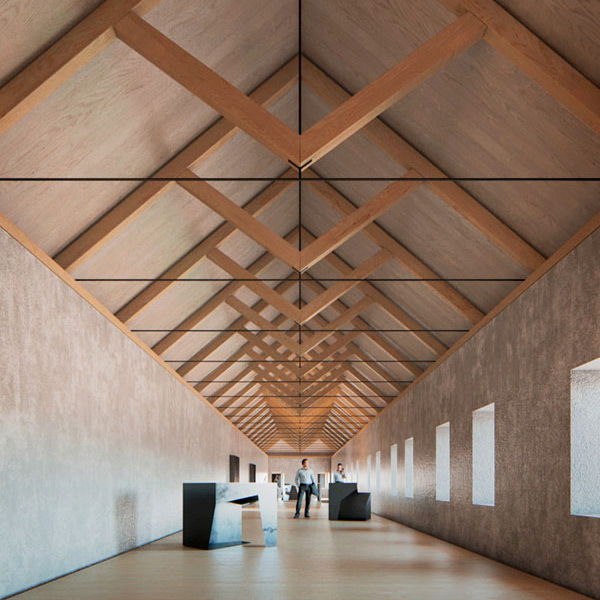
To respond to this major challenge, the architects of the Navarrese studio Vaíllo + Igaray have designed an immersive journey which materializes the metaphor of the “living oak” (“Aretz bizia”, in Basque). The new wooden structure, installed in the Mercy Room, marks the start of a route through the history of Basque culture. Spaces have been created to support the influence of Euscarian heritage: a gastronomic laboratory and a repository of restoration works will be open to the public around September.
The Euskal Museoa was born from the merger, in 1923, of the Basque archaeological and ethnographic museums. Originally, it was opened in the building of the Jesuit college of San Andrés, built in the 17th century. The museum has undergone continuous adaptations and gradual expansion, but this project, coordinated by the Bilbao Bizkaia Museoak Company, is by far the most ambitious in its history. In 2019, two years before its closure, the museum reached a historic attendance record, exceeding 100,000 visitors.
The Euskal Museoa collection is mainly composed of ethnographic pieces: traditional costumes, everyday objects and handwritten documents in Euskara. But among these objects for some folklore, emblematic pieces stand out, such as the Idol of Mikeldi, a large zoomorphic sculpture from the Second Iron Age and a treasure of the collections. Visitors will be able to find it in its original place, in the center of the Cloister.
The reopening of the Basque Museum comes in a phase of recomposition of the cultural landscape of Bilbao. The city’s Museum of Fine Arts is also undergoing renovation led by Norman Foster and Luis Maria Uriarte and should lead to a complete reopening in the coming weeks. This phase is part of the momentum generated by the opening of the Guggenheim Museum Bilbao almost 30 years ago (in 2027).