France. “Safer museums. To protect the heritage of those who do not have it”: the second part of the title of the parliamentary report on the security of museums adopted and made public a few days ago, illustrates one of the many biases of the mission led by the dissident member of La France insoumise, Alexis Corbière. Are museums reserved for those who have no heritage, who do not own their main residence?
It is less in the recommendations, which are nonetheless sensible – we will come back to this – than in the comments which accompany them that clearly stated ideological positions emerge. The rapporteur is therefore in favor of an administration under direct management of territorial museums rather than for their autonomy. He is opposed to differentiated pricing for non-Europeans and endorses the recurring criticism of the Louvre for favoring the spectacular to the detriment of security. Recommendation No. 14, just as ambiguous as the title, clearly bears the trace of a compromise in its formulation: “ Reorient mission letters towards conservation, safety and security objectives, in addition (emphasis added) of the development of museographic activity. »
A little disappointed that the Senate appeared on the front line against the management of the Louvre and particularly its president, the deputy reserves his sharpest arrows against Laurence des Cars. The virulent criticism against the “hyper presidency” in major museums in fact targets the former president-director of the Louvre. A criticism fueled by the curator of the Louvre, Côme Fabre, who during his hearing before the commission, did not have harsh enough words towards the current leader, like his predecessor Jean-Luc Martinez. Implicitly, it is because the presidents and directors of the Louvre believe themselves to be all-powerful (and keep the unions at bay) that they sacrifice security for the benefit of glitter. “Almighty”but above all close to Emmanuel Macron from whom they took their nomination: behind Laurence des Cars, it is the President of the Republic that the former member of the Revolutionary Communist League (LCR) is targeting.
A certain amount of bad faith also emerges in the report. According to the rapporteur, Paris City Hall knows how to hold its museum directors accountable. However, regarding the heist of the Museum of Modern Art in Paris in 2010 (worth more than the Crown Jewels of the Louvre), the City was praised, not for having identified the serious failures which enabled the theft, but for having immediately, after the break-in, initiated a security investment program. Obviously, the plan was not enough since in 2024, seven snuff boxes are stolen from the Cognacq-Jay Museum. Here again, the report emphasizes not the investigation into the failures, but “the management of the crisis by the museum”, including the psychological support of agents and visitors. The Louvre did not benefit from the same indulgence. The commission dissected at length the – late – implementation of the security equipment master plan (SDES) without noting that a security improvement plan was indeed in preparation. Nor admit that even without delay in the implementation of the SDES, the theft could not have been prevented, given the duration of the project.
The report, like many people, maintains confusion around Emmanuel Macron’s project for the “New Renaissance of the Louvre” by amalgamating the new room for the Mona Lisa, with a dedicated entrance, and the building’s 500 million euro restoration plan. This plan was announced in January 2025, well before the breakage, at the end of a conditioning of opinion skillfully orchestrated by the Minister of Culture at the time, Rachida Dati, which undermines the recurring criticism of the excessive independence of the Louvre with regard to its supervision.
Starting from an observation that is questionable to say the least – according to which “the hyper-presidency at the head of the major national museums” harms security – the commission takes the opportunity to put an end to what it calls “the act of the prince” in appointments. Recommendation 17 proposes to set up a transparent procedure for appointing presidents, elected by the boards of directors of establishments based on the British Museum model (which did not prevent the theft of 2,000 objects by a BM curator). The commission also wants to strengthen Parliament’s control over national museums: on the one hand by establishing the presence of parliamentarians on the boards of directors (Recommendation No. 16), and on the other hand by obliging the presidents of museums to take stock of their action before the national representation (Recommendation No. 18).
“All you have to do”
The report does not escape the pitfall of “all that’s left to do”. “All we have to do is” increase state subsidies for the benefit of cultural establishments (Recommendation No. 7). “All we have to do is” establish a multi-year programming law for heritage restoration expenditure (Recommendation No. 7). If the principle of such multi-annual programming is desirable, nothing is said about its financing. The same applies to the request to increase the resources of the safety fund (Recommendation No. 12). We can only support the idea of increased support for museums, but how can these increases be financed given the state of public finances?
The “all we have to do” takes a frankly ideological turn when the report recommends increasing the number of permanent civil servants (and not contract workers) for the positions of room guards. Did President LR of the commission really validate this Recommendation No. 36? There is obviously no question for the rapporteur of outsourcing these positions when he takes it for granted that security agents can be, as they are in the vast majority of national museums. The rapporteur is frankly opposed to reception and surveillance agents becoming “security agents”, which is admissible, but without considering the possibility of posting security agents in addition to reception agents in sensitive rooms, that is to say rooms housing jewelry.
A culture of safety
However, the report usefully contributes to the debate. The first part (a good quarter of the text) has the advantage of summarizing essential (admittedly widely known) information: definition of heritage, mission of museums, challenges linked to overcrowding, as well as the list of different threats weighing on museums.
Above all, it has the merit of formulating a set of very practical and common sense recommendations in order to “to establish a culture of safety”. This involves setting up “security” coordinators in museums (no. 3), a research unit at the ministry in order to anticipate changes in the operating methods of thieves (no. 4), extending the Ramses system (direct link between a museum and the police) to sensitive museums (no. 24).
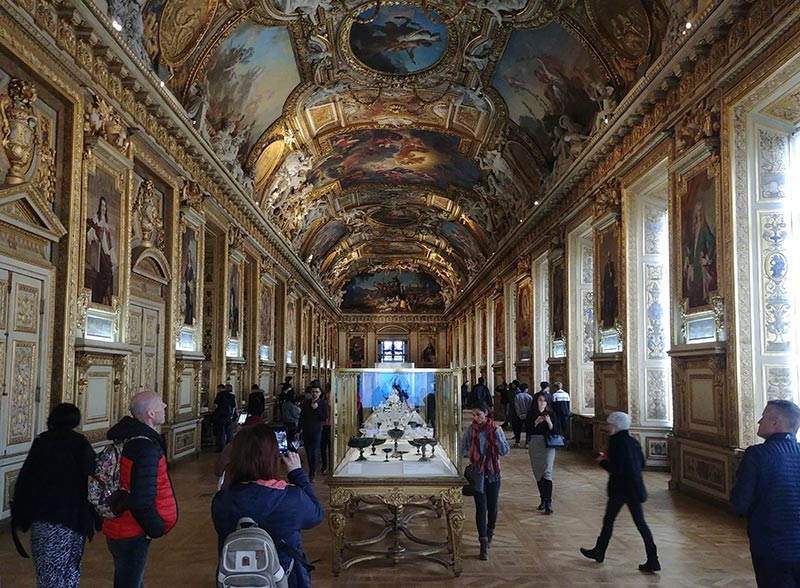
Without saying it, these measures, which do not cost too much, will awaken the practical good sense of museum directors. Because it is not always essential to deploy a long and expensive SDES, especially for galleries of paintings that are rarely stolen because they cannot be sold on the black market, unlike jewelry that can be sold: do not install the gallery of precious stones near a window that overlooks the street like at the Louvre, post a security agent in sensitive rooms, check the surveillance camera every day, etc.
Contrary to the peremptory judgment of the LFI deputy, Raphaël Arnaud, who affirmed during the examination of the text that “this commission of inquiry simply had no reason to exist”, the report is not useless. However, he would have benefited from getting rid of his biases.