France. Horse manure! Here is a fragrance that we clearly did not expect to smell when visiting an exhibition on the art of living in the, very chic, Age of Enlightenment. However, it is with this astonishing bouquet that the Museum of Decorative Arts welcomes the public of “A Day in the 18th Century”; before making him smell jasmine, wax, tobacco or a scented bath. “We wanted to totally immerse the visitor in the atmosphere of a private hotel, hence this strong sensory dimension, explains Ariane James-Sarazin, curator of the exhibition. This is the first time that we have offered an experience of this type, but it took on its full meaning for this period dominated by sensualist philosophy, and where the olfactory dimension developed strongly with potpourri, incense burners, and even impregnated woodwork. » In order to capture the visitor, the museum has renounced the traditional individual diffusion points, which require manipulation or interaction, in favor of an ambient scent which changes depending on the room in which one walks. These juices, inspired by authentic recipes from yesteryear, are combined with a few sounds reconstructed by archaeologist Mylène Pardoën, and subdued lighting which evokes the way we used to see interiors. “ The sensory approach is not a gadget, it is also supported by research in art history, in particular “sensitive studies” which provide us with more and more information and scientific elements.specifies the commissioner. Moreover, the great success of this laboratory exhibition encourages us to rethink the mediation of our collections to make them more alive, more inhabited. » Exceptional in its scale since it applies to the entirety of an exhibition, this initiative reveals an underlying trend in museums which now aim to address all of visitors’ senses.
See differently
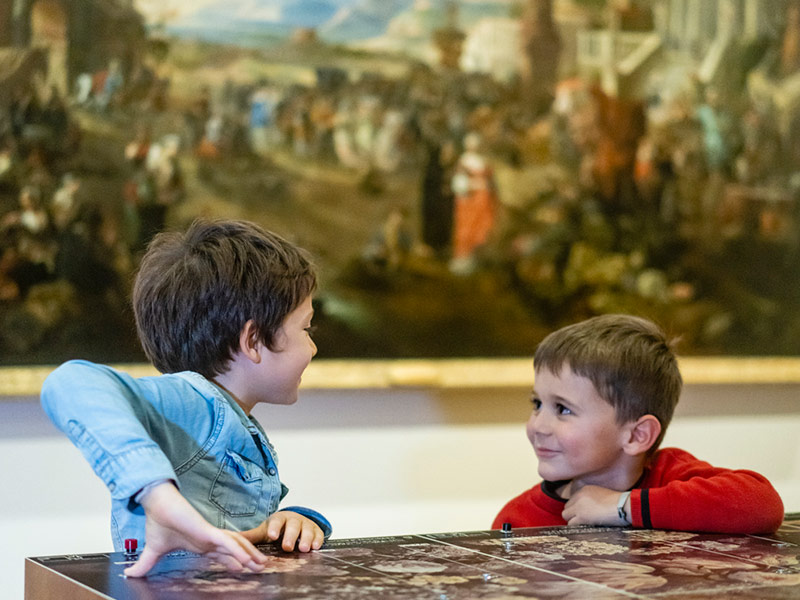
Olfactory discovery at La Piscine, sound trail at Quai Branly, aperitif exhibition in Lens and even a hypnotic visit to Cluny: alternative proposals are multiplying at high speed. More numerous, they are also changing in nature since they were previously almost exclusively the prerogative of scientific culture establishments. In addition, they were essentially designed for young audiences or people with disabilities. Like the multisensory room of the Museum of Art and Archeology of Valencia. “ In 2014, the room was completely redesigned around accessibility. A room fragrance, inspired by Porpora’s still lifes, was created by a nose; as well as contemporary music. The museum has also designed a large table which mobilizes all the senses, because you can feel and touch elements representedsentered in the tables. But in reality, everyone wants to try the devices, in fact some buttons are a little tired from being pressed so much”smiles the director of the institution Ingrid Jurzak. Same story at the Lyon Museum of Fine Arts. “The olfactory walk for which we worked closely with the perfumer Givaudan was initially designed for blind people, underlines mediator Claire Beyssac. However, the interest generated by this offer led us to offer it to all audiences to meet significant demand. » During visits in small groups, the public is invited to smell strips impregnated with the perfume custom-composed for six works, as different as a bezel from the François I period, a glass by Émile Gallé or even the Wheat field in Morvan by Corot. “ This approach is very appealing, because it enormously enriches the visit. For Corot’s painting, for example, we really have the impression of smelling wheat, thyme and rosemary roasted by the sun, advances the mediator. It vibrates our perception and it completely opens up the observation and feeling of the works. People have more emotion, they are less jaded. »
Immersion without digital
In fact, if institutions try so hard to titillate the senses of visitors, it is also to generate engagement and capture their attention, which is ever more volatile, by offering an immersive experience without relying on digital technology. “ Very clearly, the demand from institutions has changed in recent years, notes Magalie Fargeas, multimedia designer. They have grown tired of screens which are very present in our daily lives and quickly become obsolete, and on the contrary frequently demand multisensory devices which meet the experiential expectations of the public and also make it possible to attract visitors less familiar with museums. » Among the different senses used, smell is clearly the one that has the wind in its sails. “Sound, which has been very fashionable, is in fact a little in decline, confirms the designer. With the exception of binaural sound which is very popular, because it offers a very immersive experience. However, this remains a niche, because it is still very expensive, it costs almost a thousand euros per headset. The olfactory appeals, because it is an offering that is not yet too common, it allows museums to stand out. » Especially since in a short time the devices have been perfected and diversified. Microbeads, soaked chair rails, pulsation systems and show control ; the palette has considerably expanded and refined. “Not all systems have the same lifespan or the same cost. The most expensive are the beads which encapsulate the odors, and the creation of tailor-made odors, comments the specialist. This cost can be a barrier for certain places which sometimes have the means to purchase this equipment, but not necessarily the possibility of renewing it with their operating budget. » For the most modest structures, the thousands of euros that this represents are not necessarily a priority. However, these projects are often financed by sponsorship. Maison Givaudan, very active in this sector, is a partner of the Beaux-Arts de Lyon and the Decorative Arts exhibition. “It’s quite technical, because they are small cassettes fitted with a filter which are slipped into a device fitted with a fan which diffuses, at an adjustable intensity, the perfume in a room, without it mixing with the scent of the room next door, summarizes Ariane James-Sarazin. You have to change the cartridges once a week, so it’s a fairly expensive device that we might not have installed without this partnership. »
A sensitive mediation
The cost of these services, their maintenance, but also the discomfort they can generate for certain people who prefer simple contemplation of the works, explain why sites most often opt for temporary rather than permanent proposals. In this sense, the Maritime Museum is aoutsider because multisensory was at the heart of the program written for its overhaul in 2023. “We wanted to offer universal accessibility as well as a wide diversity of experiences so that the visitor does not get bored along the way”explains Lucie Aerts, head of the mediation service. The site has notably developed an olfactory and sound signature: “The idea is to have a total museum. Here, we are far from the sea so as soon as the visitor passes through the doors, they must be taken elsewhere. Now, smell is very effective for this, because it is the sense that goes most quickly to the brain; it provokes immediate emotion by awakening memories and sensations. » Spray, spices, gunpowder and even fuel oil, the public gets their noses full. “ This works very well and allows us to recapture attention, by experiencing the museum through the body and not just through intellectualized language. » This global reflection, which we call sensitive mediation, tends more and more to be established in museums which see in it beneficial collateral effects. Because these proposals which arouse surprise and emotion also encourage exchange between visitors. A godsend at a time when their supervision is increasingly asking institutions to also promote social and intergenerational ties.