Bilbao,
A pioneer in the use of technological tools and supports with creative objectives from a very early phase of her career, it is now that Marisa González, who in 2023 received the Velázquez Prize, finally presents in the Basque Country, at Azkuna Zentroa, an anthological exhibition that reflects her constant explorations with photocopiers, video, photography and computers for fifty years and which has been curated by Violeta Janeiro.
The retrospective, which has already been seen at the Reina Sofía Museum, is titled “A generative way of doing”, because its montage emphasizes that this Bilbao author very early used this type of devices (thermofaxes, color photocopiers and other machines that at the time were considered cutting-edge technology, but also the very homemade plates) not to generate simple copies or replicas of pre-existing images, but to illuminate new ones, constantly using her own method open to chance, to trial – error, to the discovery even among the ruins and to immediacy.
There are approximately twenty series and projects that Azkuna Zentroa examines, giving us a circumstance that tells us about the difficulties of authors like González in making their way into institutional and private collecting: most of the pieces come from her studio – she has confessed not to throw anything away – and, in some specific cases, from family funds and from the aforementioned MNCARS. This multiple artist has always been an active part of the artistic ecosystem, but until recently from the background. Even from the continuous collaboration: committed at the time against the dictatorship, and somewhat later with the causes of feminism and with workers with fewer rights, since the seventies she has been part of a large number of associations, such as the Professional Association of Artists of Madrid or Women in the Visual Arts.
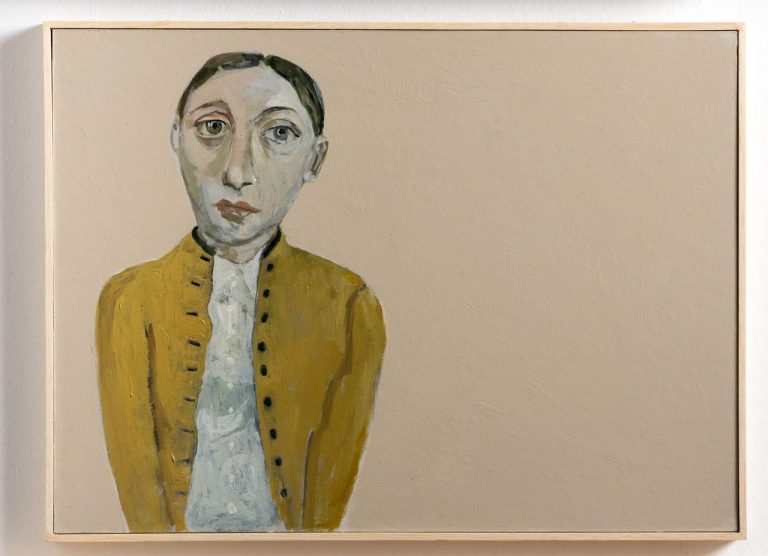
The journey of this exhibition begins by reviewing his early attention to materials and paths far from those he was exposed to when he studied Fine Arts and to the by-products derived from the use of various technologies, from heat-sensitive papers and printing tests to the colorful residue of a dryer filter. Self-portraits and silhouettes were already among his most frequent motifs; the latter as a symbolic mark that we all possess, including those always relegated to anonymity and the disinherited.
Her time in the United States would be vital in Marisa González’s career: at the Art Institute of Chicago she completed the master’s degree called Generative Systems: Art, Science and Technologywhere she met Professor Sonia Sheridan, who collaborated with her from then on. Since then he delved into image processing on multiple occasions to achieve different visual effects, textures and tones, that is, potentially infinite possibilities of variations, superpositions and fragments.

His first color photocopier, then a prized jewel, was a 3M Color-in-color and its use allowed the artist to analyze the multiple options of distortion and anomaly, with inevitable echoes beyond the strictly creative in contexts of uniformity. Their archives themselves tend towards this distortion, rather than strict classification: they are nourished by recovered and recycled materials; seemingly useless objects to which she gives alternative meanings, from batting to doll limbs.
After training in Chicago, González returned briefly to Spain and then returned to the United States: at the Corcoran School in Washington, and together with Mary Beth Edelson, she delved into the fields of feminism, also artistically. Their series dates from then Maternitywhich she carried out while pregnant and which alludes to the religious, legal and health implications of that condition; The downloadwhich captures the gestures of her fellow artists upon learning of the torture inflicted on women prisoners during the Pinochet dictatorship; either Lizz Williams and her masksaround the racial identity or lack thereof of a mulatto fellow student.

Later, another photocopier arrived to change many things: the Color Bubble Jet 145which allowed him to use a larger paper format, similar to DIN A4. He reviewed previous materials with her, such as those from the series Identity vertigoabout the vital stages of women, or The rapea denunciation of female objectification based on a casually found doll. Her own archive was a source of reinterpretation for her.
When painting took on new vigor in the late seventies or eighties, Marisa González immersed herself in it, linking it with her musical interests (she had studied piano at the Bilbao conservatory). He incorporated photocopies of processed scores into the usual media of that medium, in series such as Musical Grafías, with the collaboration of Llorenç Barber and Javier Darias; In these works, the rhythm and cadence emerge from the movement of the paper and the gradations of light.

If the pentagrams were the starting point of those projects, that lint from the dryer, which was captivated by its tones and lightness, would be the origin of the series Presencesin which light also had a lot to say. They could be seen at the time in the Evelyn Botella gallery.
We will also contemplate a set of works, some still in progress, in which he investigated the links between the unique and the multiple and between what is living and what is inert. One of its fundamental tools in this purpose was the computer system Lumenaand even with the residue of its obsolescence it has been able to function. In Transgenics, in addition to referring to the ethical and health consequences of these products, he contrasted artificiality and desire, and in the portraits Lumena He exerted complex distortion on his models, colleagues linked to the artistic sphere such as Soledad Lorenzo, Lola Dopico, Pedro Garhel or Menene Gras, among many.
The installation has also arrived at Azkuna Zentroa Fax Stationprepared together with his students from the Current Art Workshops – anyone could contribute to its contents -; her images dedicated to the community life of the highly skilled Filipino domestic workers in Hong Kong; and its projects focused on two former Basque infrastructures that no longer have a useful life: the Lemóniz nuclear plant (it inaugurated the not small path of artists who have worked around its empty facilities) and the Bilbao bakery, which had more than a thousand employees until it closed at the end of the nineties.
In the installation dedicated to the latter, original lamps from that place illuminate communications from those who first ran the company, attributing drops in productivity to the demand for… annual vacations. The presentation of this proposal in Bilbao expands on the exhibition at the Reina Sofía, delving into the impact of the decline of industrial architecture in the last century, derived from the impossibility of adapting its monumental characteristics to the new demands of the market, distant from the original mechanization of this complex. We will be able to see photographs and audiovisual material linked to the record of the destruction of the Bakery Flour.

Marisa González. “A generative way of doing things”
AZKUNA ZENTROA
Arriquíbar Plaza, 4
Bilbao
From October 29, 2025 to January 18, 2026