Paris. Difficult to imagine Georges de la Tour (1593-1652) on the bench of the big forgotten in the history of art. Master of Light, virtuoso of the chiaroscuro, the Lorraine artist nevertheless met with a success as bright as he was ephemeral, who quickly faded after his death. More than two centuries with a complete forgetfulness, followed by a resounding rediscovery at the beginning of the 20th century, the exhibition of Jacquemart-André extends this highlight when no major demonstration had been dedicated to him in France for almost thirty years. “” It is a less large exhibition than the great retrospective which had been devoted to him to the Grand Palais in 1997, which resumed practically fifty years of research on the artist ”recognizes Pierre Curie, curator at the museum, who ensures the police station with the art historian, Gail Feigenbaum, specialist in the work of the tower. Two flagship paintings – almost never loaned – lack in particular: The Bonnes Adventure Tayer (Metropolitan Museum of Art, New York) et the cheater at the tile ace (Louvre), genre scenes that appear apart in his work. “It is therefore not a retrospective, but” one “Georges de la Tour which is presented. That of the light effects, nights, beggars and beggars… ”
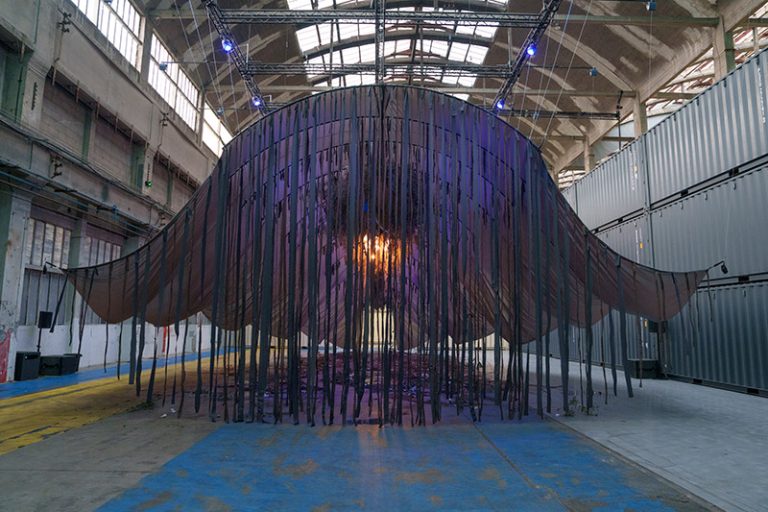
View of the exhibition “Georges de la Tour. Between shadow and light ”at the Jacquemart-André museum.
© Culturespaces
© Nicolas Héron
From the outset, the entrance sets the tone. The eye is immediately attracted by The woman with a chipone of the most enigmatic paintings on the tower, loaned by the Nancy Lorraine Museum. Profane or religious work? Woman tearing a chip or servant giving a rosary? The subject challenges, and the painting reveals the importance of the light under the artist’s brush, which makes the glow of a candle a structuring element of the composition. In a beautiful echo to this chiaroscuro, the picture rails with black and gold tones bring out the paintings well. A scenography signed Hubert Le Gall, which regularly designs those of the exhibitions of Jacquemart-André.
The work of the tower is, on several occasions, compared with that of the artists of his time: Mathieu Le Nain (1607-1677), Jean Le Clerc (1586-1633), Bigot Trophism (1579-1650)… “These are works that Georges de la Tour could see, which influenced him, or who at least have a link with his career and his work, explains Pierre Curie. We also wanted to enrich the exhibition with the best paintings in his workshop. »» This choice is relevant in the case of Georges de la Tour, since this confrontation allows a better understanding of his work.
There are still today, many gray areas in the artist’s life: no one knows with whom he formed, what the production of his first fifteen years of career looked like, and none of his works can be dated with certainty before 1645. Above all, a large part of his work disappeared during the fire in Lunéville in 1638. Of the hundreds of paintings he had to paint, are allocated and the exhibition brings together twenty-three of them. The presence of workshop copies, which sometimes represent lost originals, is therefore all the more welcome.

View of the exhibition “Georges de la Tour. Between shadow and light ”at the Jacquemart-André museum.
© Culturespaces
© Nicolas Héron
A suitable sequencing
As usual, the route must deal with the museum’s narrow spaces, which inevitably harm the comfort of visit. But the smallness of the rooms is counterbalanced as far as possible: if the limited space embarrasses the contemplation of a few large formats (all the same few), like the portraits at the foot of blind beggars, the distribution of works is well thought out. Thus, in a long corridor, there are several apostolados of small dimensions that are hung. In more spacious rooms, the visitor can discover or review emblematic works by Georges de la Tour, starting with The newborn From the Museum of Fine Arts in Rennes, one of its most famous. Light transcends, all in subtlety, this maternity scene: the sweet clarity that bathes the infant’s face invites to a spiritual reading, which is of any religious attribute. Another masterpiece of the painter, one of his versions of The Madeleine penitent – That of the National Gallery of Art from Washington – plunges the saint into a meditative posture, far from any caravagesque theatricality.
Another point of interest, the exhibition reflects the recent advances in research on the work of Georges de la Tour. Since the retrospective of the Grand Palais, some paintings have been identified as his hand, like a Saint Jacques Le Major reappeared at auction in 2008. Other canvases, also presented, continue to divide specialists: the Saint Gregory could Lisbon museum be part of the painter’s corpus? And the Saint Francis in ecstasy of the Tessé museum (Le Mans), of high plastic quality, really a workshop copy? Without insisting on this point, the exhibition raises the thorny but exciting question of attribution.