Málaga (Spain). The Picasso Museum in Málaga devotes a rare retrospective to óscar Domínguez (1906-1957), is apart from European surrealism. Volcanoes, dragon makers – these prehistoric trees that dot the Canary landscapes -, earth bursts, wild material. But also kite, absurd, light forms. The whole work of óscar Domínguez vibrates this tension between harshness and reverie. It is this ambivalence that the Picasso museum captures in an expected, and successful retrospective. Carried out in collaboration with the Tea (Tenerife Artistic Espace), this exhibition is the first devoted to the painter in Spain since 1996. Through seven sections, the museum has explored the universe of this unclassifiable artist, halfway between surrealism and a personal mythology deeply rooted in geography.
The surrealist imprint
Born in Tenerife in 1906, in a family owner of banana plantations, Domínguez left the islands at the age of 21 to join Paris, where he was supposed to take care of family affairs. In the capital, he immerses himself in surreal circles, meets André Breton and Dalí, forges a place in this nebula of artists.
During the German occupation, Domínguez chose to stay in Paris. His workshop becomes a refuge. He participated, notably with young poets, in the editions of the hand to the pen, a surreal collective which takes over from Breton during his American exile. It is partly thanks to this work that he has a strong bond of friendship with Picasso, which will also be his inspiration, according to his example in the deconstruction of classical forms.
But the canary is not a copier. If he shares with his Spanish compatriot the interest in the bursting of structures, and with the surrealists the love of chance and provocation, he moves away from the visual and symbolic substrate of his work. Where others summon Freud or Lautréamont, Domínguez always returns to his original land, dotted with archaic masses, the gaze turned towards the celestial vault.
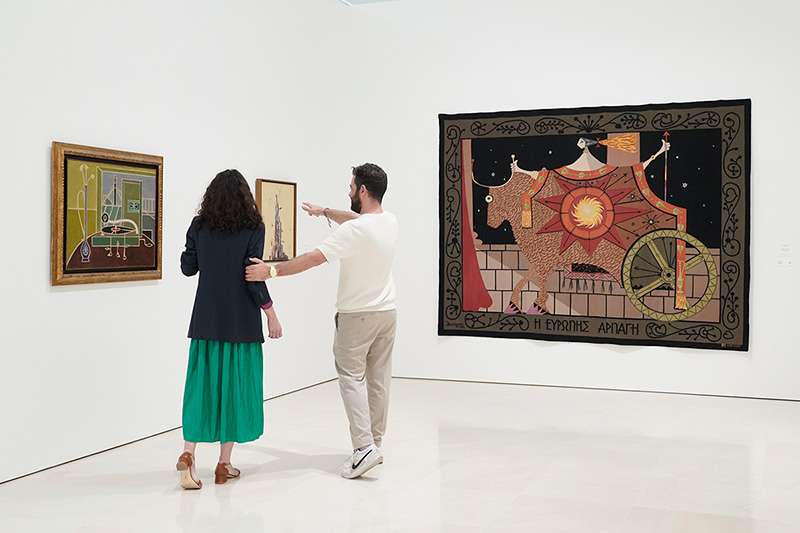
View of the exhibition of óscar Domínguez at Museo Picasso in Málaga.
© MPM Jesus Dominguez
© Adagp Paris 2025
The course, thought of by Isidro Hernández Gutiérrez, himself from Tenerife, follows a chronological line. We discover an excessive and tormented painter there, but carried by a sense of black humor and the will to explore the borders of reality. The scenography, sober and effective, plays with green walls of water, like a tablecloths of vegetable mist from which the works stand out.
Each section has a dozen paintings, and more in the room dedicated to decalcomania. This technique which he invented in 1935 occupies a central place in his work. It consists in applying painting to the surface of the canvas and then pressing it against another to produce unpredictable structures, thus creating rugged, almost geological forms. This practice, which is not unrelated to automatic writing dear to surrealists, becomes in Domínguez a plastic tool of rare power. The patterns emerged from the friction of surfaces are both abstract and evocative, metallic and minerals. In Delphi (1957), among the flagship works of the exhibition, a mountain seems to fossilize under an industrial patina: perfect fusion of the landscape and the machine. The era is in technical exploration, mechanics, the beginnings of computer science and atom. Domínguez registers there, without losing his raw material there.
The central room, designed as a space for dialogues, puts the painter with regard to other names of European surrealism: Magritte, Roberto Matta, Dora Maar or Claude Cahun. Everyone, everyone in their own way, question the body and the metamorphosis. But it is still Domínguez, who, by his figures between animals and machine, by its unreal landscapes and its graphic metamorphoses, seems to push this logic of permanent transformation the furthest.