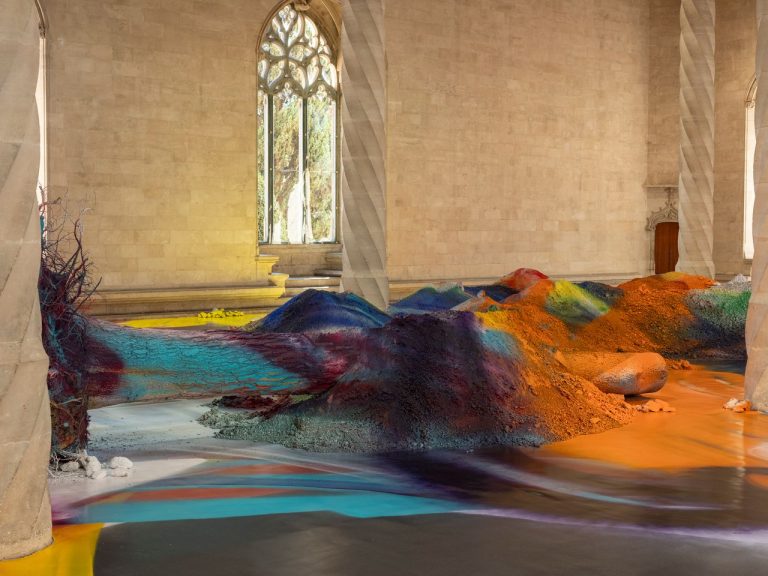
Ornans (Doubs). This summer, Benjamin Foudral, curator and director of the Museum and Pôle Courbet, bet on an exhibition on 19th century painting showing “ landscapes, in a rather unique angle of approach which is specific to the work of Pierre Wat”. This art historian, specialist in romanticism, also deals with contemporary art and knows Éva Jospin well. Inspired by his book, Peregrinations. Landscapes between nature and history (Hazan, 2017), he was the scientific curator of the exhibition while the visual artist was invited to the Atelier Courbet for a carte blanche, “Echo Chamber”, resonating with Courbet’s work on nature.
Pierre Wat constructed the exhibition “Marching Landscapes” based on a quote from the painter Pierre-Henri de Valenciennes, taken from Reflections and advice to a Student on painting and particularly on the genre of landscape (1799): “ Travel as little as you can while stationed; leave this luxury to the rich ignorant people who travel the world like trunks, and who, locked in their cars, only see the country they are crossing as a magic lantern for which their door serves as a frame.[…] The artist must travel in short days, on horseback if possible, and most often on foot. » The commissioner’s aim is to show why “the artist, and in particular the landscape painter, must travel on foot. What does walking do to paint? “.
Many examples illustrate the importance of walking among writers, notably for Victor Hugo, Gustave Flaubert and, in Great Britain, William Wordsworth and Samuel Taylor Coleridge. We can also go back to Petrarch who, in 1336, was the first to climb Mont Ventoux and to record it in a letter, detailing the thoughts that came to him during this effort. The subject is less studied among Western painters (on the other hand, it is among Chinese and Japanese artists). It is known that Claude Lorrain, John Constable, William Turner, Gustave Courbet, Paul Cézanne, Claude Monet and Vincent Van Gogh were great walkers. In his work, which has won several prizes, Pierre Wat shows that this creative habit concerns many other artists. Its transposition into an exhibition was therefore eagerly awaited.
A very literary journey
However, this transition from writing to spectacle is precisely the pitfall: the visitor runs out of steam in this very literary journey. In the first room, entitled “Reason and passion for walking”, the visitor can differentiate the painters who walk from those who wander. The first produce “landscapes of reason”. For others, who deviate from the roads and paths, “ it is no longer from the outside that nature is apprehended in the manner of an observable and traversable place, but from the inside: in what is most inextricable, in what is immeasurable. […] Another relationship with the world, less transitory and rational than the journey, is offered to those who take the risk of wandering. Something more tactile is given, a proximity more corporeal than visual with what makes up the very material of the world”. But Théodore Rousseau alternates works whose horizon is blocked like Forest interior (between 1836 and 1837) and those which include a vanishing point such Road in the forest of Fontainebleau, storm effect (between 1860 and 1865). This is typically the case where “approaches to walking […] confront each other, antagonize each other and sometimes intermingle.” Guaranteed perplexity for anyone who comes to see paintings…
Auguste Pointelin (1839-1933), Landscape, valleycirca 1924-1925, oil on canvas, 52 x 72 cm, Dole, Museum of Fine Arts.
© Pierre Guenat
Further on, the painter walks “in the familiar”, that is to say around his home. Here is Landscape, valley (around 1924-1925) (see ill.) by Auguste Pointelin. “ You have to love such a landscape to decide to paint it. You have to have walked there, have experienced the gentleness of this slope, know this place physically to grasp it in this way”comments the cartel. However, we know that this Jura artist often painted landscapes that he had only seen from the train. Purifying his paintings more and more of details that could have seemed picturesque, he was engaged in an asceticism similar to that of the monk Charles-Marie Dulac. Moreover, continues the cartel, “he does not paint from the motif but from his memory and his feelings”. His landscapes are metaphysical, the fruit of a contemplative rather than ambulatory approach and the identification of the walking artist is short-lived.

Louis-Edmond Cougny (1831-1900), Courbet seated, palette in handcirca 1855, terracotta, 26 x 17 x 16 cm, Ornans, Gustave Courbet departmental museum.
© Pierre Guenat
The visitor can agree with the point… or not
The sixty canvases, papers, cardboards and photographs, the three sculptures – including The Walking Man (between 1899 and 1904) by Auguste Rodin – and the few objects and documents presented are brought together in Ornans to interpret the score of an author recounting his own intellectual journey. This type of exhibition is always divisive: the visitor adheres to the discourse or he does not understand it. However, following a “zig-zag journey”, the curator forces him to look at the works carefully and to change his perspective, by discovering the temporal dimension of a landscape, for example. At the same time as a “In Praise of Slowness”as Pierre Wat defines it, this exhibition is a eulogy of the side step.