London,
Giuseppe Penone was born in 1947 in Garessio, a town near Cneo, in northern Italy, and forests and mountains of that region have largely nurtured the whole of their work, based on the exploration of ties between people and nature.
His first great proposal, in fact, was named Marittime Alpi: It consisted of a series of documented actions through black and white photographs that he made during the winter of 1968 in the forests around his hometown. In one of those images, this author holds in his hand the trunk of a tree; In a posterior, this hand is replaced by a similar mold. As the tree grows, its shape is altered by the pressure applied by the mold, thus pointing out issues that will define its production: life outside the city, the passage of time and that interaction between human and natural forces. These concerns will imbricate this artist with the Povera current.
His exhibitions have been constant and the most recent, which is also one of his greatest retrospective so far, the Serpentine Galleries of London is host: “Thoughts in the roots” gathers sculptures, facilities and drawings dated between 1969 and the present, work in which it has used to wood, leaves, resin, bronze and marble to claim that natural processes and artistic processes do not They can necessarily walk through distant directions. In fact, for Penone, breathing itself can be perceived as a sculptural act, since it seeks to shape the air.
In the center of the exhibition awaits us I will breathe l’ombra (breathe the shadow)a sensory installation elaborated from bay leaves. Penone compares this human breathing with the loss wax casting procedure, in which the molten metal fills the mold while the wax is expelled from the reeds. The aroma of the leaves of that plant, when dissipating, symbolizes breathing, highlighting the delicate symbiotic relationships in the natural world. By interacting with these visual, tactile and olfactory aspects of the materials he uses, the Italian discovers hidden structures, rhythms and gestures that would test the interconnection of living beings.
With that work it links directly In Soft Di Foglie (Leaf Breath): He used organic materials to register his own breathing. Here the artist lies on a lot of boxers, insufflating them, so that the footprint of his body and his air is printed on them, as traces of his physical presence.

They attest to their consideration of trees as a major and simplest symbol of life, but also of culture and sculpture, the pieces that make up its series Alberi (trees)started in 1969 and molded by carving the outer rings of mature wood, removing the layers to reveal the original shape of the tree. Over time, that practice has been extended until the foundry of trees in bronze, a material that, when oxidized, develops a patina of tone similar to that of the bark.
Given the location of the serpentine in the Kensington gardens, it was foreseeable that Penone extended this exhibition beyond the walls of the gallery, towards the surrounding landscape, and so it has been. They will leave in the gardens as they pass their Vegetable Gesti (Vegetable Gestures)a series of sculptures that conceived in the eighties, after drawing in drawings the movements of the human body with fluid brushstrokes. These forms then molded them in clay and finally melted them in bronze. In the installation, three sculptures are located between pots, intertwined with living vegetation, such as the pitosporus and the starry jasmine.
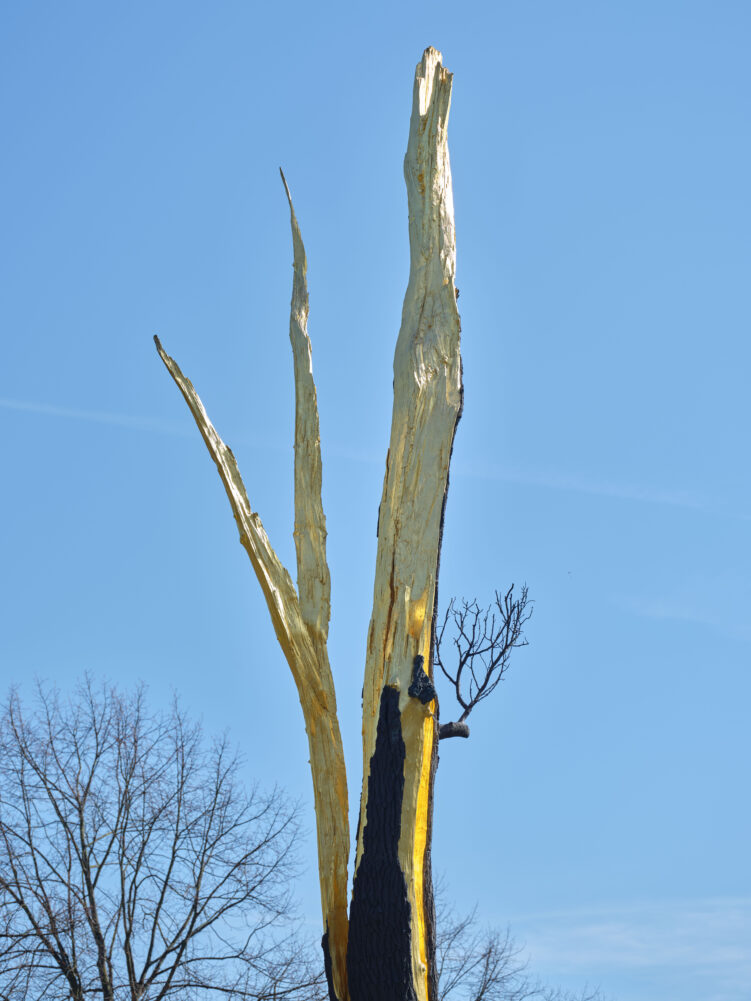
In that exterior we will also contemplate Folgorate Albero (stunned tree) and Idee Di Pietra (Stone Ideas)also cast in bronze. The first is inspired by a Centenary Sauce that grew in Grand-Hornu, in Belgium. After being reached by lightning, his trunk was broken through the center, exposing the internal structure of his wood. Penone melted the tree in his beloved bronze and recovered his pulp with gold bread, capturing the invisible force of nature that sculpted before him that shipyard and its complex interior joint.
As to Idee di Pietrarefers to the relationship between the stones of a river and human thought. It is a sculptural series in which songs in various shapes and sizes are arranged in the bifurcations of the treet bronze branches.

London has also arrived To Occhi Chiusi (with his eyes closed)work that explores the relationship between the view and the act of closing your eyes, a recurring matter in this artist. Already in ROVERSCIARE I PROPRI OCCHI (investing his eyes)a 1970 black and white photograph, was looking directly at the viewer while wearing mirror contact lenses. When interrupting his vision and blinding him, these lenses reflected what his eyes would have seen.
Penone describes that action as a process that defines the volume of my body as a sculpture. The absence of hearing, in his opinion, Create space for imaginationhence, numerous acacia thorns trace and represent closed eyes, synthesizing our senses in connection with the nature of the purest and closest way.
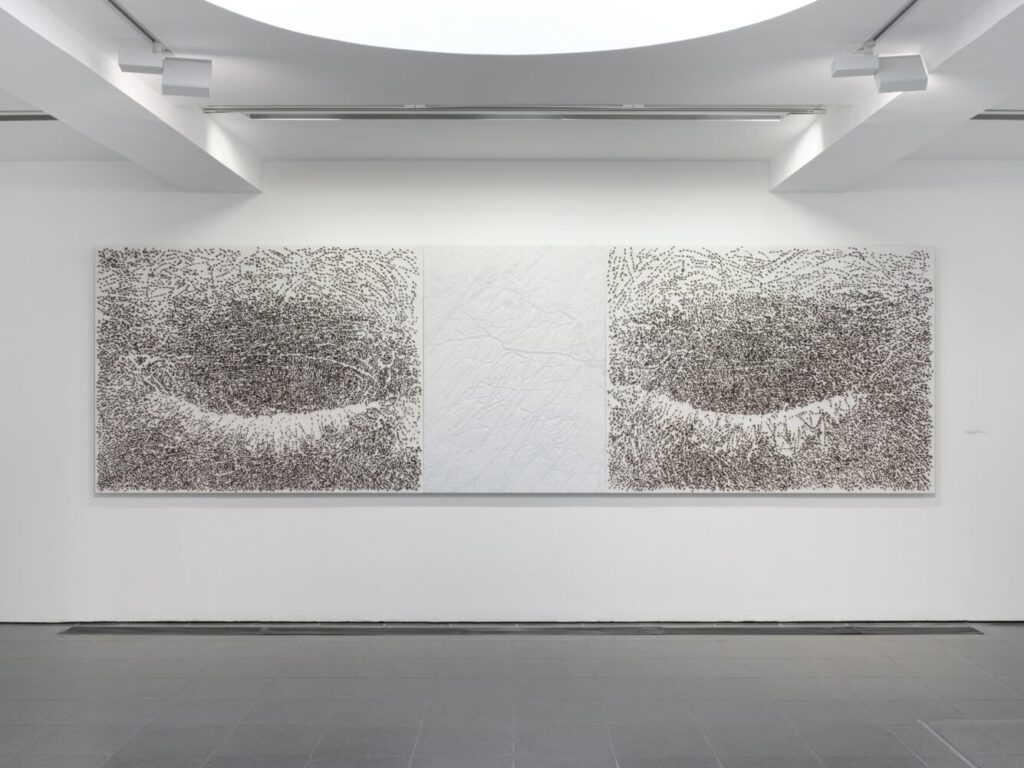
Specifically for this center you have created Pressure (pressure)a large -scale graphite impression that occupies two walls of the gallery. His germ is found in the works that integrated his 1970 series Svolgere La Propria Pelle (unwinding the skin)in which he captured his traces by pressing adhesive tape ink and charcoal covered on his body. This method kept the lines and wrinkles with an almost photographic detail.
For Pressthose footprints have been extended, projected on the walls of the gallery and meticulously traced hand in graphite. The resulting charcoal drawing reveals not only the intricate topography of the artist’s skin, but also the different pressures exercised, both in the original printing process and in the act of drawing. According to Penone, the skin is more than cells: Like the eye, it is a limit element, the end point capable of dividing and separating from what surrounds us … It is the point that allows me, still and after all, recognize me.
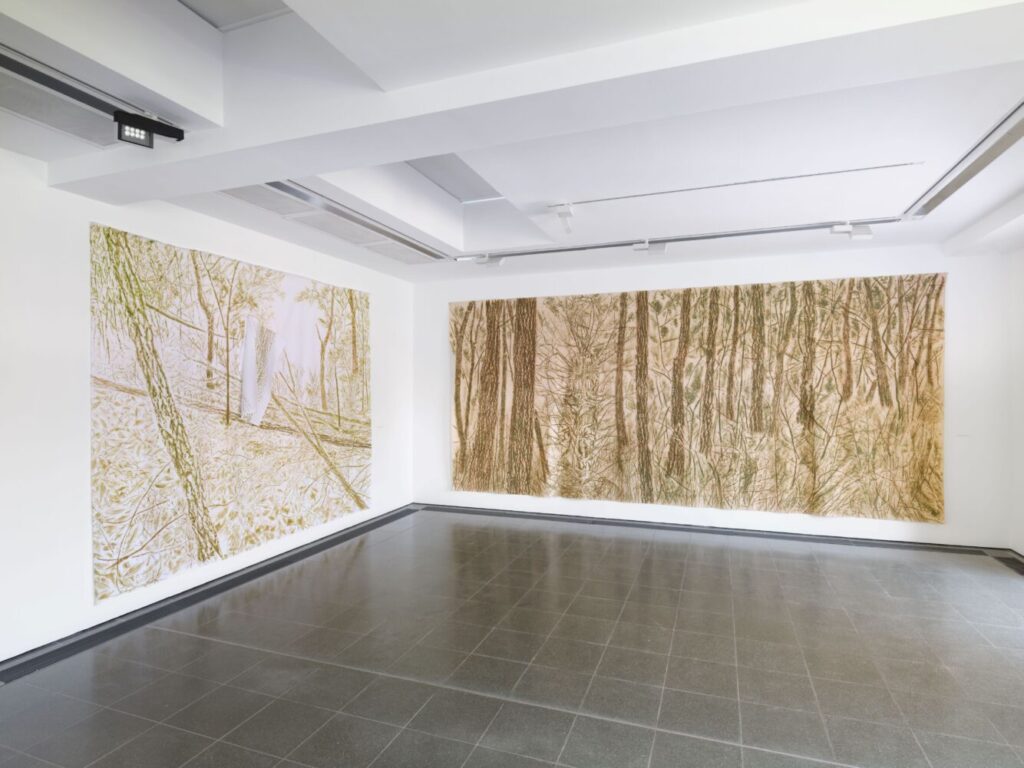
That experimentation with the “unwinding of the skin” led her beyond the human body, to the plant world. The lush forests represented in the project Bosco green They arise from the printing of the cortex surfaces, the branches and the leaves of the trees: Penone wraps natural cotton fibers around the trunks of living trees; The cortex grooves are transferred and recorded in the fabric, composing the base of the vegetation of the drawings.
In addition, in those pieces, the green vibrant of the spring leaves and the reddish browns of aged autumnal foliage transluce the passage of the stations.
“Giuseppe Penone: Thoughts in the roots”
Serpentine Galleries
Kensington Gardans,
London
From April 3 to September 7, 2025