Paris. In 2002, Jean Gaumy was one of the nine photographers exhibited at the National Museum of the Navy as part of the second international maritime photography biennial, devoted to “men of the sea”. A specific space had been devolved to its “open sea” project led for fifteen years on the last high seas trawlers and its crew men. A year earlier, the eponymous book published under the direction of Xavier Barral, published by La Martinière, had been particularly noticed for these black and white images, made in the boat and on the bridge in all time, day and night, as close as possible to bodies and faces.
Twenty-three years later, these fishing scenes, fish cups or crew rest, these tightened framing on a line, a throat net of cod … are placed halfway through the monograph “Jean Gaumy and the sea” offered by the National Navy Museum. They have not lost their intensity. Before discovering the first sea and shore stories, his story on the employees of the Boucane de Fécamp (fishing of fish has since disappeared) and others on fishing in Spain and Long Island. Attachment and rescue at sea of the tug Flanders beeblack tide caused by the oil tanker Amoco Cadiz, exploitation of gas deposits in the North Sea or report and film on board a nuclear submarine in the French Navy … Again, the point of view is up to men. Documental photography and black and white dominate but regularly interferes with the color while the image becomes more graphic at the limit of abstraction, which takes on its fullness with the shots of the expeditions it led with scientists to the North Pole.
The maritime world has been weaving a common thread for over forty years in a work that had never been unrolled. This exhibition is also for the photographer and filmmaker, member of the Magnum agency, the first devoted to him by a national museum, and the first of such magnitude in Paris. Certainly Jean Gaumy has been approved since 2008 “official naval painter” in the category and cinema. But this exhibition is above all the fruit of the donation of his archives which he made, seven years ago, at the heritage and photography media library. “It is thanks to these archives that we were able to carry out such a project”recalls Matthieu Rivallin, head of the MPP photography department and co-commissioner of the exhibition with Marion Veyssière, director of the Deputy of the National Museum of the Navy. For the MPP, this collaboration with the establishment is also a first and marks an important step in the enhancement of the archives of contemporary photographers, more and more numerous to give their fund to this archive service of the Ministry of Culture, since it is also for the institution of its first photography exhibition in a national museum.
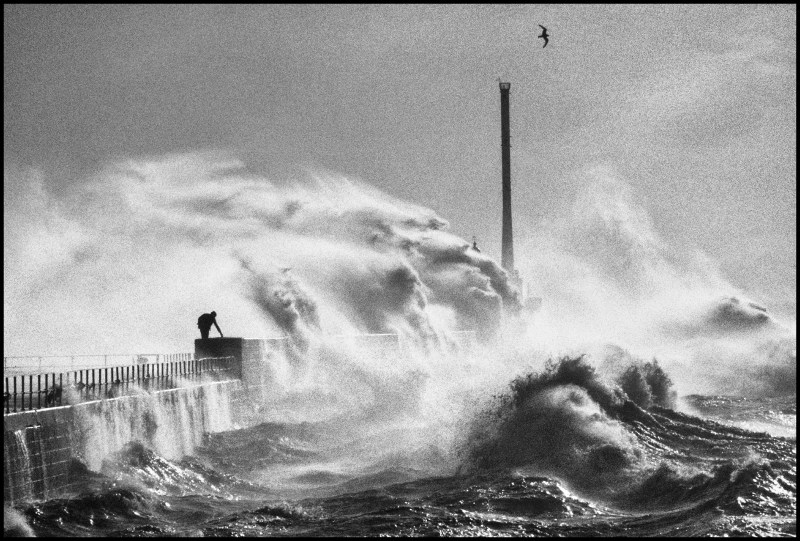
Jean Gaumy, Aboard the Spanish trawler Rowanlea armed in La CorogneNorth Atlantic, winter 1998.
© Jean Gaumy / Magnum Photos
An extensive but too dense course
The exhibition “Fishing beyond the cliché”, placed beforehand, can however deconantly although its reflection on the representation of fishing since the 19th century, built from the collections of photographs of the museum, is interesting. Its opening with Anita Conti, the first French oceanographer woman, photographer and filmmaker, strengthens disorder. Its dense content, in number of images and texts to read, requires time, which can harm the section dedicated to Jean Gaumy. Two exhibitions presented consecutively, that is a lot for the visitor! Even if the first is much shorter, but it is still necessary to know at the time of its discovery. Because it would be a shame not to appreciate until the end what Jean Gaumy tells about the maritime world, in 150 photographs (mostly drawn for the exhibition), two films and thirteen chapters, rich in human stories. The crossing is full of breath, lives and lived, convictions and attachments. This is also evidenced at the end of the course, the choice of Jean Gaumy for his installation in the photography section of the Academy of Fine Arts, not of the traditional sword, but of a 3D copy of one of the rare pisciform spatula of Paleolithic art.