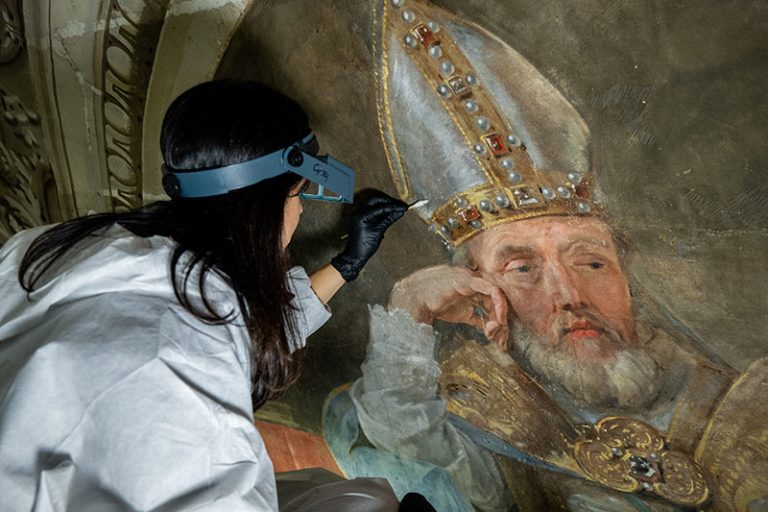
The Brazil National Museum partially reopened in June 2025, seven years after the fire that had destroyed almost all of its collections and its historic building. This progressive reopening, limited to a few restored rooms of the Paço de São Cristóvão, (Palais de Saint-Christophe) marks a symbolic stage in the Renaissance of the oldest scientific museum institution in the country, founded in 1818 and installed since 1892 in the former imperial palace of Rio de Janeiro. The museum, once the largest of natural history in Latin America, retained up to 20 million objects covering anthropology, paleontology, zoology and archeology.
The paço de São Cristóvão, built between 1819 and 1868, first served as an imperial residence before becoming the seat of the Constituent Assembly, then National Museum. The building, classified, was seriously damaged during the fire of September 2, 2018. Before the disaster, the museum exhibited 6,000 objects on 3,400 m².
The fire was caused by a short circuit in a dilapidated air conditioning system, installed in the auditorium on the ground floor. The survey has revealed significant security negligence: absence of sprinklers (fixed automatic water extinction installation), fire doors, insufficient water pressure for fire spears and faulty electrical system. The fire, which spread in a few minutes, destroyed between 85 and 90 % of the collections and caused the collapse of a large part of the main building. The scientific annexes and the botanical garden, however, remained intact.
The loss was considerable: meteorites, fossils, ethnographic collections, imperial archives were destroyed. If some emblematic objects, such as the Bendegó meteorite, have survived most of the collections have been reduced to the state of fragments, such as the skull of Luzia, the oldest human fossil in South America. From the first days, an excavation operation was launched in the rubble: thousands of objects and fragments were extracted, sorted, packaged and restored. National and international donations have once again enriched the collections, including 1,104 old fossils received in 2024 from a private collector.
The renovation project provides an exhibition surface on 5,500 m² for around 10,000 objects. The museum management was based on the Federal University of Rio de Janeiro (UFRJ), owner of the site, and on a consortium of public and private actors to initiate reconstruction. The “Museu Nacional Vive” project brings together the UFRJ, UNESCO, the Ministry of Education, the Federal Bank of Rio, the Federal Government, among others.
Reconstruction has been hampered by many obstacles. The site, officially launched in November 2021, was first delayed by a lack of funds: three years after the fire, only 65 % of the necessary resources were brought together, or 385 million reais (60 million euros) out of the 515 million reais (80 million euros), mainly from the Brazilian Development Bank and private patrons. Inflation and the increase in the cost of materials, the architectural complexity of the site, the Pandemic of Covid-19 and the administrative heaviness has further slowed down the work. The restoration of the facade, entrusted to the H+F Arquitetos cabinet, was completed in 2022, but the interior rehabilitation continues. The complete reopening of the museum is scheduled for 2027.