
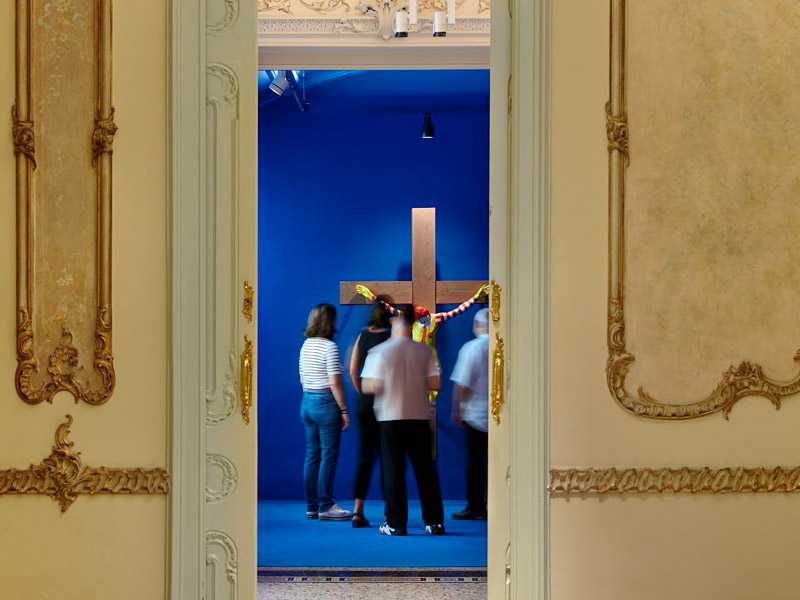
The Barcelona prohibited art museum closed its doors a few days ago after less than two years of activity. Installed in Casa Garriga Nogués, the museum was inaugurated in October 2023 by the journalist and entrepreneur Tatxo Benet. The establishment, unique of its kind, presented a collection of more than 200 works having been the subject of censorship or prohibition. Officially, this decision follows an unlimited strike started in February by the SUT union, relayed by the staff of several subcontractors, and to a brutal fall in attendance making the project economically inviable.
The museum comes from a personal approach by Tatxo Benet. In 2018, he acquired a work by Santiago Sierra, PRESOS POLíTICOS EN LA ESPAña Contemporáneawithdrawn from a Madrid fair for political reasons. This starting point marks the start of a collection gathered in five years, made up of censored works, attacked or removed from exhibition, bringing together artists like Ai Weiwei, Picasso, Warhol, Goya, Mapplethorpe or Barceló. The museum’s ambition was to offer a global panorama of artistic censorship, by exhibiting pieces accompanied by notices detailing their prohibition context. Some works, such as a portrait of Mao by Warhol or a sculpture by Eugenio Merino representing Franco, had already aroused international controversies. The collection, presented as unique in its kind, wanted a tool for reflection on the limits of freedom of expression in art.
The claims of the strikers focused on their working conditions: long standing stations, lack of break, lack of air conditioning and integrating wish within the permanent team. The union highlighted the contradiction of a museum defending freedom of expression while refusing union demands. The continuous presence of strike stakes in front of the entrance has greatly dissuaded the public, resulting in a 75 % drop in income. Officially, the closure is attributed to the strike and its consequences on attendance. But the economic viability of the project was already weakened by dependence only in ticket revenues, making the model unbearable with regard to the number of visitors (120,000 visitors between 2023 and 2024 according to the Crònica); One might think that the entrepreneur took the opportunity of the strike to put an end to the museum adventure.
Tatxo Benet, born in 1957 in Lleida, led a double career as a journalist and entrepreneur. He began in written press in the late 1970s, worked for El País, El Periódico de Catalunyathen joined TV3 where he held management functions, especially in sports until 1996. In 1997, he founded with Jaume Roures and Gerard Romy the company Mediappro, which became a major player in Spanish and international audiovisual.
MEDIAPRO, created in 1994, is an audiovisual group specializing in content production, sports rights management and television distribution. Present in more than 25 countries, he distinguished himself by negotiating major rights, especially for the Spanish football liga.
In France, we know MEDIAPRO well for having been at the center of a resounding scandal during the call for tenders for the broadcast rights of Ligue 1 in 2020. The group did not honor its financial commitments, leading to a major crisis for French clubs and an estimated loss of 600 million euros for hexagonal football.
The collection should be in the form of a traveling exhibition, but the museum has not communicated more on this project.


