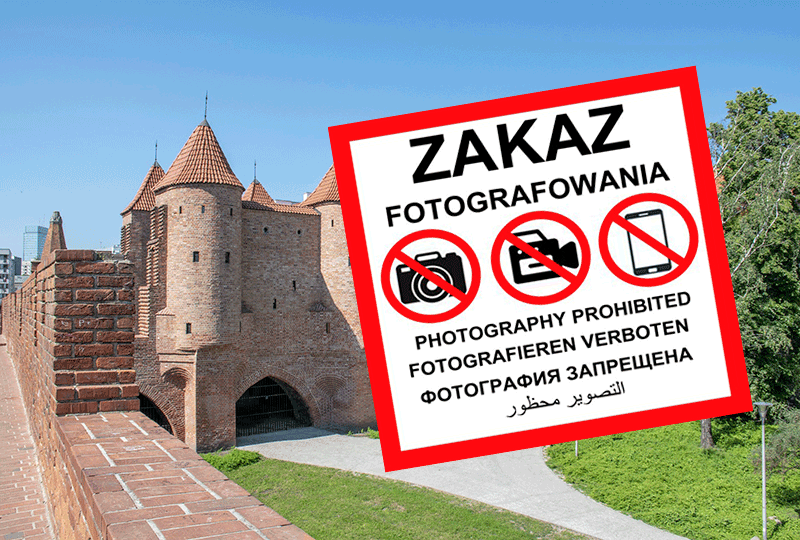
A decree prohibiting taking photos of sensitive infrastructure without special authorization came into force in Poland on Thursday, April 17. Panels mentioning “Zakaz Fotografowania, prohibition to photograph” are being installed on 25,000 sites, mainly military infrastructure as well as bridges, tunnels, port facilities, airports and the National Bank. These warnings, visible in English, German and Arabic, will be accompanied by pictograms representing cameras barred in red.
Although this ban was adopted in 2023, it had not yet been applied due to the lack of details on its implementation in the law on “Patrical protection”. The law follows the growing concern of Poland in the face of Russian and Belarusian espionage, in the context of the war in Ukraine, of which it is one of the main military supports.
“We observe a series of small -scale activities in order to obtain information on our infrastructure”said the Chief of the Polish Army Staff, General Wieslaw Kukula, as reported by Polsat News. Sabotages have been reported. Recently, strangers partially paralyzed rail traffic and disseminated the Russian anthem, according to the Tagesschau media.
The law also aims to protect the military, explained the defense minister Pawel Zalewski: “Unit employees are photographed when they leave their work. It is a matter of security that we should not underestimate. »»
The offenders are exposed to the confiscation of their photographic equipment, to a prison sentence of up to 30 days and to fines of up to the equivalent of 4,700 euros.
If the Ministry of Defense specifies that this does not concern tourists, criticisms are fused: a real spy, in principle, will be able to blend into the mass. The publishing house specializing in the Swiat Kolei railways also criticized the Facebook law, judging it disconnected from reality: “At a time when smartphones are omnipresent, the prohibition will be difficult to apply. Travelers by train can photograph without knowing the prohibited sites. »»
Professional photographers will have the opportunity to request an authorization. The authorities will then have 14 days to examine the request.