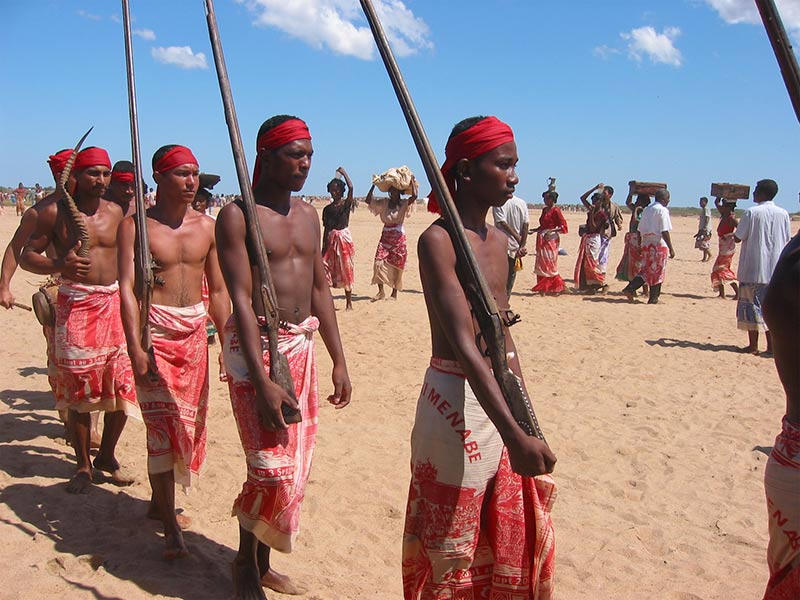
Madagascar. On August 30, 1897, the last Malagasy bastion still resistant to French colonization fell. This battle marks the end of the conquest of the island, started two years ago. That day, Toera, king of the province of Sakalava on the west coast, was defeated in his capital, Ambky; It is captured, executed, beheaded. Its head is then sent to France, where it will be kept at the Trocadéro Ethnography Museum, which today has become the Museum of Man.
On April 2, 2025, the Council of State decreed that this skull, as well as those of two warriors who accompanied King Toera, ceases to be part of the national collections and were returned to the Republic of Madagascar. This is the first application of the framework law, adopted in 2023.
Previously, the remains of Saartjie Baartman (the “Venus Hotentote”) had been returned in 2002 to South Africa, and the 21 Maori heads rendered to New Zealand between 2011 and 2012 as part of two specific laws. On the other hand, the release of the public collections of the remains of the Vaimaca Perú cacique and the skulls of Algerian resistance fighters, and their restitution at Uruguay and Algeria, were carried out by presidential decree, without going through the Parliament.
The skull of Toera, king of the province of Sakalava in Madagascar.
© DR
Very specific restitution criteria
It is precisely to avoid these exceptional laws and these legally questionable decrees that was voted, in December 2023, the framework law resulting from a report written by the former president of the Louvre, Jean-Luc Martinez, who became thematic ambassador. The return decree is the culmination of a process initiated by an official request from Madagascar in 2020, followed by the establishment of a bipartite commission that examined the return criteria.
If it was not possible to identify the skulls by DNA comparison, a bundle of concordant clues made it possible to establish a high probability that these are the skulls of the three warriors. In addition, the Commission has ensured that the remains will be returned to their community of origin for cultural purposes (such as burial), and not cultural (museum exhibition). The Council of State has verified the conformity of the conclusions of the relationship with the law of 2023. In circles close to the file, it is emphasized that this co-construction approach is not shared by all countries and that it does honor to France.
This restitution under the law of 2023 will undoubtedly be followed by many others; The National Museum of Natural History (MNHN) estimates to have 24,000 human remains, including 400 of Malagasy origin. Not all come from violent contexts: some were collected peacefully in the old colonies or during archaeological excavations in France. To date, no other country has made an official request for the restitution of human remains. On the other hand, work is underway, in particular with Australia, with which has recently been created a joint committee to identify aborigine remains in the French collections.
The return of human remains to French overseas communities is not covered by the law of 2023 and awaits a specific legislative system. The return to New Caledonia of the head of Chef Ataï to his descendants Kanaks is the most recent example.
Five years ago, another object returned to Madagascar: a royal decorative element, which adorned the Dais of the Throne of Queen Ranavalona III, last sovereign of the island (1883-1897), and kept at the Army Museum in Paris since 1910, has regained its place at the Palais de la Reine in Antananarivo. But this return follows a more tortuous path: the object is placed in the expectation of an exceptional law or a framework law on goods taken from a colonial context. If no one doubts that he will remain definitively in Madagascar, whatever his status, great uncertainties remain as for the third framework law envisaged by the Martinez report. While those on stolen objects during the Second World War and on human remains are now applied, the law on cultural property is at neutral.