Hong Kong. It is within the framework of its series devoted to Chinese artists of the 20th century that the art center of Asia Society exhibits Hoo Mojong (He Muqun, 1924-2012). Since 2017, four other artists have been celebrated: Fang Zhaoling (alias Lydia Fong, 1914-2006), Pan Yuliang (1895-1977), Irene Chou (Zhou Luyun, 1924-2011) and Lalan (XIE Jinglan, 1921-1995). Hoo Mojong is the subject of a recent rediscovery, in the wake of the retrospective devoted to it by China Art Museum in Shanghai in 2024.
Born in Ningbo, in a relatively easy family, she left China in 1948 for an exile of more than half a century. After having successively lived in Taiwan, Brazil, Spain, she settled in France in 1965. In 2002, she returned to live in Shanghai after this long exile and spent the last ten years of her life there. The artistic recognition which she will benefit from in China from the 1990s played a decisive role in her return. She also bequeathed a hundred works at Shanghai Art Museum. However, the Asia Society mainly presents works from private collections in China, Taiwan and North America.
Entitled “Objects of Play” (playful objects), the exhibition was designed by Valerie Wang, in partnership with Bao Foundation, founded by the couple of Chinese collectors Yang Bin and Yan Qing. Offering a nuanced overview of the artistic trajectory of Hoo Mojong, it brings together nearly 100 works covering the different stages and practices of her career: paintings, drawings and engravings, accompanied by some archive documents. Working in parallel with his reasoned catalog, Valerie Wang stresses that we still know little about the artist’s personal life, which remains very discreet throughout his life.
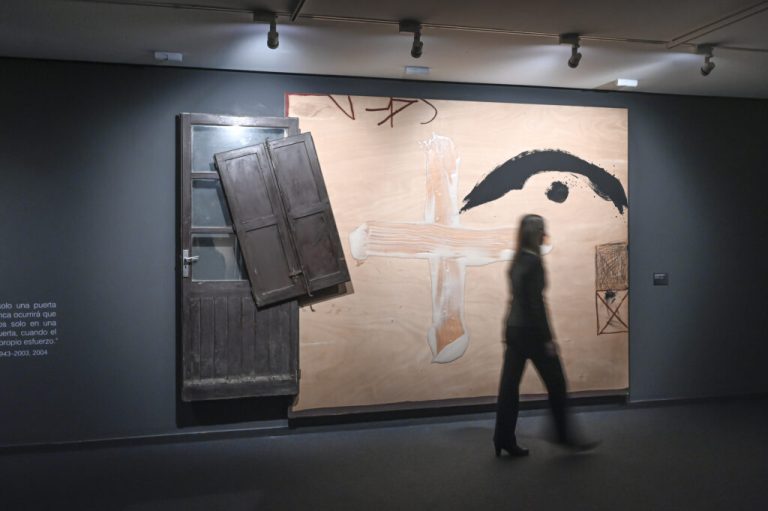
View of the exhibition “Objects of Play: Hoo Mojong Centennial Retrospective” at the Asia Society Hong Kong Center.
© Asia Society Center
With three out of five sections devoted to his Parisian works, the course highlights the epiphanic character of this period in his journey. Its integration into the Academy of the Grande Chaumière in Paris played a key role, as for its Chinese predecessors Sanyu and Zao Wou-Ki or other women artists, such as Louise Bourgeois and Maria Helena Vieira da Silva. His talent was quickly recognized, thanks in particular to the price that the Female des Femmes Paintres awarded him in 1968 for his series on toys, which inspired the title of the Hong Kong exhibition.
Hoo Mojong favors contrasts, flattened of bright colors and framing that often truncies part of the subject or scene. The characters are frequently represented from the back or with the cut face, as frozen. By accentuating the two -dimensionality of the canvas, its compositions give up the monofocal perspective in favor of a chromatic, timeless and radiant depth. Faced with the serenity that emerges from his paintings, his numerous drawings of female nudes introduce a surprising agitation, carried by a vitality both calligraphic and sensual.
An essential figure in the dialogue between oriental and Western artistic languages, Hoo Mojong operates a transfer of Chinese aesthetics, traditionally linked to ink, to oil painting, modern medium par excellence in Chinese perspective. The recurring motif of bread, associated with Asian cultural references, perfectly embodies this bridge in its Parisian works.
It is thus part of the wake of Pan Yuliang, but also other pioneers of Chinese modernity. We think in particular of Qi Baishi (1864-1957), which shares with it the taste of apparently simple subjects, like fruits, but deeply symbolic. Mastering an art of comfort, falsely naive and spiritually playful, it seems to inherit, like him, with a Taoist vision of the world, between nature and immortality. Embodying a modernism rooted in the figuration and decentralized of the West, Hoo’s work frees from schools to assert a strong personal style, like that of Wu Guanzhong, painter of the same generation.