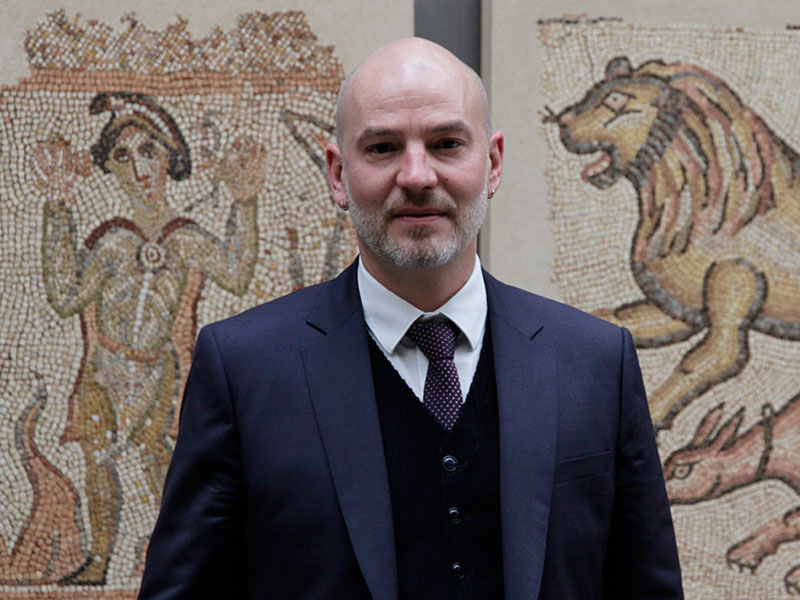
The renewal of the mandate of Maximilien Durand (50 years) at the head of the department of Byzantine Arts and Eastern Christendom at the Louvre Museum recalls the existence of a status that is still little known: the department directors do not only exercise internal authority. They also assume, in the name of the State, national responsibilities as heads of major heritage departments. Two decrees signed by the Minister of Culture Catherine Pgard frame this renewal. The first reappoints Maximilien Durand as head of the department of Byzantine Arts and Eastern Christendom of the public establishment of the Louvre Museum; the second renews him as head of the corresponding large heritage department.
The heritage code organizes this system. It defines the major heritage departments as reference entities in a given field, to which the State entrusts specific expert missions. The Louvre has nine, even if not all its departments have this status. The departments are today headed by Ariane Thomas (Oriental Antiquities), Cécile Giroire (Greek, Etruscan and Roman Antiquities) and Hélène Guichard (Egyptian Antiquities), as well as by Olivier Gabet (Art Objects), Souraya Noujaim (Islamic Arts) and Maximilien Durand (Arts of Byzantium and Eastern Christendom). Sébastien Allard and Xavier Salmon are respectively in charge of Paintings and Graphic Arts. The Sculptures department remains without a director since the departure of Sophie Jugie. Laurence des Cars, before his departure, had wished to no longer automatically renew the mandate of department directors, starting with that of Sébastien Allard which is coming to an end. His successor Christophe Leribault has not yet commented on the subject.
In a large museum, a department director is in charge of the collections, supervises the teams, supports restorations, prepares exhibitions and participates in acquisitions. At the Louvre, when a department falls into the category of large heritage departments, its director also intervenes beyond the museum, in conjunction with the Service des musées de France, a department of the Ministry of Culture.
Its first national mission consists of advising the museums of France in its specialty. The ministry can request it regarding a purchase, a restoration, a reorganization of collections or a broader scientific question. He is a reference point of contact for the entire museum network. He also participates in the Scientific Commission of National Museums, where the heads of major heritage departments inform the ministry on files of collections, scientific projects and claims for cultural property. Finally, it examines requests for export authorization certificates falling within its field of competence and issues an opinion to the French Museums Service.
The nomination method is carried out in two stages. The president of the Public Establishment of the Louvre Museum proposes a name or a renewal, then the Minister of Culture signs the corresponding decree. The function thus falls under both the governance of the museum and the authority of the State. The profile of the incumbents confirms the level of responsibility attached to these positions. Most belong to the body of heritage curators, sometimes at the rank of chief curator or general curator. The Louvre can open certain positions to contract workers, but the function remains defined by a high level of scientific and administrative expertise. The term of office is three years, renewable.
This is the case of Maximilien Durand. A graduate of the École du Louvre and holder of a DEA from the École Pratique des Hautes Études devoted to hagiographic texts preserved in the Department of Egyptian Antiquities, he taught at the École du Louvre. He established himself as a specialist in Byzantine art and Eastern Christianity.
He was scientific director of the NGO Patrimoine sans Frontières, then responsible for conservation and restoration at the Museum of Decorative Arts in Paris, before directing from 2011 to 2017 the Museum of Fabrics and the Museum of Decorative Arts in Lyon. After a stint at Christian Dior Couture between 2018 and 2019 as head of conservation, he joined Paris Musées in January 2021 as deputy director of collections and research, while becoming curator of the Paris Catacombs.
The Louvre entrusted him in 2022 with the prefiguration of the department of Arts of Byzantium and the Christendoms in the East, the perimeter of which is located between the origins of the Christian image and the Treaty of Lausanne of 1923, in an area stretching from Ethiopia to Russia. He defined the scientific project, brought together previously scattered works and prepared the effective creation of the ninth department of the museum. The theaters are due to open in 2028.