Pamplona,
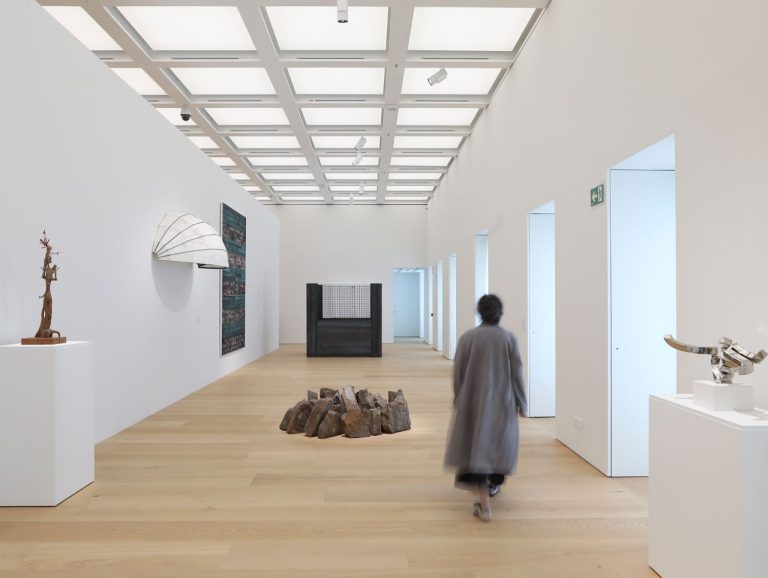
This year the curatorial project turns twenty-three Building Bridges of the University of Navarra Museum, aimed at establishing relationships between contemporary artists and the funds in their collection.
The latest author to join him is Antoni Muntadas, who is now exhibiting “Other Fears” in this center, a project that he has been working on since 2022 but that links with thematic lines quite earlier in his career: it analyzes the ways in which Western societies have contemplated and used that emotion as a political argument since the beginning of the 21st century.
The man from Barcelona has investigated how someone who is afraid behaves, what its consequences are and the manipulations and uses that have been made of it when taking it from the individual to the collective field, thus decisively influencing the formation of ideologies and the debates of ideas. It is a feeling as old as life itself, but its conversion into a tool for transforming and manipulating opinions and beliefs, an ideological weapon in polarizing environments, is more recent.
The Sanfermines and their context have been the starting point of this work by Muntadas: he has extracted visual and auditory elements from the dramaturgy of the bulls that, when combined in an installation, generate an abstract synthesis of these events. It consists of two projections arranged in a vertical face-to-face: on one side, we contemplate the ground of the busy streets projected at our feet; on the other, the sky that covers that same route, in which we can glimpse the “crests” of some buildings, projected on the roof. We will also hear sounds recorded in the race, among which comments from the participants referring to their fears have been interspersed.
The images also run at the average speed of a running of the bulls until they reach the end, in which men and animals culminate their journey in the bullring, where the bulls are led to their corrals to be fought hours later. Muntadas’ work, like the party, has a festive conclusion: fireworks close the projection.
The Catalan delves here into the nature of a type of fear associated with feat, chance and skill, but especially in many dualities: between fun and fear, competition and recklessness, attraction and repulsion. Fear is shared in these celebrations between bulls and people, between actors and spectators (those physically present and those remote) and paradoxically generates interest, one perhaps linked to the survival of an ancestral masculinity in this rite.
Along with this unpublished proposal, we can contemplate previous works by the artist that respond to the same line of interest and provide context, highlighting the psychological, social and political aspects of fear today, globally.
Convinced that art, in addition to providing us with aesthetic experiences, facilitates the formation of diverse forms of knowledge and imaginaries in which everything around us can be different, Muntadas uses discursive resources typical of the humanities and social sciences; This is the case of this project on fear, with the methods of anthropology and psychology.

Already in 2005 and 2007, this author produced two video works, which can be seen in Pamplona: “television intervention” projects on two specific places, symbolic in their territory of staging the “fear of the other” derived from the rejection of immigration and racism. It is about On Translation: Fear and On Translation: Fear/ Jaufwhich bring together interviews with people who regularly experience tensions in these areas: the border between Mexico and the United States and the Strait of Gibraltar.
They are single-channel videos that remind us that fear is an emotion “translated” across these borders from very different perspectives; The first reviews the impact of the decisions made from power on the ground and the second refers to the construction of the south as fiction and reality connected to otherness and exoticism.
We will also see Alphaville and Outros… (2011), another single-channel video that was part of an installation of the same title and took us to Alphaville, an almost walled residential neighborhood in São Paulo. He stopped at the phenomenon of “closed communities” built from the exclusion of those who are different, and also made reference to Godard’s dystopia, whose images are interspersed here.

Another work in the exhibition, The construction of fear (2008 – 2025), was conceived as a map of the fears of the place where it is exhibited (it has passed, among other cities, through Alicante, Amman, Buenos Aires, Caracas and Paris). And the journey ends with Fear, Panic, Terror (2010), a proposal composed of five framed panels that each include six covers of books published in the United States whose titles include those concepts. It refers to how the publishing industry has commercially exploited the types of aversions felt by English-speaking societies, perhaps fostering a sense of collective fear.
It is known that the University of Navarra Museum has a vast collection of historical photography in which it is possible to appreciate the construction of certain ethnographic or anthropological perspectives in the first decades of the 20th century. These funds and this exhibition emphasize that art and anthropology have a close relationship and that the readings of these pieces can be made from many times and geographies.

Antoni Muntadas. “Other fears”
UNIVERSITY OF NAVARRA MUSEUM
University Campus, s/n
Pamplona
From October 15, 2025 to March 1, 2026