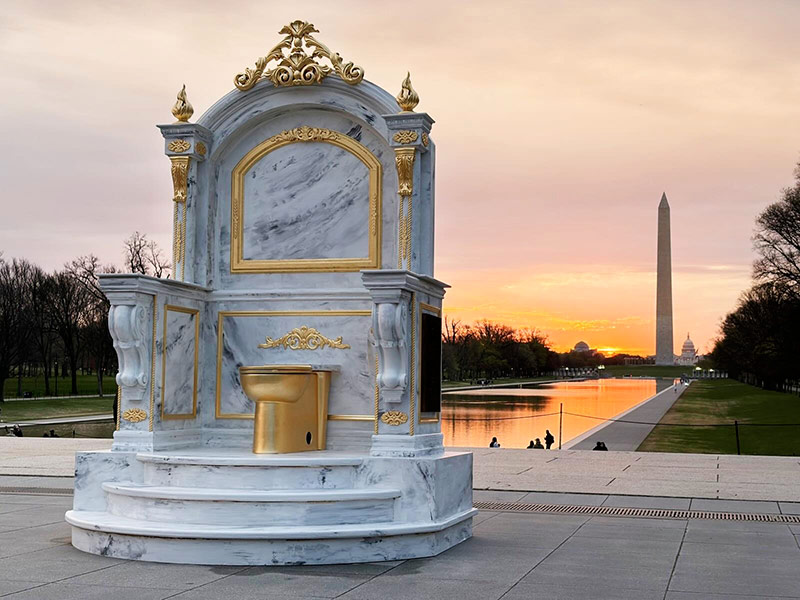
Washington, D.C. A Throne Fit for a King (“A throne fit for a king”, (see ill.)). During the month of March, a monumental sculpture of an explosive kind was installed in Washington. Made of faux marble, it was erected on the National Mall, opposite the Lincoln Memorial. It rose to 3.5 meters, like a monarchical throne, framed by consoles and decorated with golden ornamentation. Volutes, foliage, flames, the vocabulary called, to excess, the pomp of another century. The seat? a golden toilet bowl offered to passers-by to imitate the current President of the United States. A few hours later, the police rushed to dismantle it.
This sculpture is inspired by the bathroom of the Abraham-Lincoln suite at the White House, recently redone on the instructions of Donald Trump. She points out the grandiloquence of the latter. Other sculptures of the genre are more political. Placed anonymously in public spaces, they are multiplying in Washington and other cities in the United States.
The phenomenon, which the Americans call “Guerilla Statues”, is quite recent. The debunking of Confederate, colonial or slave statuary began in 2015, opening the way to protest through monuments. But the wild erection of statues in public spaces really began during Trump’s first term. He is also the main figure. As early as the 2016 election campaign, the activist collective Indecline placed statues from the series “The Emperor Has No Balls” in several cities, representing the billionaire in the simplest form. Then, from campaign to mandate, the model flourished with, among others, the “Trump Statue Initiative” project, i.e. living sculptures where actors, covered in gold paint, embody different satirical versions of Trump.
A choice of strategic locations
Since the start of the second term, only fifteen months ago, the pace has accelerated. Arbitrary or inconsistent decisions, the actions of the ICE immigration police, the Epstein affair, etc., many subjects have united the protest. Anonymous people are mobilizing around the Guerilla Statues which, very photogenic, are going around the world via social networks.
Anonymous, the sculptures are not completely anonymous. For example, the collective The Secret Handshake has signed several statues: King of the World (approximately 3.6 m high), inspired by the film Titanic (1985), where Jeffrey Epstein and Trump appear, one behind the other, in a chilling parody of a cult scene from the blockbuster; And Best Friends Forever (“Best Friends Forever”, 3 meters high, in bronze), which depicts the triviality of the friendship between the child molester and the President of the United States. The latter was dismantled and damaged less than a day after its erection, despite official installation authorization. When the members of the collective arrived on March 10 in unmarked vehicles on the National Mall, not far from the White House, they hoped to install their statue for a few days, but the park police were very quickly mandated by the prestigious neighbor to remove the object of opprobrium.
The location of his protest works is strategic. A game takes place, activists come to taunt the State a stone’s throw from the Capitol and the authorities quickly intervene and destroy the works. To compensate for the ephemeral nature of the installations, the collective is therefore developing a 3D model of the statues and invites anyone who wishes to reproduce them. The models are free of rights, allowing the multiplication of militant actions. Thus, a few days after dismantling, a statue identical to Best Friends Forever was resettled for a few days in the same place, and another in northwest Washington.
Statuary taken on the wrong foot by activists
The phenomenon is taking root and gaining momentum because the activists are targeting one of the president’s obsessions. Through its political charge, statuary is one of Donald Trump’s guilty pleasures. As soon as he came to power, he suggested that his face complement the giant figures of Mount Rushmore (four statues of presidents emblematic of the history of the United States, editor’s note). A bill was even tabled by Anna Paulina Luna, a Republican elected official from Florida, but it did not go beyond the committee discussion stage. In any case, the project was buried in advance, for geological reasons: the rock is too friable. The former manager of the place, Dan Wenk, commented on the situation with a pithy sentence: “They come up against the reality of the rock. »
Furthermore, the Trump administration is reversing its ordering of public statuary. It is customary for 0.5% of the costs of construction or modernization of federal buildings to be allocated to artistic commissions. With these sums, previous mandates had, under Barack Obama, promoted the diversity and contextualization of public statuary, and, under Joe Biden, institutionalized the removal of contested figures. Donald Trump assumes the opposite extreme, as evidenced by the statue of Christopher Columbus recently placed near the White House. It is a replica of the one unbolted and thrown into the port of Baltimore in 2020, during the waves of anti-racist protests following the assassination of George Floyd. The president’s message is accepted. The “National Garden of American Heroes” project in West Potomac Park, launched during his first term, was also reactivated. The call for proposals is underway, organized by the National Endowment for the Humanities. It provides, to the tune of 40 million dollars (34.2 M€), the production of 250 sculptures of the great American “heroes”, including the contested figures to return to a historical narrative of the “Golden Age”. Artists will have to follow the roadmap issued by Trump: “Honoring tradition, promoting civic pride and inspiring citizens. » The height of megalomania, a gold statue created by the artist Alan Cottrill (see ill.) bearing the likeness of the tycoon, should adorn the Trump hotel during the G20 scheduled for December this year in Miami.
Screening of the G20 in Miami with the bronze statue covered in gold leaf of Donald Trump created by Alan Cottrill.