Paris. Maximilien Luce (1858-1941) was a landscaper? During his lifetime, the question divided criticism, and his biographer, Adolphe Tabarant, refused to decide. Build a retrospective of a hundred works by titling it “Maximilien Luce.” The instinct of the landscape ”encourages to ask the question again. In 2010, the Giverny Museum of Impressionisms had titled its retrospective “Maximilien Luce, neo-impressionist”, which did not commit to anything on the question of the genre practiced by the artist but brushed the disinformation concerning the school to which it can be attached. This is the whole problem with Luce: it is very difficult to define it.
We know that he discovered neo-impressionism in Georges Seurat and applied it in his own way, abandoning the rigorous rules of departure to cheerfully compose artifice fires with the help of brush shots of all forms. Made according to this principle, the pretty little oil on cardboard Edges (sd) seems covered with confetti. But this gentle divisionism works wonders in this beautiful humanist painting that is The toilet (1887). In his landscapes, the painter multiplied experiences, especially to make the light in the morning or evening, his favorite. From where it follows that Gisors cathedral (rue du Fossé aux Tanneurs) (1898) is a lilac symphony. His friends, Camille Pissarro and Charles Angrand, ended up pointing out to him that he still used purple a lot … However, what a success when this purple comes even more unreal when the Hauts-Fourneaux ofFactories near Charleroi (1897)!
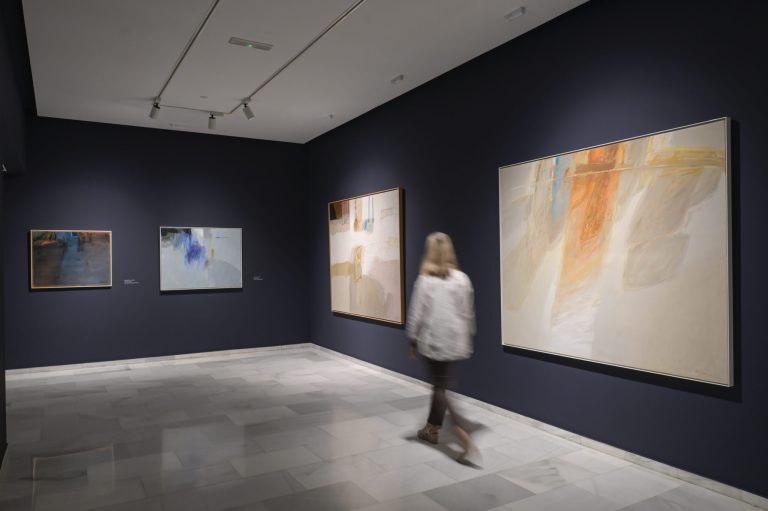
View of the exhibition “Maximilien Luce. The instinct of the landscape ”at the museum of Montmartre.
© André Ferreira
Often, the Luce’s landscape is inhabited, to the point that criticisms have planned to classify it in the painters of figures. But, here too, he seeks, borrows and often does not find the right formula. Batager in Saint-Tropez (1897) is a slightly strange transposition ofIn harmony (1895) by Paul Signac. At the end of his life, Méricourt, the beach (1930) still derives without genius from the founding table of Seurat, Un Sunday afternoon on the island of Grande Jatte (1886). However, there is a theme where the painter has no trouble inscribing his figures in a landscape: work. Pile drummers (1903) is a real historical landscape as well as Foundry in Charleroi (1896) is a painting of history.
Luce is definitely an elusive painter. There are not these artists digging a furrow towards perfection of which it is easy to show the trajectory. To present a chrono-thematic retrospective of his works is to exhibit very good paintings and others much less interesting, pecking in the multiple genres he addressed: interior scenes and portraits, illustration, print, drawing, ceramics. It is also giving too much room for its last twenty years, obscure fight against fauvism and avant-garde. With him, who too badly embraced.

View of the exhibition “Maximilien Luce. The instinct of the landscape ”at the museum of Montmartre.
© André Ferreira