Welcomed with jubilation and festive explosions, bones attributed to Tsar Samuel of Bulgaria landed in Sofia on Saturday October 3. This transfer follows an agreement concluded on September 29 with the Greek government, in exchange for the return of 48 religious objects – taken in 1917 by Bulgarian forces – to the Hellenic Republic. On the Athens side, the satisfaction of finding the artifacts took on a bittersweet taste in the speech of Prime Minister Kyriakos Mitsotakis, who did not fail to reaffirm a long-standing desire of his government: to recover the marbles kept at the British Museum.
“My country will not accept any arrangement involving the recognition of foreign ownership or the so-called borrowing of its own treasures”declared the Greek Prime Minister, after welcoming the diplomatic success achieved by Greece and Bulgaria, the fruit of long-term negotiation work. Already before the fall of the Bulgarian communist regime in 1989, Athens claimed the return of the relics, looted during the First World War from the monasteries of Panagia Eikosifoinissa and Timios Prodromos, in the north of the country. If the agreement with Sofia comes after a long series of requests for restitution, it does not fully satisfy them: the National History Museum of Bulgaria, owner of the artifacts, made it clear that the return to Greek soil was not accompanied by a transfer of ownership and that the relics remained listed in its inventory.
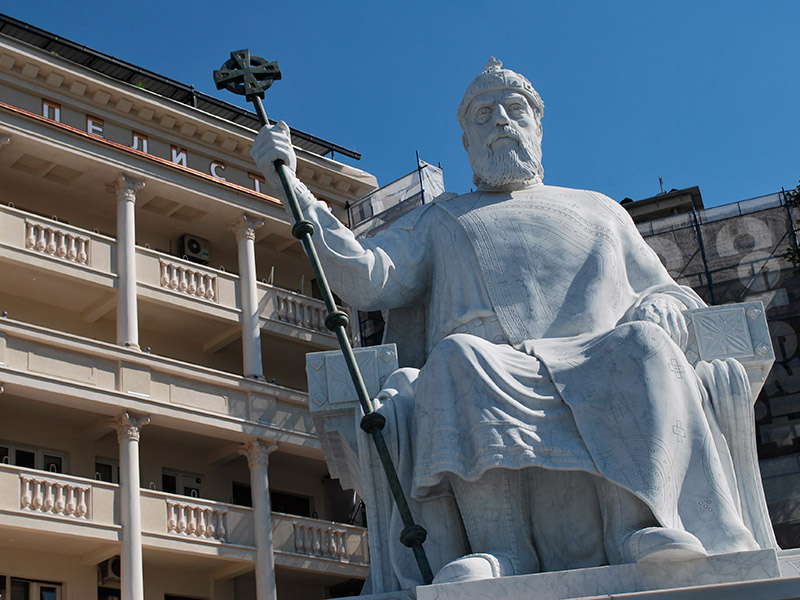
Likewise, the bones attributed to Tsar Samuel, ruler of the Bulgarian Empire from 997 to 1014 and opponent of the Byzantine emperor Basil II, were returned to Bulgaria as part of a deposit, and not as a definitive restitution. Their arrival on Bulgarian soil was nonetheless celebrated as a victory following successive demands for restitution, officially formulated since 2007.
But facing the United Kingdom, there is no question for the Greek government of being satisfied with a reciprocal deposit. Since the 1980s, and particularly since the diplomatic offensive launched in 1982 by the then Greek Minister of Culture Melina Mercouri, Athens has demanded the return of the marbles and the transfer of their ownership to Greece, believing that they were illicitly looted between 1801 and 1805, when the country was under Ottoman rule.
While the United Kingdom maintains a position consisting of claiming the legality of the conditions of acquisition of the Parthenon statues and refuses to subscribe to Greece’s demands in the name of the universality of the works concerned, Athens has for several years consolidated its argument around the principle of integrity of the Parthenon, deprived of all aesthetic coherence. A principle reaffirmed by Kyriakos Mitsotakis upon receipt of the Bulgarian loan, and which he probably hopes will resonate as far as London.