Cork. Through their cultural and geographical proximity, Belgian artists have always quickly immersed themselves in the trends developing in France. In 1886, Manet and Renoir exhibited at the Cercle des XX alongside James Ensor and Fernand Khnopff. The year following its presentation in Paris, the painting A Sunday afternoon on the island of Grande Jatteby Georges Seurat, caused a sensation in Brussels at the 4th Salon des XX.
The exhibition proposed at the Musée de la Boverie in Liège is less a story of “Belgian” impressionism than a journey on the pictorial transposition of light, at this pivotal period between 1860 and 1914, by Belgian artists resolutely turned towards modernity.
Nearly a third of the 150 works presented come from the collections of the Liège Museum of Fine Arts, and are supplemented by those from around forty Belgian and foreign museums, as well as private collections. The chrono-thematic deployment imagined by curators Michel Draguet and Élie Barnavi with the cultural agency Tempora follows the artistic journey between the creation of artistic circles such as the Société Libre des beaux-arts and magazines Free Art Or Universal Art until the emergence of symbolism and expressionism.
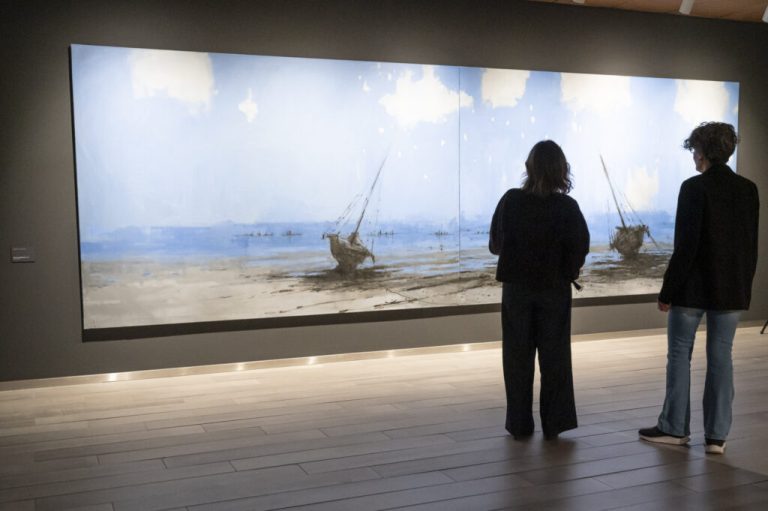
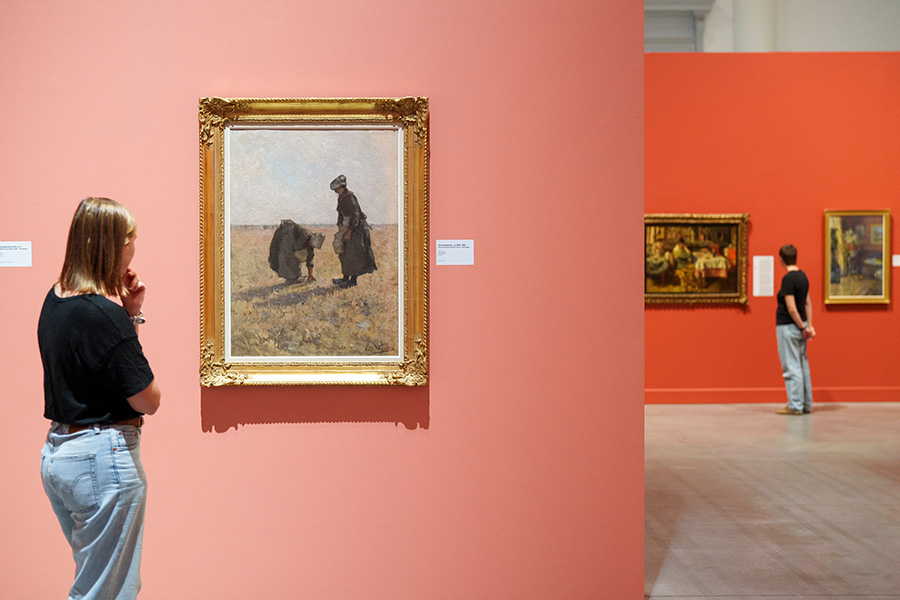
View of the exhibition “Impressionism, a Belgian history” at La Boverie.
© Tempora / db creation
Leave the workshop
In the second half of the 19th century, Belgium was one of the cradles of the industrial revolution. Turning their back on academicism, some of its artists wanted to echo this moment of rupture by creating avant-garde art. Like French painters, their first instinct was to leave the studio to capture what the light said about the landscape. The ambition was also to provide the young country with a national landscape, from the forests of the Ardennes to the dunes of the North Sea. Here a Belgian specificity is already marked with a pictorial touch which aims to be more atmospheric and more realistic, visible in the tormented skies of Hippolyte Boulenger where the clouds boil like a raging sea or in the paintings of Guillaume Vogels with thick paste applied with a knife. The Bourgeois Salon (1880), one of the three paintings by Ensor present in the exhibition, well illustrates a Belgian approach. Inspired by impressionism and the call of light, the Ostend master stands out radically in his dark and heavy atmosphere under touches of thick colors.
The detour via pictorialism, represented in Belgium in particular by Leonard Misonne and Guillaume Marissiaux, is interesting. While the advent of photography freed painters from having to stick to reality, pictorialists borrowed their compositions and framing from painters and made light their main material for images that seem to reflect an ideal and peaceful world. Responsible for commissioned work on the industrial and mining world of Charleroi, Marissiaux draws images with a vaporous aesthetic under their veils of light; the miners only appear in the form of silhouettes, and the violence of the working conditions disappears under a halo of aestheticism. The remark also applies to their fellow painters, for whom the mining and industrial world does not constitute a subject while Belgium experienced worker riots in 1886 followed by bloody repressions.
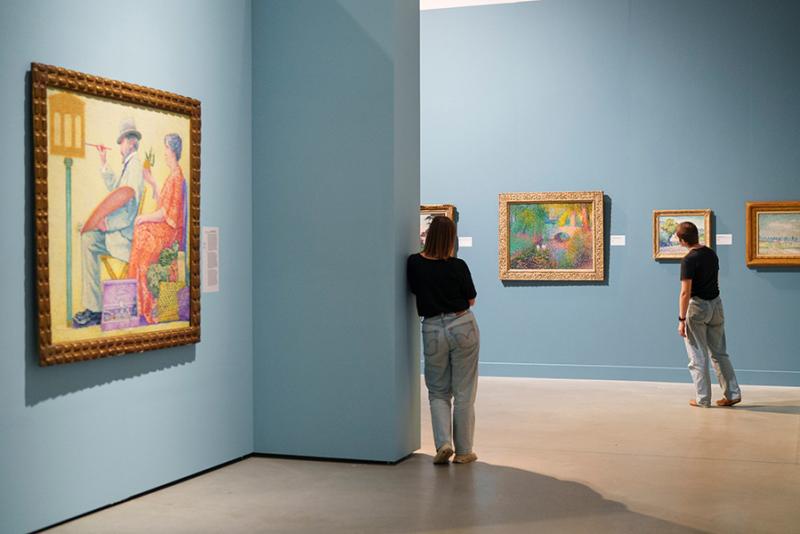
View of the exhibition “Impressionism, a Belgian history” at La Boverie.
© Tempora / db creation
The neo-impressionist movement, in which Théo Van Rysselberghe distinguished himself, was widely followed in Belgium, with an approach to light. more atmospheric and poetic than scientific. Thus in the art of portraiture, well represented here, where the pointillist touch adopts softer and realistic shades on the faces.
Luminism, a Belgian specificity
Even if they did not yet have their place in the academies, more and more women painters made a name for themselves, like Anna Boch, Juliette Wytsman or Yvonne Serruys, but often in compositions linked to the floral world, whether in portraits, still lifes or landscapes.
Luminism, undoubtedly the most specifically Belgian movement arising from impressionism, continues this atmospheric vein. Grouped around the painters Émile Claus and Georges Morren and the Vie et Lumière circle, the artists place the rendering of light at the center of their work. A light that dictates the shape and appearance of things depending on the time of day and the succession of seasons. The countryside becomes a space of refuge, idealized and tinged with melancholy as in the superb Wake up on the farm (1907) by Adrien Joseph Heymans whose composition and character disappear under the pastel tones, with the exception of the more marked silhouettes of two farm birds.
The journey ends as light gives way to color among the Brabant wild beasts, and impressions are overwhelmed by the expression coming from within.