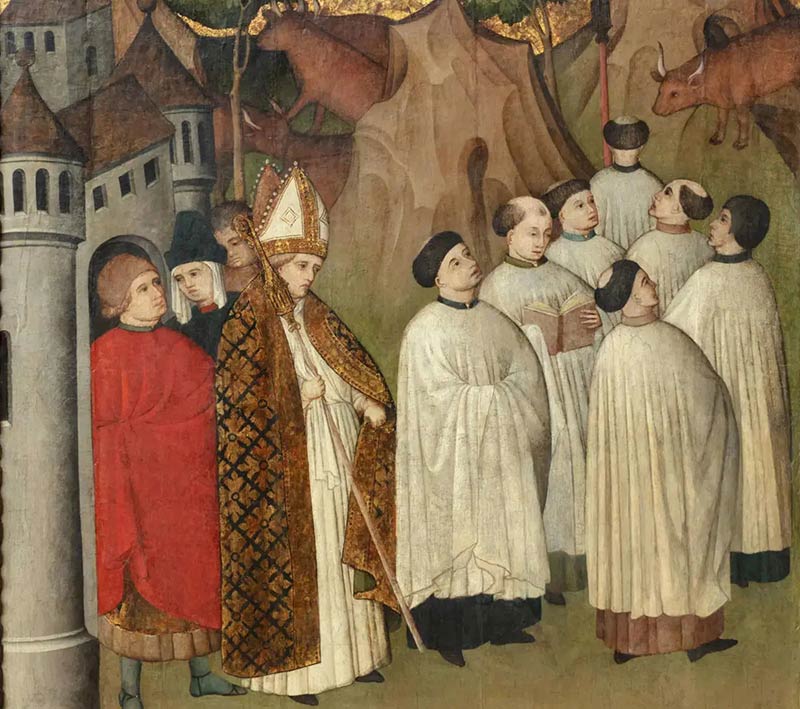
Every day, artificial intelligence brings its share of new uses. So Procession to Mount Garganoa Gothic panel painted by Nicolás Francés, was found in 2026 in an American museum after more than 70 years of absence thanks to AI. Made around 1440-1450 in tempera on wood, the work was part of an altarpiece in the San Miguel de Villalpando church (Castile), alongside three panels dedicated to the archangel Saint Michael.
In 1957, the priest of Villalpando, with modest means, sold the paintings to finance parish work. Procession to Mount Gargano was sold for 5,000 pesetas (30 euros today). The three other panels subsequently joined prestigious institutions (Cincinnati Art Museum in Ohio, Museu Nacional d’Art de Catalunya and the Museum of Montserrat).
Nicolás Frances (1400-1468), Procession to Mount Garganoc. 1440-1450, tempera on wood.
© Cincinnati Museum of Art
The trace of Procession to Mount Gargano seemed to have been lost until a recent investigation by historian Jaime Gallego. This made it possible to identify the panel in a museum in Massachusetts using a method combining archives and visual recognition.
The investigation began with the discovery in the archives of the Amatller Institute in Barcelona of a negative from 1960 produced by the historian José Gudiol. This photograph, showing the panel after its disappearance, constitutes the first reference image. It attests to its passage into the private market. Consultation of the correspondence between the Schaeffer gallery (New York) and the Cincinnati Art Museum shows that the American museum had considered a purchase at the end of the 1950s. The transaction having failed, the American lead remains plausible but no source makes it possible to identify the subsequent owners.
Faced with the archival impasse, the team resorts to digital tools. The negative image is submitted to Google Lens. The algorithm immediately produces two matches to recent photographs posted online by visitors, revealing the work installed in a US gallery.
Analysis of the metadata linked to these photos makes it possible to identify the museum: the Michele and Donald D’Amour Museum of Fine Arts in Springfield (Massachusetts). When questioned, the institution confirmed that it possessed the panel and was previously unaware of its Spanish origin. The museum has since collaborated with the ZamorArte Heritage Foundation (Zamora) to document the journey of the Procession to Mount Gargano since its acquisition. The work, legally taken out of Spain, cannot be repatriated.
According to Jaime Gallego, this would be the first documented case of a work in “paradero desconocido” (unknown location) located by this type of tool. This is not entirely correct. AI has already made it possible to find stolen works. Procession to Mount Gargano was, however, neither stolen, nor sought after, nor integrated into a corpus being reconstructed. Simply known but lost to historiography.