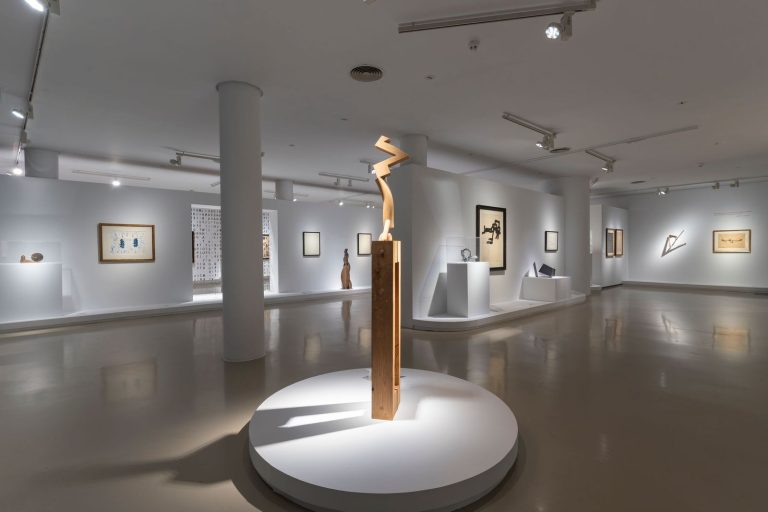
Lisbon (Portugal). In October 2023, the Belém Cultural Center celebrated the inauguration in its walls in its walls of its new museum of contemporary art called Mac / CCB, for Museum of Contemporary Art / Belém Cultural Center. This new museum must, however, compose with an inheritance that is both bulky and essential: the Berardo collection.
At its opening in 1992, the immense CCB built on the banks of the TAGE in front of the famous Hieronymit monastery first worked as a conference center and an institutional space for high-level meetings linked to the Portuguese Presidency of the Council of the European Union that year. It was after this institutional phase that he became a cultural center – the largest in Portugal – with shows, a conference center and an exhibition space. A sort of Humboldt forum in the recent Berlin castle, more Mediterranean.
In 2007, the businessman José Manuel Berardo (born in 1944), who made a fortune in the mines and in the bank, puts in the CCB his prestigious collection of modern and contemporary art while the exhibition space is renamed Museum of the Berardo collection. But in 2019, the Portuguese state entered its collection which served as a guarantee for bank loans in the amount of one billion dollars which he had not reimbursed. He was even briefly imprisoned for suspicion of fraud. In 2019, International mail Thus titled his article summarizing the Portuguese press: “Joe Berardo, the businessman riddled with debts who revolts Portugal”. While legal proceedings are still underway, the State decides to leave the 900 works in its collection at the CCB which then undertakes to create a real museum around this nucleus enriched with two other collections, that of the Holma / Ellipse investment fund acquired by the State, and that of the lawyer Teixeira de Freitas lent to Mac / CCB.
But the heart of the collection remains the Berardo collection. “It is a known name and an important asset for the new museum, explains Nuno Vassallo E Silva, the president of the CCB. The challenge is to keep this collection. »» If the State remains the owner of the collection after the legal proceedings, the Mac / CCB is likely to be a depositary because Lisbon is singularly lacking in a large public museum of contemporary art. The unhappy good “National Museum of Contemporary Art” is above all a Portuguese museum of art from the end of the 19th century to 1945. He appears pale in front of the wealthy Gulbenkian foundation which has just inaugurated its new art center today. But this one does not present a permanent whole of modern and contemporary international art.
By its building, its budget (€ 23 million per year, including € 10.5 million in grant) and its influence (125,000 spectators for theater and music and 590,000 visitors to the exhibitions), the CCB can grow the Mac. Especially since Nuno Vassalo e Silva has finally made a project a project that dates back to the origins of the CCB: building a hotel and commercial galleries in the extension of the building. This public/private partnership which is to be completed in 2030 will bring new resources to the center.
A recomposed narrative of 20th century art
Exposure. How to build a semi-permanent exhibition representative of modern and contemporary international art from three disparate sets? This is the mission that the Spaniard Nuria Enguita accepted which led the Tàpies Foundation for a long time in Barcelona and then the IVAM in Valence before resigning after allegations of conflict of interest. As soon as they arrived a year ago, she set out to tell the story of modern art and post-war revolution in another revolution to another revolution that which led to the end of the dictator in Portugal (1974) and then shortly after decolonization (Angola, Mozambique). Despite the promise – which has become a topos – to offer a disruptive rereading of art history and to highlight “artistic forms usually set aside”, the course unrolls the main traditional stages: from pop art cubism with some strengths linked to the collection such as surrealism and op art. But as it is necessary to fill the holes in his collection, in particular the absence of women artists, Nuria Enguita inserted in the middle of the course an exhibition devoted to that of Peggy Guggenheim in 1943 in the explicit title “31 women”. On the other hand, it has not yet reactivated the semi-permanent collection of contemporary art that rests-there too-a lot on the Berardo background. Despite its weaknesses, the whole is held and offers for the first time in Lisbon a panorama of 20th century art.