Opened in March 2024, then expanded and redeveloped last spring, the Museum of Viennese Actionism (WAM) will cease its exhibition activity on January 10, 2027. Its managers justify this decision by the controversies sparked by the retrospective devoted to Otto Muehl (1925-2013), a major figure of Viennese actionism, convicted in 1991 for sexual violence against minors. But the financial difficulties of this private museum could also explain this premature cessation.
The establishment will not disappear completely, however, but plans to transform into a foundation dedicated to research into Viennese actionism and the history of the Friedrichshof community, founded by Muehl. The future WAM Foundation will be headed by Klaus Albrecht Schröder, former general director of the Albertina, who took over as director of the museum in September 2025.
The collections and archives will continue to be the subject of scientific work, and the foundation plans to maintain a publishing activity by publishing works, as well as to develop an events component by organizing public meetings. Access to the venue will remain possible by appointment.
In September 2026, the WAM opened the exhibition “Art on the Verge”, dedicated to the different periods of Otto Muehl’s production. Hostile voices were raised in Austria, accusing the retrospective of serving a statement that was too complacent towards the artist, by highlighting his artistic importance to the detriment of the violence committed against the members of the community he led, deemed too discreet in the statement.
Otto Muehl (1925-2013) was sentenced in 1991 to seven years in prison, notably for sexual abuse of minors and abuse of authority within the community he led. Testimonies from former members of the Friedrichshof, a community of artists that he founded in Austrian Burgenland, speak of psychological violence and control. Muehl’s movement rejected private property and traditional couple relationships, in the wake of the hippie counterculture born in the United States in the 1960s. At its peak, it brought together several hundred people, including a considerable number of minors. Behind the ideals of collective life and liberation from social norms was a hierarchical organization dominated by Muehl. From the end of the 1980s, the community disintegrated, against a backdrop of denunciations of abuse. It was dissolved in the early 1990s, when legal proceedings were initiated against Otto Muehl.
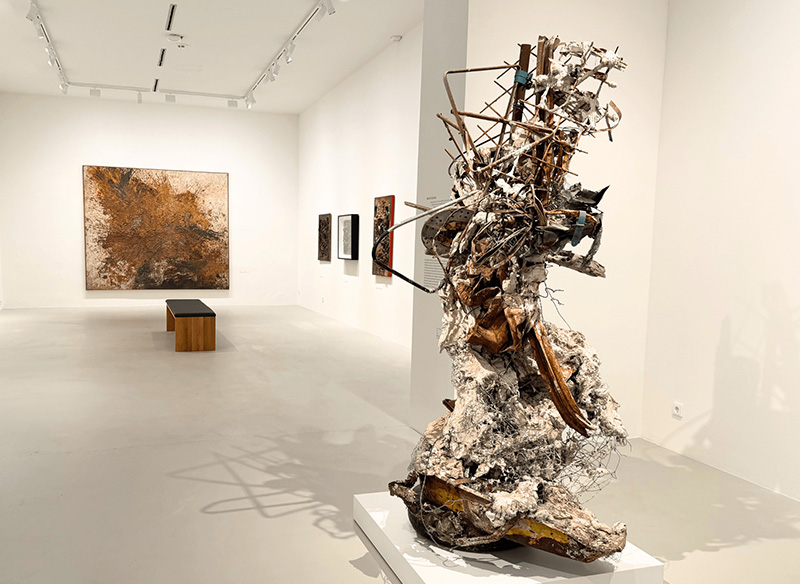
View of Otto Muehl’s exhibition, “Art at the Abyss,” at the Viennese Actionism Museum.
© Bildrecht, Vienna 2026
Faced with the protest, the leaders of the WAM defended the need to restore the importance of Muehl in the history of actionism. The impossibility of reconciling artistic recognition, scientific integrity required, and the moral condemnation of the artist, which the museum nevertheless considers “legitimate”, was thus put forward as the reason for the closure of the exhibition space.
An explanation that the Austrian daily Der Standard questions, bringing to light the significant economic difficulties of the establishment. The accounts of the operating company, WA-M Wiener Aktionismus Museum GmbH, show a loss recorded in the 2025 balance sheet of almost 2.7 million euros and negative equity of around 560,000 euros. According to Der Standardthe establishment however escapes the qualification of over-indebtedness within the meaning of Austrian law on collective procedures thanks to the valuation, to the tune of 5.3 million euros, of its inalienable collection of works produced between 1960 and 1971. Another part of the collections, valued at 10 million euros and including in particular some 13,000 drawings and paintings by Otto Muehl, belongs to WA-S Wiener Aktionismus Sammlung GmbH, the company that owns the operator, whose 2025 accounts show a balance sheet loss of 1.44 million euros.
Der Standard also puts forward the hypothesis that the museum’s investors could have counted on the gradual sale of Otto Muehl’s works held by the company that owns the museum (WA-S) to finance it. An economic model largely oriented towards the museum promotion of Muehl’s work.
Viennese Actionism is an avant-garde movement that emerged in the 1960s, aiming to break with traditional forms of painting and violently question the moral, religious and social norms of post-war Austria. It relies in particular on performance art used for provocative purposes, featuring extreme gestures. Otto Muehl, Günter Brus, Hermann Nitsch and Rudolf Schwarzkogler are the main figures. The Museum of Modern Art in Vienna (Mumok) maintains an important collection of Actionist works and houses a research center on the movement.