The Indian government has given the green light to the financing of the Yuge Yugeen Bharat Museum, which Narendra Modi aims to provide with the largest museum exhibition space in the world. On Wednesday, November 11, the Cabinet Committee on Economic Affairs, chaired by Prime Minister Narendra Modi, approved a budget of 32.3 billion rupees (or 320 million euros) for the development of the Yuge Yugeen Bharat Museum, after examination of the file by the Office of Public Investments last July.
With a planned exhibition area of around 100,000 m2 (the Louvre has 73,000 m²), the establishment should cover around 178,500 m2 in total, including reception areas and collection reserves. It plans to welcome up to 10 million visitors per year. Its implementation will be spread over four years, from 2027 to 2031, with a gradual opening. A first gallery, dedicated to adornment and ornaments), is due to open to the public in the North Block at the end of 2027. Following a public call for tenders launched by the Indian Ministry of Culture, Los Angeles-based architect Kulapat Yantrasast was entrusted with the development project.
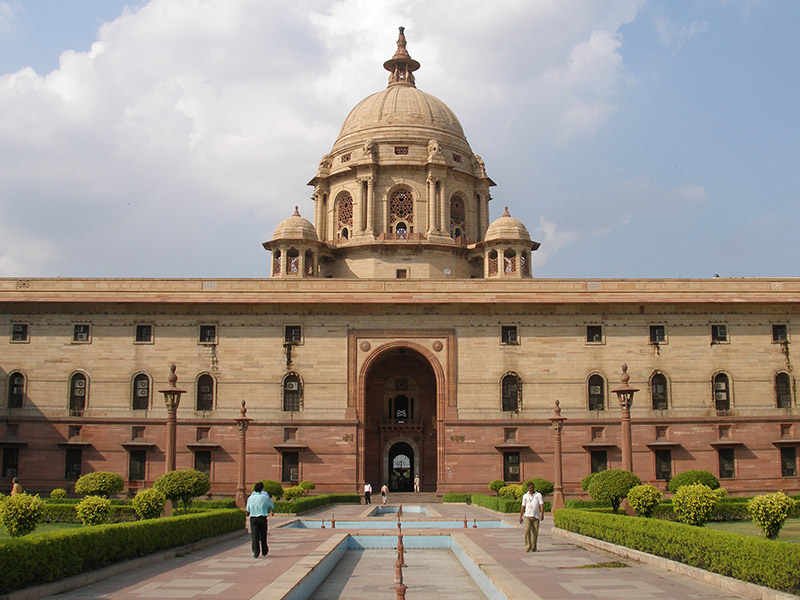
Announced in May 2023 by Narendra Modi, the project is part of the vast “Central Vista” urban redevelopment program. It provides for the reconversion of the two century-old buildings of the North Block and the South Block, built during British colonization, which housed several ministries, whose services have since been transferred to new premises.
The North and South block in New Delhi, which will host the Yuga Yugeen Bharat National Museum.
Designed as a global showcase of Indian heritage, the museum project intends to retrace several millennia of history of Indian civilization, through approximately 1.8 million objects, coming from various institutions in the country. 20 to 30% of the heritage preserved by the current National Museum of New Delhi should thus join the collections of the future Yuge Yugeen Bharat, as well as works and artifacts from other establishments of the Ministry of Culture, from 52 museums of archaeological sites, managed by the Archaeological Survey of India (ASI), but also from private collections.
The route should be spread over several galleries, which will notably address architecture and urban landscapes, mathematics and astronomy, languages and writings, faith and spirituality, as well as commercial and intellectual exchanges between India and the rest of the world.
France is associated with the project through the France Muséums Développement (FMD) agency, which was responsible for the Louvre Abu Dhabi project. A technical cooperation agreement was signed with the Indian National Museum on December 19, 2024, giving the French agency responsibilities for development strategy. Its missions concern the feasibility study, the definition of the museum model, the programming of spaces and the selection of project management.
The Yuge Yugeen Bharat Museum raises questions about how it will tell Indian history. Several historians and intellectuals fear that the establishment favors a Hindu nationalist reading of civilization, to the detriment of the diversity of the country’s religious and cultural heritage, particularly Muslim contributions. A vision aligned with the ideology of the Bharatiya Janata Party (BJP), the ruling Hindu nationalist party. In a survey published in March 2025, the independent Indian media The Wire noted in particular choices of vocabulary and periodization contested by academics.