Martigny (Switzerland). In May 1902, the German art historian and publisher Richard Muther commissioned a monograph on Auguste Rodin (1840-1917) from the Austro-Hungarian writer Rainer Maria Rilke (1875-1926). To carry out this task, Rilke moved to Paris with his wife, the sculptor Clara Westhoff, who studied at the Rodin Institute. The meeting between the two men is a friendly love at first sight, each recognizing themselves in the other. The book Auguste Rodin appeared in March 1903, but the relationship between the artist and the writer lasted until 1913, punctuated by reunions, epistolary exchanges, conferences given by Rilke on the sculptor, but also conflicts initiated by Rodin. The last, definitive, took place in 1913. After several reissues of his work, Rilke, who did not hold grudges, added to the 1919 version a note on the death of the artist, which occurred in 1917. He himself died in Valais.
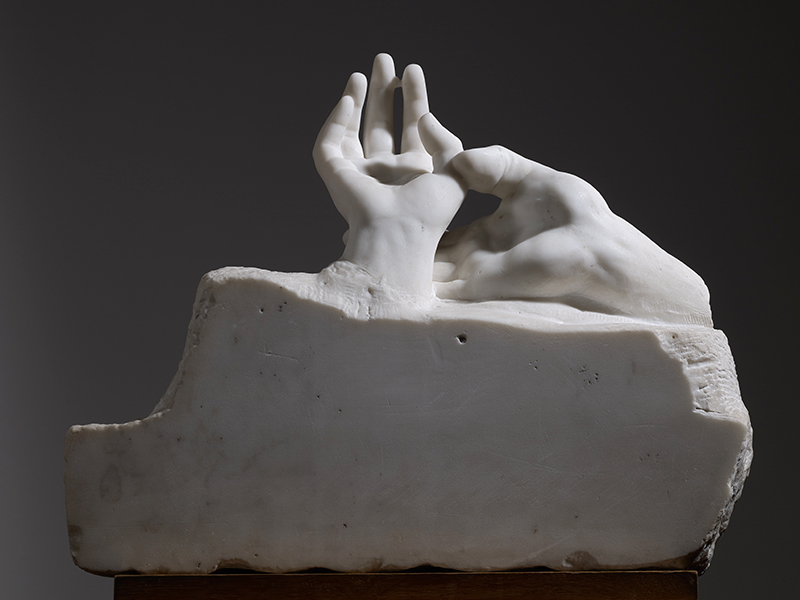
The centenary of his death is commemorated this year, notably on the occasion of this exhibition programmed by Léonard Gianadda before his death, and produced in collaboration with the Rodin museum. The exhibition presents works and documents (sculptures, drawings, photographs, letters and books) mainly from the museum, to which is added a bronze from the Gianadda Foundation, The Danaïde (1889, marble in 1890). Véronique Mattiussi, curator of the exhibition, composed the route based on what she calls “selected pieces”showing Rodin through Rilke.
Rilke’s illuminating writings
Of the wallpapers immerse the visitor in the atmosphere of the time, showing the two friends together: Rilke among the sculptures, the sculptures in the workshop – we know that Rodin used photography extensively to document his work. The works are accompanied by quotes from Rilke taken from his book, his poems or correspondence between the two artists. These writings were printed on transparencies, stuck on the dark background of the picture rails, which makes them illegible: the visitor must look at them on a set of photocopies that he can keep when leaving. Showing the admiration that the poet had for the sculptor and above all his deep, instinctive understanding of what the latter expressed through his art, they are a wonderful way to look at Rodin’s work with a new perspective.
Each section is built around a theme analyzed by Rilke. The Rodin Museum has chosen to send mainly plasters, such as that of Monumental thinker. The visitor’s experience is thus closer to that of the writer, since it was mainly these intermediate works that he saw in the workshop. The Thinker is also present twice in the route, in its monumental form, the cast of which was presented to the public in 1904, and in its original form, that of the Poet (1880). This 71 centimeter high figure which appears in The Gates of Hell shows a man “sitting, lost in thought and mute, heavy with images and ideas”. Rilke recognizes in him his double, a tormented poet possessing “the strength of someone who acts”and whose inner depth he reveals to us.