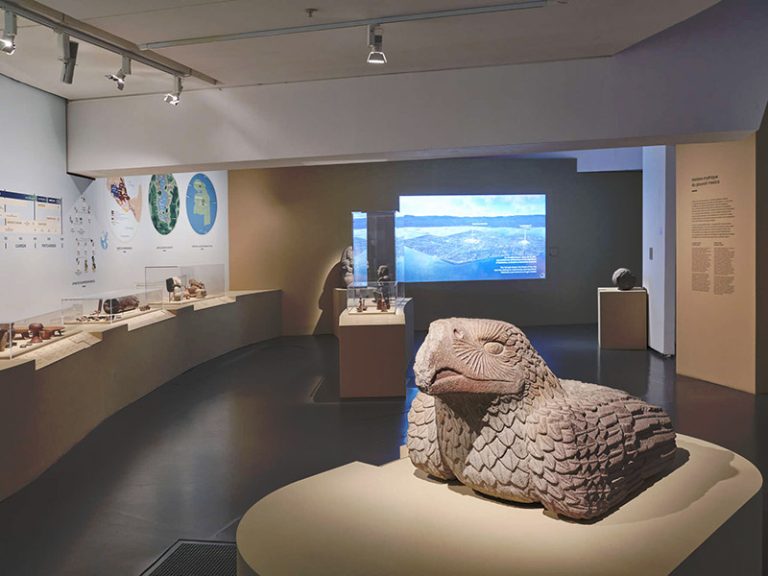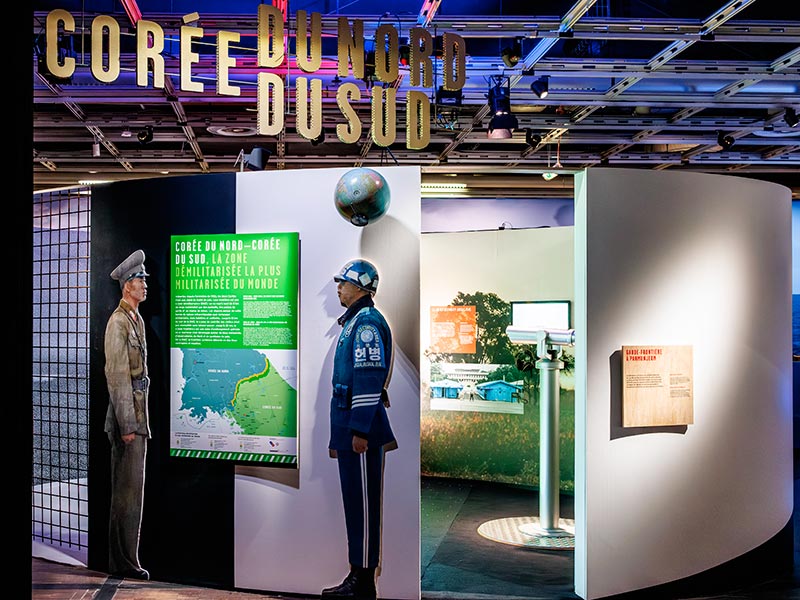
Paris. For most young Europeans, the notion of “border” remains vague, even though Europe has experienced numerous changes in borders between the countries that make it up, as shown by a digital table presented in the exhibition at the Cité des sciences et de l’industrie. The commissioners and the scientific committee retained several current frontiers and three transversal themes: “cyberspace”, “maritime limits” and “strange frontiers”, each being explored using specific devices. For the Venezuela-Mexico border, a table equipped with screens is surrounded by bar chairs and Mexican carpets, the one between Georgia and Russia is embodied in a small theater of objects accompanied by sound and light, and the section focused on cyberspace has metallic gray tones, with several screens and digital tables. “We wanted to space out the borders, give them volume,” explains Maud Gouy, co-curator of the exhibition. The themes were chosen according to the specialties of the geographers of the scientific council, because the exhibition aims to “valorize the field work of geographers”specifies Sylvie Retailleau, president of Universcience: several geographers are cited in the exhibition, such as Valérie Gelézeau whose work on the border of the two Koreas serves as material for the section devoted to “the most militarized demilitarized zone in the world”according to the expression used in the room texts.
The human element, often erased in political discourse on borders, is very present here: from the different categories of travelers between Venezuela and Mexico to the migrants who died in the Mediterranean, including gold miners in the Algerian Sahara, “the exhibition shows the thickness of borders and the humans who live there”, underlines Maud Gouy. Visitors can see a list of names of people who died at the borders, and click on the map of the main migration routes: unsurprisingly, the Mediterranean Sea has appeared like a huge cemetery since 2013.
Section devoted to the border between Colombia and Venezuela in the “Frontier” exhibition at the Cité des Sciences.
© A. Robin / EPPDCSI
Interactive devices
Concerning Europe, visitors are invited to answer questions in the style of game shows: one visitor asks the questions and two others respond by tapping a bell. On the day of our visit, this game was a great success with high school students who were very interested in the subject – the sound level of the exhibition, already quite high, was affected. “All these devices were created in-house by the museographer teams, with consideration given to ergonomics,” specifies Maud Gouy.
The route also includes works of art, a more poetic look at borders, like the diorama boxes of the duo Les Chevreaux Suprématistes on “strange borders” (the island of Pheasants on the Franco-Spanish border, the French borders lost in the jungle of Guyana, Antarctica). Certain sections devoid of devices to use remain no less interesting: the one on the “sand border” between Algeria and Niger broadcasts on three screens a fascinating documentary, in a setting of ocher sand which resonates with the theme addressed.