
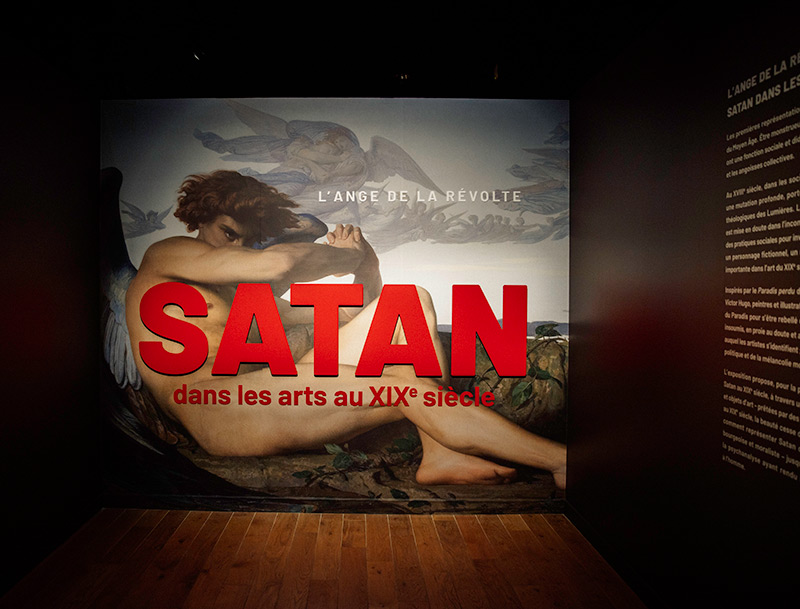
Cherbourg (Manche). Discovering the interest aroused Satan (1833), a sculpture by Jean-Jacques Feuchère preserved at the Thomas-Henry Museum, Louise Hallet and Paul Guermond decided to work on the devil in 19th century art. This exhibition labeled “of national interest” explores a paradigm shift because, “at the end of the 18th centurye century, explains Louise Hallet, the devil goes from religious figure to literary and artistic figure. A devil who is beautiful. »
An introductory room shows works from the 12th to the 18th century where he appears either as a bestial monster or as a fallen angel. If The Fall of the Rebel Angels (between 1672 and 1683) by Charles Le Brun, dates from the end of the 17th century, the subject of the beautiful angels expelled from Paradise coexisted from the Middle Ages with that of the terrifying Satan. It is a shame that the mediation does not specify that, in the Old Testament, Lucifer, literally “bearer of light”, is described as a being of great beauty, while in the New Testament the Apocalypse of John makes him a monster: it is his banishment to hell, in the company of the angels he has perverted, which transforms him into the vile Satan. However, this ontological ambivalence of the devil allowed his face to change in the 19th century.
View of the exhibition “The Angel of Revolt. Satan in the arts in the 19th century” at the Thomas-Henry Museum.
© City of Cherbourg
The Englishman John Milton, in his poem Paradise Lost (1667), is the first to depict a Promethean Satan having retained the beauty of Lucifer. However, the route first presents Mephistopheles, avatar of Satan who appeared alongside Doctor Faustus in German literature in 1587, taken up by the English playwright Christopher Marlowe in 1616, then by the German poet Wolfgang von Goethe in 1808. If his predecessors had made Mephisto a monstrous devil, Goethe describes him as elegant and cynical, a character entirely attractive for the romantic artists who discovered him in the translation French by Albert Stapfer, in 1823. Eugène Delacroix’s lithographs for the 1828 reissue show him as a “Gothic tempter”, according to the title of the room where they hang.
The other figure of the beautiful Satan is that of Milton interpreted successively by Thomas Lawrence (preparatory drawing for Satan summoning his legionscirca 1796-1797), George Frederic Watts (Satan1847-1848), Gustave Doré in 1866 or Alexandre Cabanel whose The Fallen Angel (1847) is the highlight of the exhibition. The End of Satan (Hetzel, 1886), an unfinished poem written by Victor Hugo from 1854, was illustrated by Georges Antoine Rochegrosse (1887) and also Jean-Paul Laurens (around 1888) in the same vein of the beautiful and tragic devil while Émile Bernard shows him desperate in 1935, a path in which Odilon Redon had preceded him with his various representations of terribly human fallen angels of the years 1870.
The journey ends with the internalized demon, in the possessed women of Félicien Rops (The Satanics1882) or by Jesus, solitary and prostrate in the poignant The Temptation in the Wilderness (1898) by Briton Rivière, a gem from the United Kingdom. Because Satan is beautiful even when we no longer see him.


