Paris. Funny life than that of Hilma af Klint (1862-1944). For a long time, she continued a regular production of landscapes in the post-impressionist style and portraits. Alongside her academic career – in Sweden, it was possible to attend an art school already in the 19th century – she turned to esoteric sciences and practiced automatic writing and drawing under hypnosis.
It is established that the principle of sacred geometry, which often embodies divinity, is exploited by numerous artists, such as Sérusier (1864-1927) or Mondrian (1872-1944), then a member of the Theosophical Society. Like Mondrian, Hilma in turn became a follower of theosophical doctrine in 1904. Around her was created “De Fem” (The Five, 1896), a group of initiates determined to find adequate forms to represent the invisible. They all consider themselves as a man and a woman at the same time, live frugally and do not sign their works. It is no coincidence that these artists are women: at the end of the 19th century, women played a central role in the spiritualist movement, which they often led and led, a movement sometimes associated with the crusade for the right to vote.
Hilma af Klint (1862-1944), The Ten Greatest, No. 4 (Youth)1907, tempera on paper laid on canvas, 315 × 234 cm.
© Hilma af Klint Foundation / photo The Moderna Museet, Stockholm
Form in the service of the sacred
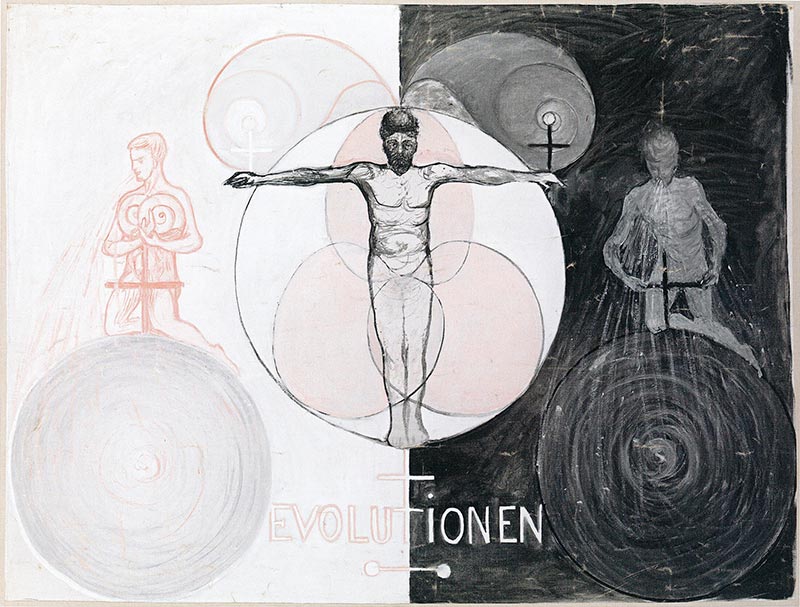
Hilma, for her part, develops work composed of flat areas with clear contours and great chromatic richness. Sometimes, as in the magnificent Evolution series, elements still remain figurative. Gradually, the images stylized with extreme refinement are transformed into geometric abstractions of strong chromatic intensity. But, gradually, Hilma feels invested with the mission of building a temple and begins to work in a style close to biomorphism, where geometry replaces any representation of reality. Art, at the service of mystical thought, is above all a gateway to an inaccessible world. His declarations, guided by the spirits of the “Great Masters”, and his efforts to build a universal temple, are characteristic of this. She also met Rudolf Steiner (1861-1925) and integrated anthroposophy into her spiritualism.
Hilma worked for a long time on a grand narrative of the transformation of the human condition: The Ten Greatest (October 2-December 7, 1908) (see ill.). These are paintings more than three meters high, in pastel colors – yellow, blue, pink – which represent the different ages of life. However, these works remained confidential, because Hilma had requested in her will that they remain safe for twenty years after her death in 1944. In reality, the work remained hidden until 1986, the date of the major exhibition in Los Angeles, “The Spiritual in Art, Abstract Painting 1890-1985”, where the relationships between the spiritual and abstraction were studied.
Seductive with its decorative aspect – a term which acquired its letters of nobility thanks to Matisse – the work undoubtedly deserves to bring Hilma af Klint into the prestigious circle of pioneers of abstraction. With one difference: where Mondrian or Malevich (1879-1935) used mystical thought to justify the disappearance of the subject, everything suggests that with the Swedish artist, the pictorial, didactic gesture is above all in the service of the sacred – the visible in the service of the visionary.
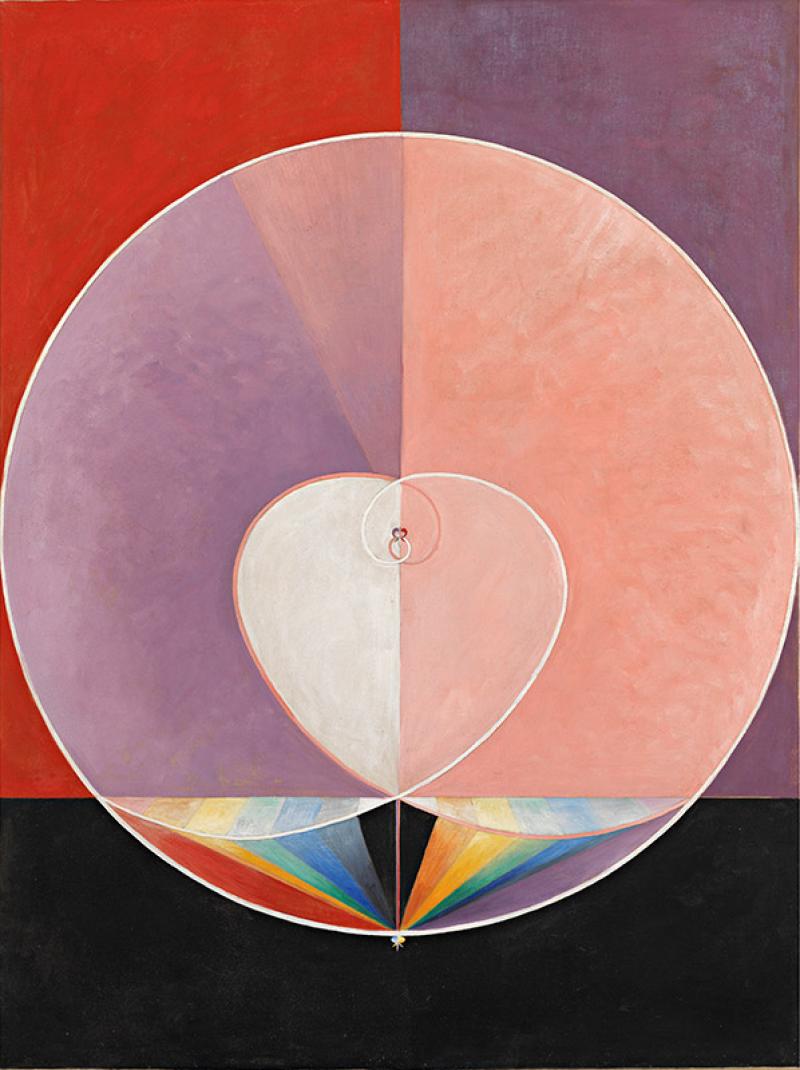
Hilma af Klint (1862-1944), Dove, No. 21915, oil on canvas, 155.5 × 115 cm.
© Hilma af Klint Foundation / photo The Moderna Museet, Stockholm