
In 2022, fifty years will have passed since the Navarrese capital hosted, between June and July 1972, the Pamplona Meetings, an artistic festival whose development brought many surprises and had international repercussions. Expanding its activities to different settings in the city and encompassing various forms of expression, interrelation and play, that event reviewed the experimental practices carried out in Spain in the sixties, at a time when many of them were beginning to decline, and allowed us to contemplate works carried out in different media (painting, sculpture, poetry, film or music) that affected the contradictions existing then between “official” avant-garde art and conceptual paths that went beyond pop, abstraction or social realism.
Financed by the Huarte group and organized by the Alea collective, made up of the composer Luis de Pablo and the artist José Luis Alexanco, the Meetings would be compared in their magnitude with Documenta V and included proposals by Zaj, Valcárcel Medina, Nacho Criado, Navarro Baldeweg, Francesc Torres or Antoni Muntadas, along with works linked to experimental cinema, manifestations of cybernetic art, poems by Spanish or foreign authors, creative music and videos, like those who were part of the cycle This is your roofmade by Willoughby Sharp, the aforementioned Muntadas and Dennis Oppenheim.
There were a total of 350 participating creators under the coordination of Ignacio Gómez de Liaño, a hundred of them Spanish, and among their most popular works were the pneumatic domes of Prada Poole, a symbolic space for meeting and artistic action; Lugán’s random telephones, a metaphor for communication and lack of communication; or presentations of concrete and electroacoustic music, because the coexistence of the senses and the fusion of tradition and the avant-garde were promoted.
In short, that event became a turning point in the artistic development in Spain in the last years of the Franco regime and also meant, as many pointed out, a symbolic end to the dominance of informalist painting and abstraction, then assumed by the official cultural policy.
Since that anniversary, the Navarrese Government and the Baluarte Foundation, with the support of the “la Caixa” Foundation and the collaboration of the Pamplona City Council, have been resuming the celebration of these Meetings as a biennial, curated and directed by the essayist and poet Ramón Andrés and subdirected by the journalist and researcher Berta Ares.
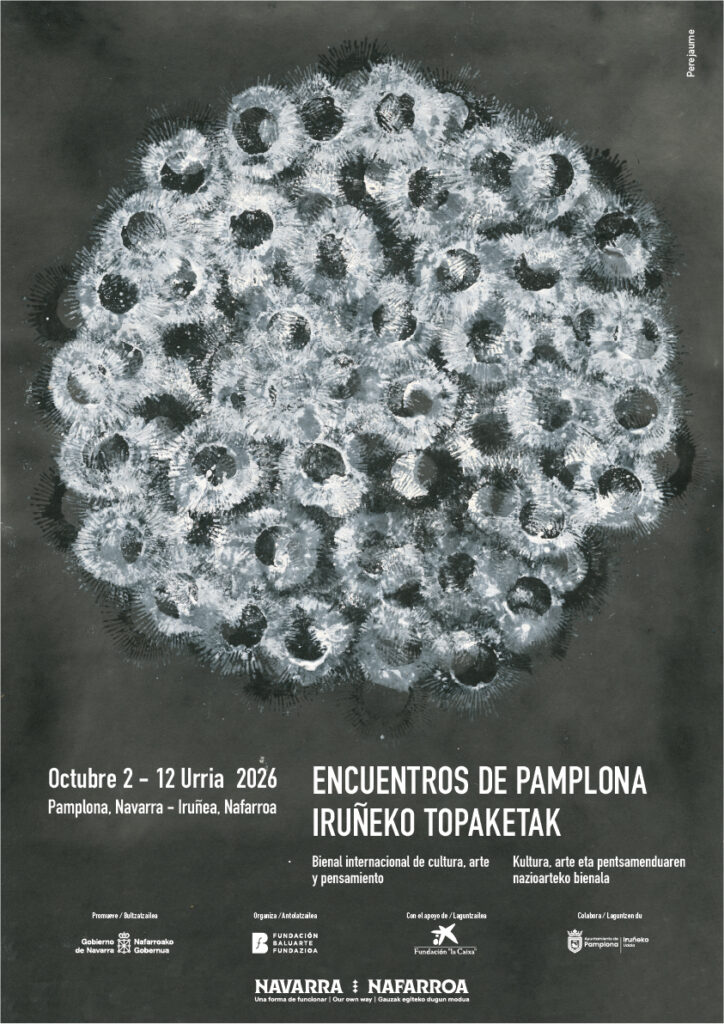
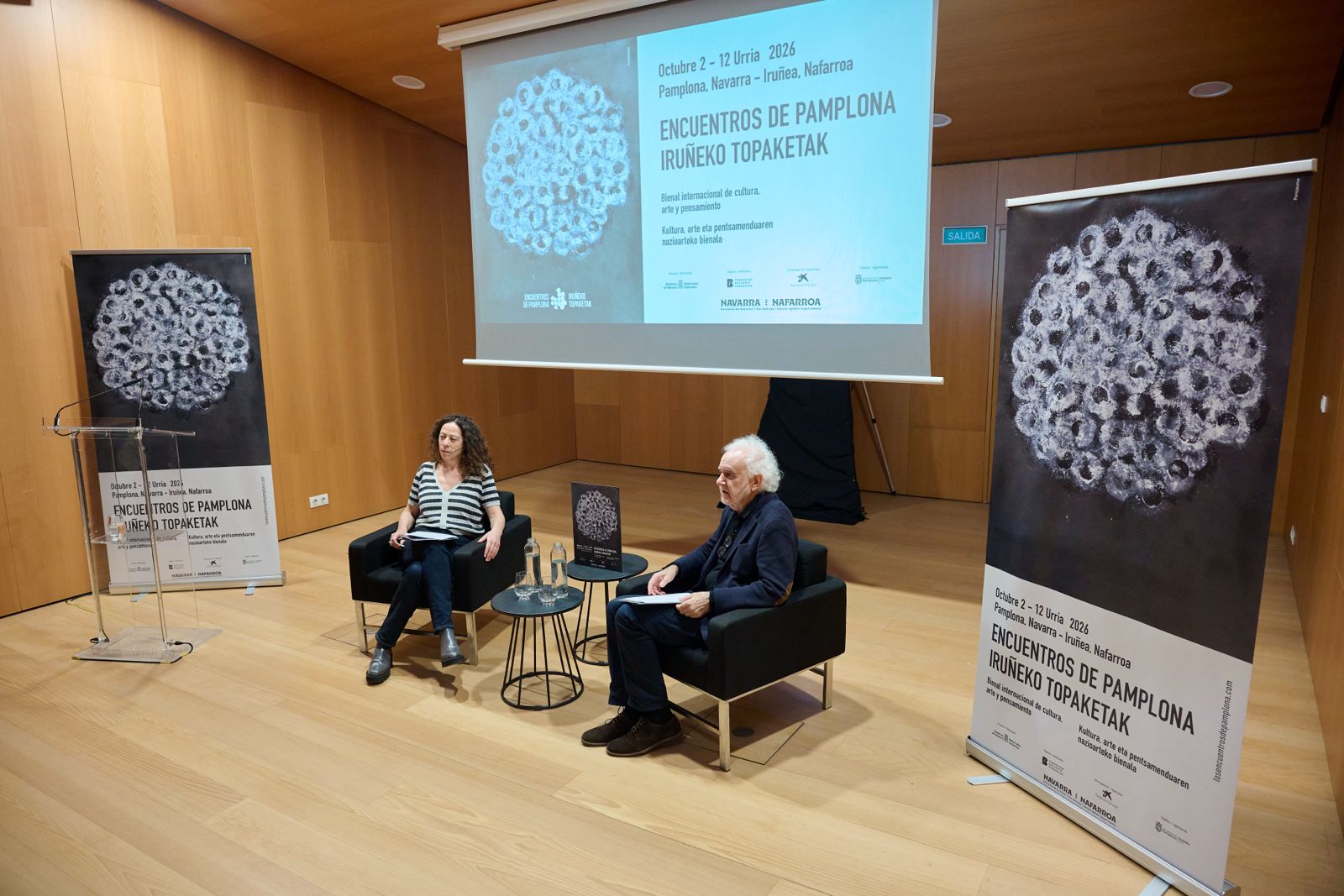
Its next edition will take place from October 2 to 12 and will seek to appeal, according to those responsible, to the capacity for dialogue and wonder that culture still possesses. In Pamplona we will be able to attend numerous scenic and artistic activities, dialogues, conferences, musical proposals, sound walks or workshops designed, according to Ramón Andrés, to reposition human beings in the face of the technological empire and to propose new forms of coexistence that consolidate the sense of community.
FROM MYSTICISM TO NIHILISM, FROM EMPIRE TO COMMUNITY
This third edition of the new Pamplona Meetings will be structured around eleven itineraries and will begin with an intervention by the medievalists Victoria Cirlot and Blanca Garí, who will talk about the works and thoughts of two precursors of feminism: the mystics Hildegarda de Bingen and Margarita Porete; The final touch will be given by another historian, fellow activist Irina Scherbakowa, currently at the head of Memorial, an organization founded by Sakharov and awarded a Nobel Peace Prize for her activism in matters of memory and civil rights in the Russian context. After it we will listen to a piece by the composer Carlos de Castellarnau based on OilPasolini’s posthumous novel.
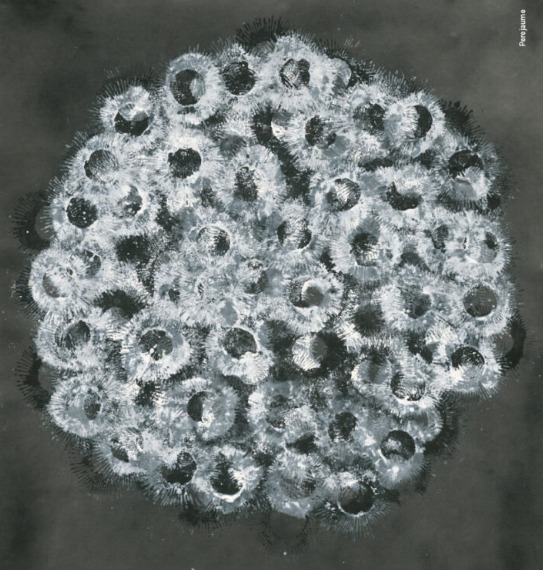
Three artistic installations await us in the Citadel grounds: Web by Mona Hatoum (Oven building) and Fountain nº3 by Susana Solano (Sala de Armas), on loan from the “la Caixa” Foundation Contemporary Art Collection; and Is the museum a battlefield? by Hito Steyerl (Polvorín building), on loan from the Reina Sofía Museum. Perejaume, invited to create the poster for this edition, will also carry out an intervention in the lobby of the Baluarte building, in addition to the installation of a piece in the Museum of Navarra; All four will be present in Pamplona and will participate in the dialogues of the Meetings.
Paths of another waythe itinerary that inaugurates the Biennial with the dialogue around the mystical authors already mentioned, will also feature the participation of the philosopher Chiara Bottici, who will delve into the power of narration within the construction of the gender condition, and the philosopher and dancer Marie Bardet, who will interweave different knowledge from the field of philosophy, social sciences and feminist thought, associating them with the body and gestures.
The itinerary dedicated to artificial intelligence, one of the great challenges of our time, will be organized around two activities: a dialogue between the scientist Juan Ignacio Cirac, an expert in quantum computing and optics, and the philosopher Daniel Innerarity, and an interview with Yuk Hui, a thinker who will elucidate the possibilities of creating a new humanism capable of overcoming the opposition between the human and the technological.
Another itinerary, focused on imperialism, will feature the voices of the historian of fascism Emilio Gentile; political scientist Natascha Strobl, analyst of the resurgence of the extreme right; and that of the aforementioned Irina Scherbakowa.
And another one will be dedicated to reflection on democracy and nihilism. We will be able to listen to Ray Brassier, analyst of this phenomenon in contemporary society; Barbara Stiegler, well versed in Nietzsche’s work; and the Arendtian philologist and philosopher Barbara Cassin. This itinerary is completed with an event around democracy and theater that will be joined by playwright Victoria Szpunberg, National Prize for Dramatic Literature 2025 and Max Prize for theatrical authorship this year.
Some more of the proposed itineraries, Why have we built ourselves like this?will feature the participation of philosophers Thomas Macho and Víctor Gómez Pin, thinkers of philosophy and science, while the professor of History of Science at Stanford University, Robert N. Proctor, will give a conference on the construction of ignorance and the perverse strategies of power. Another route of the Meetings will be How much of the world do we have left?in which a conference by physicist Sonia Contera and a dialogue between biodiversity conservators María Sánchez and Luis Arranz will take place.
CARTARESCU, ERICE OR MARÍA NEGRONI IN PAMPLONA
On the other hand, three essential itineraries in each biennial are those dedicated to literature, cinema and music. The first will this year feature the presence of writers such as Mircea Cărtărescu, Adanía Shibli or Marion Poschmann and poets such as María Negroni, Fermín Herrero, Antoni Clapés, Miren Agur Meabe and Aitana Monzón.
Víctor Erice and José Luis Guerin will attend the section dedicated to cinema in dialogue, and the German filmmaker Angela Schanelec; Likewise, there will be film screenings and a workshop taught by filmmaker Mercedes Álvarez.
In the musical field, the itinerary The voices that we were It will invite us to think about voice from an anthropological approach, and will address how it has developed over time. There will also be musicologist Björn Schmelzer, who will conduct a concert with the Graindelavoix ensemble, dedicated to the historical interpretation of polyphony from the 15th and 16th centuries.
This cycle is completed by a vocal experimentation performance by Isabelle Duthoit, sound walks offered by Beñat Achiary and Xabier Erkizia and a workshop by soprano Raquel Andueza. Another stellar musical activity will be the concert by Alim Qasimov (Teatro Gayarre), an artist from Azerbaijan whose voice has been declared a UNESCO heritage site.
Finally, once again, the Pamplona Meetings will give us the opportunity to learn up close the work of composers of contemporary classical music; This will be the case of Unsuk Chin, who will dialogue with Ramon Lazkano, or Beat Furrer and Mauricio Sotelo. This musical itinerary will be complemented with naturala proposal by the Navarrese violist Isabel Villanueva together with Conrado Moya (marimba) and Héctor Varela (electronics).
Performing arts and dance will complete the program: Baluarte’s main auditorium will host aSHthe dance of the Indian dancer Shantala Shivalingappa, and the performance of TAO Dance Theater, a company from China whose choreographies are linked to social concerns.
For its part, the Gayarre Theater will host rare earthsfrom the company La Phármaco, directed by Luz Arcas (2024 National Dance Award), with a plot around the fight for geopolitical control, natural disasters and technological progress. The performing arts will also take over the public space with the spiritual liturgy of the Voladores de Papantla, which evokes one of the most attractive rituals of the ancient Mesoamerican peoples.
Likewise, the Kamchàtka theater company will develop its creation in a “surprising” way Fugit (Max Award for the best street show 2025), in the Rochapea neighborhood. It addresses flight as a fight and a form of resistance.
MEETINGS ARE OPEN TO ARTISTS AND STUDENTS
As on previous occasions, artists can also participate in this event through the call Artistic memory of the Meetings. Spanish authors or authors residing in Spain are offered the option of creating newly created works inspired by the ideas and themes developed in the dialogues, conferences and activities of the program, establishing an endowment of 90,000 euros to be distributed among six selected proposals.
Another of the important projects of the Meetings is the one that takes place during the year in rural schools and high schools in various Navarrese towns. For several months, students, teachers and artists carry out projects of experimentation, reflection and crossing of artistic disciplines whose fruits can be seen in an exhibition at the Palacio del Condestable, where family workshops will also be held.
If you want to attend, note: invitations for the set of free activities, which will be the majority, will be available from September 7. Up to two per person can be withdrawn, online or in person at the Baluarte ticket offices.
As for paid tickets to the stage shows, they can be purchased now, with special prices to guarantee maximum accessibility, on the website www.losencuentrosdepamplona.com and at the venues where the events are held.
All the information can be consulted on that same portal: www.losencuentrosdepamplona.com


