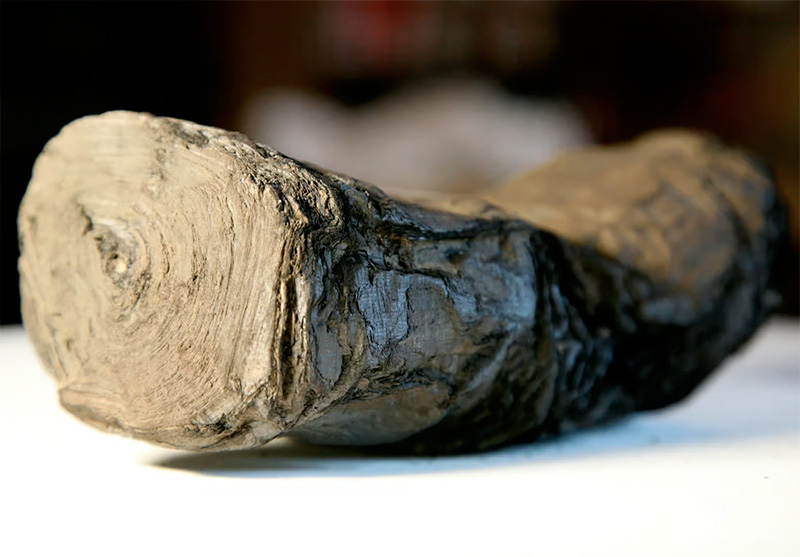
A team of researchers from the University of Kentucky managed to read a charred papyrus buried by the eruption of Mount Vesuvius two thousand years ago, using advanced technologies. This is the first time that the preserved part of a Herculaneum scroll has been translated in full, marking the biggest breakthrough in the Vesuvius Challenge competition, created in 2023.
Led by Brent Seales, a doctor in computer science at the University of Kentucky and one of the founders of the Vesuvius Challenge, the team was able to transcribe the contents of the document using phase-contrast X-ray microtomography, then geometric reconstruction, virtual flattening and detection of the ink by machine learning, its precarious state not allowing it to be physically unrolled. Involved in the deciphering of the Herculaneum papyri for around twenty years, researchers have been working specifically on the “PHerc 1667” papyrus since 2023. Not only is the accomplishment decisive, but the method adopted can be used to decipher other papyri among the 1,800 fragments of scrolls from the Villa of the Papyri in Herculaneum.
If the researchers have completed the deciphering process, it only concerns a fragment of the original document, the majority of which disappeared in the eruption of Vesuvius in 79. Its external layers were considerably damaged by the successive manipulations of historians between 1800 and 1980. Hypotheses on the nature of its content could nevertheless be formulated. The themes covered, such as human nature, instinct or the moral progress of men, have led researchers to identify it as a “treatise on human nature”.
The mention of Aristocreon, the nephew and disciple of the philosopher Chrysippus identified among the authors of the Herculaneum papyri, suggests that it is a Stoic text. However, as reported by Alessia Lavorante, member of the American research team, we must proceed with caution, because the object belongs to a group linked to a predominantly Epicurean tradition. If the authentication of the author remains at the hypothesis stage, academics have managed to date the document between the 3rd and 2nd centuries BCE, making it one of the oldest papyri in the Villa. A discovery which allows us to rule out the attribution to Philodemus of Gadara, the main author of the Herculaneum papyri.
For the moment, the Vesuvius Challenge, a competition combining the tools of “machine learning”, computer vision and geometry with the objective of deciphering the carbonized scrolls of Herculaneum, has paid 1.8 million dollars (around 1.6 million euros) to the various participants who have declared discoveries. But until now, no advances of this magnitude had been reported: only words or papyrus passages had been deciphered. According to Brent Seales, “The Vesuvius Challenge technical team has significantly improved the software since the 2024 Vesuvius Challenge Grand Prix”a year when we could only read sequences of letters invisible to the human eye. This progress accompanies parallel advances on the “PHerc. Paris 4”, and “PHerc.139”, attributed to Philodemus of Gadara and titled by the researchers On Gods, Book 8.
Discovered in 1750 during archaeological excavations in Herculaneum, the Villa of the Papyrus had been buried by the eruption of Vesuvius in 79. It would have belonged to Piso, father-in-law of Julius Caesar and protector of the philosopher Philodemus of Gadara, an interpretation which is the subject of debate. Its library includes emblematic texts of Greek philosophy, such as extracts from From rerum natura of Lucretius and texts of Epicurus. The National Library of Naples and the Institut de France in Paris preserve the majority of papyrus scrolls. A group of sculptures, 1st century Roman copies of Greek models from the classical and Hellenistic periods, were also found there, including the famous bust of the Pseudo-Seneca from Naples.