Helvetia returns… but keeps the works. Eleven works preserved at the Rietberg Museum, including a bronze commemorative head from the 19th century and a sculpted ivory tusk from the 18th century from the Kingdom of Benin no longer “belong” to the City of Zurich, but to the Federal Republic of Nigeria. Two of them will soon head to Benin City, the former capital of the Kingdom of Benin. The other nine will remain in Switzerland, on long-term loan.
At the same time, the University of Zurich agreed to transfer to Nigeria the ownership of fourteen objects from Benin preserved in its Ethnographic Museum. The one in Geneva disposed of three pieces from the same provenance. In total, twenty-eight Nigerian artifacts change owners. However, some of them will not change latitude immediately.
The Benin Switzerland Initiative, launched in 2021 and coordinated by the Rietberg Museum, has identified around a hundred objects from the former kingdom of Benin in eight Swiss museums, at least fifty of which are linked to the pillaging of Benin City by British troops in 1897. Some entered public collections from 1899, others until 2022, via the international art market.
The impetus does not come from Berne but from the museums themselves. The Benin Switzerland Initiative, partly funded by the Federal Office of Culture, favored a slow, almost diplomatic method: inventory shared with the National Commission for Museums and Monuments (NCMM) of Nigeria, cross-travels, forums and a joint declaration signed in Zurich in 2023.
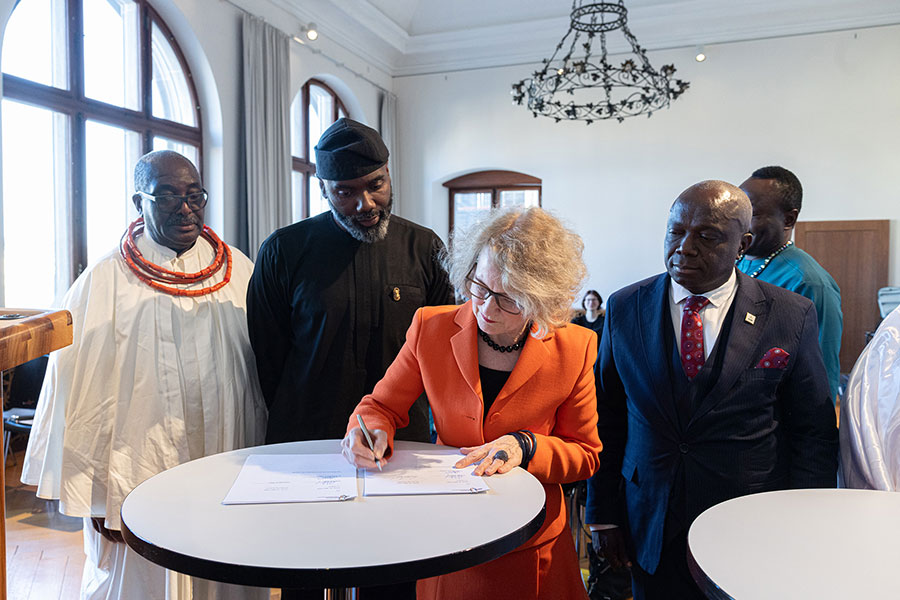
Nigerian demands for restitution came next, in a very formal manner. In March 2024 for the objects from the University of Zurich, in July 2024 for those from the Rietberg Museum, in May 2025 for the Geneva pieces. The ceremony of March 20, 2026 ratifies the transfer of ownership of the twenty-eight artifacts, presented as the continuation of a dialogue initiated several years earlier.
This chronology says a lot about the “Swiss way”. There is no major framework law on colonial restitutions, but federal guidelines on provenance, targeted funding, then decisions taken on a case-by-case basis by cities and universities. This year, an independent commission responsible for “historically problematic art” takes office. Competent for property plundered by the Nazis as well as for objects acquired in a colonial context, it does not have any binding power. It must offer fair and equitable solutions.