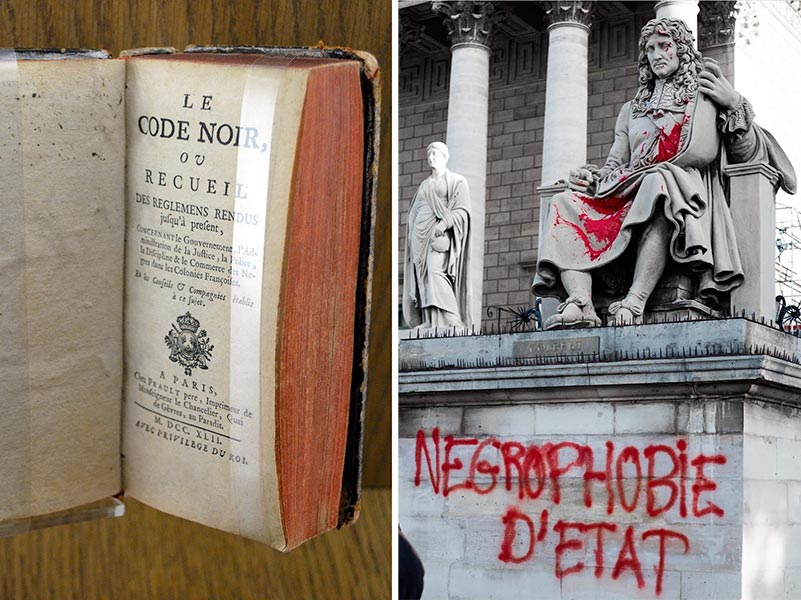
Paris. For several years, many activists have used art to denounce the inaction of the French state in the face of climate change or to fight against racism. Faced with the resulting degradation of cultural property, freedom of expression is increasingly demanded by activists. A ruling from the Court of Cassation of January 14, 2026 has just clarified the control that must be carried out by judges in order to reconcile these two imperatives. At the heart of this dispute is the act of vandalism by Guadeloupean Franco Lollia on the statue of Jean-Baptiste Colbert located in front of the Palais-Bourbon. On June 23, 2020, the activist tagged “State negrophobia” in red on the base of the statue of the minister of Louis XIV before spraying it with paint. For Lollia, it was about fighting against state racism since Colbert was the initiator of the Code Noir which favored slavery in the French colonies.
On June 28, 2021, the activist was sentenced by the Paris criminal court on the basis of article 322-1 of the penal code which sanctions the “destruction, damage or deterioration of property belonging to another” and provides for a penalty of 30,000 euros fine, reduced to 3,750 euros when none “resulted only in slight damage”. Lollia’s suspended fine of 500 euros was confirmed by the Paris Court of Appeal on May 5, 2025, but the tagger appealed to the Court of Cassation. According to him, the criminal conviction would constitute a disproportionate attack on his freedom of expression guaranteed by Article 10 of the Convention for the Protection of Human Rights and Fundamental Freedoms.
“Debate of general interest”
For several years, the Court of Cassation has considered that “the criminalization of conduct constituting a criminal offense may, in certain circumstances, constitute a disproportionate interference in the exercise of freedom of expression, taking into account the nature and context of the conduct in question”. Originally confined to press offenses, this neutralizing effect has imposed itself on common law offenses, such as the sexual exhibition of a member of Femen at the Grévin Museum (Cour of Cassation, Feb. 26, 2020) or the removal of portraits of Emmanuel Macron (Cour of Cassation, Sept. 22, 2021). The notion of “debate of general interest”, mobilized to justify the primacy of freedom over other rights or antagonistic interests, is therefore at the center of the discussions.
In this case, the appeal judges recognized that Lollia’s act was part of a debate of general interest: that of the slave trade and slavery. However, they considered that registration did not allow “for the uninformed citizen to understand that the reference to what Colbert embodies for the Afro-descendant community, in the absence of banners or other demands formulated concomitantly which would have made it possible to explain the action”. The magistrates therefore concluded that, “given the absence of an obvious link between the subject of general interest on which Mr. Franco Lollia wished to alert public opinion and his action, the criminalization of his actions does not constitute a disproportionate interference in the exercise of freedom of expression, even if these actions are part of political and militant action.” This vision has just been overturned by the Court of Cassation.
“Disproportionate interference”
For these latter judges, the Paris Court of Appeal had not properly assessed the necessity of the criminal conviction in the present case. Worse, it had reversed the burden of proof by requiring the activist to demonstrate the necessary nature of his action in relation to other symbolic expressions such as debunking. Also, “the effect given to industrial action (from the activist) has no impact on the assessment of whether a criminal prosecution may constitute a disproportionate interference in the exercise of freedom of expression on a subject of general interest.. The cassation is therefore pronounced and the case will have to be retried. This judgment is in line with European case law (“Sinkova” judgments of February 27, 2018, or “Bouton” of October 13, 2022) and could lead to the activist’s release in the name of freedom of expression.
The Court of Cassation does not validate the damage but recalls that recourse to criminal law must remain exceptional when the expression targets a political, historical or societal subject. However, such a vision poses a question regarding the protection of cultural heritage since it seems to give a premium to degradation under the cover of a debate of general interest. The risk is therefore to encourage activists to resort to shocking or radical protest expressions about cultural property.