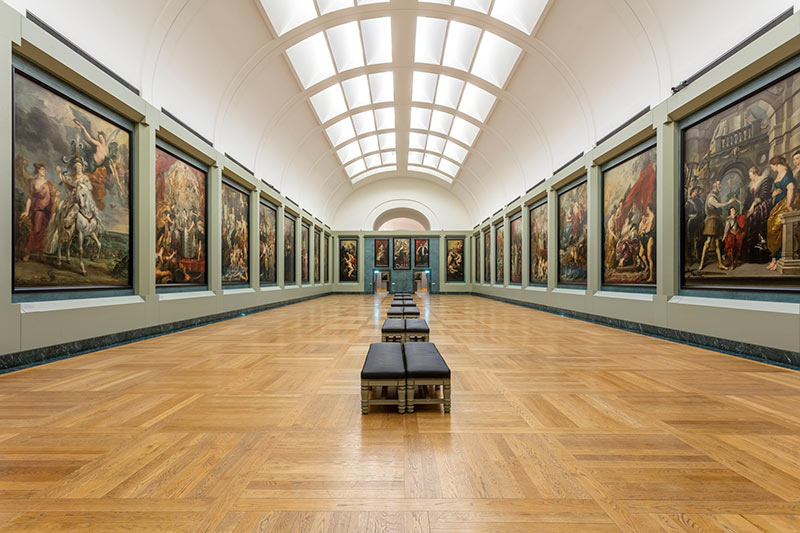
Paris. “The skies should be blue, they are greenish. The reds are completely extinct »lists Sébastien Allard while contemplating the great cycle of Marie de Medici. “ A betrayal of the very essence of Rubens’ painting”which the curator, at the head of the paintings department of the Louvre, intends to remedy. The operation promises to be extraordinary: 24 monumental paintings to be restored, representing more than 290 m² of pictorial surface. In terms of large-scale restoration, the museum is not sure it is its first attempt, as evidenced by those of the Wedding at Cana by Veronese or more recently large formats by Delacroix. But for Sébastien Allard, the observation is unambiguous: “The paintings department has, until now, never launched a restoration of this magnitude. »
Although it will take four years to complete the project, ten years of preparation were first necessary to implement it. It all started in 2016, when a first health assessment was established. The verdict is then clear: varnishes yellowed under the effect of oxidation, repainted from old restorations that have become discordant… The diagnosis, corroborated by a preliminary study in 2020, above all reveals the worrying state of several paintings whose pictorial layer is peeling off from the support. And for good reason, the last major restorations date back to the 1950s, even if certain supports were occasionally taken up in the 1990s. “This study has proven the critical need for this restoration. For aesthetic reasons obviously, since it is important to find or at least get as close as possible to the Rubenian colors, but also for conservation reasons. If we do nothing, the pictorial layer falls and the loss is irremediable. summarizes Oriane Lavit, curator of the department, responsible for co-piloting the project.
A site prepared with rigor
The technical challenges quickly multiplied. The first: find the company that will conduct the second complementary study, consisting of producing precise imagery of each painting. A company able to cope with a relatively tight deadline while having the capacity to accommodate monumental paintings. The second challenge: that of financing. The patronage of the Society of Friends of the Louvre came to remove this obstacle, by financing the operation to the tune of four million euros.
Peter Paul Rubens (1577-1640), The Queen’s Landing in Marseillebetween 1622 and 1625, oil on canvas, 394 × 295 cm.
© 2024 Louvre Museum / T. Radelet
With the conditions now met, the Louvre launched its call for tenders in February to select two groups of restorers, who will work simultaneously on the paintings from the fall. “Two solutions were available to us: either intervene in half, which would have spread the work over ten years, or close the room and reduce its duration to four years,” specifies Sébastien Allard, adding that keeping the room open was all the less possible as it too will be subject to restoration, with the revision of its lighting and security devices. The Médicis gallery, which hosts the cycle, will therefore no longer be accessible to visitors, from May, while the site is prepared. Because the choice of a restoration in situwhich quickly established itself given the size of the canvases, adds its share of constraints. “Transforming this huge room into a restoration workshop means creating custom-made easels, custom-made support tables… and thinking about a site organization that allows several paintings to be restored simultaneously”details Oriane Lavit.
Two teams of ten to fifteen restorers will therefore work on cleaning the paintings, re-covering them, then filling in the gaps to restore the readability of the cycle. Meticulous work which will be based on extremely detailed imagery. “2,944 plates were produced, just for x-rays! Added to this are the images obtained under ultraviolet, under infrared… We therefore have a very large documentary mass”describes Matthieu Gilles, head of the painting sector at the Center for Research and Restoration of French Museums (C2RMF) who provides his expertise throughout the operation. These x-rays, from which the cycle has never benefited before, revealed the presence of repentances, transpositions… “All the paintings have been modified, retouched, transformed at the very level of the composition. The imagery shows that this cycle is deeply personal, deeply autograph,” observes Oriane Lavit, thus dismissing the critics who may have attributed a lesser share of the execution to Rubens himself.
THE Cycle of Marie de Medici is none other than the most important order that the Flemish master has ever received. The series of paintings, inaugurated with great fanfare in 1625, illustrates the heroic life of Marie de Medici (1575-1642), widow of Henri IV and mother of Louis XIII. “We can define it as a vast political allegory built around the queen,” summarizes Blaise Ducos, curator of Flemish and Dutch paintings at the Louvre. Intended to adorn one of the galleries of the Palais du Luxembourg, the monumental cycle was finally transferred to the Louvre in 1816, joining the ranks of the museum’s most emblematic works. “This operation is structuring, essential for the museum. The Médicis Gallery is the beating heart of our restoration policy for at least four years,” enthuses Sébastien Allard. And this dynamic is set to continue with another large-scale restoration, that of the Raft of the Medusa by Théodore Géricault (1818-1819), the launch of which is scheduled for next year.