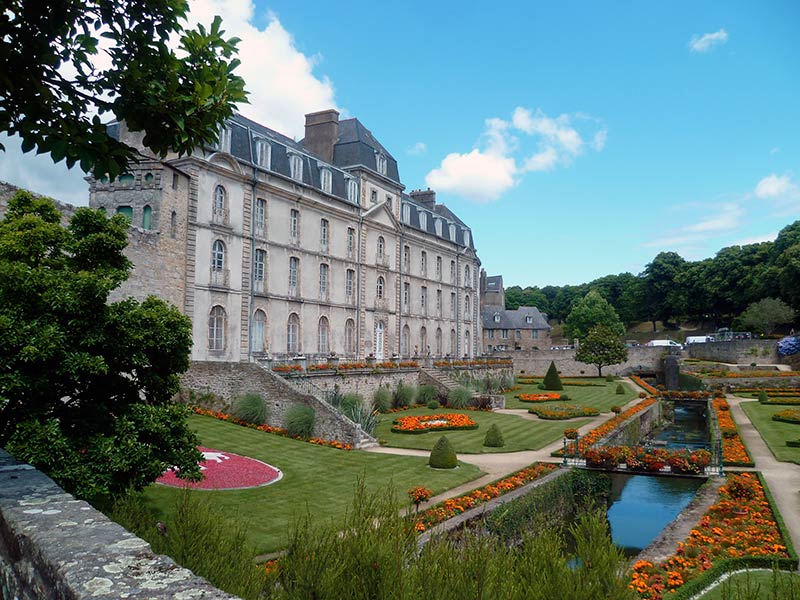
Vannes (Morbihan). It is one of the key projects of the municipality, which will have struggled to see the light of day. Presented in 2019, voted in 2021, the move of the Museum of Fine Arts at the Château de l’Hermine had to be postponed following the discovery of archaeological vestiges on the ground where an extension must be built. With more than two years late, the project is now in the concrete: after signing the building permit last March, the municipal council voted, on May 5, the final preliminary project of the future museum. A decisive step which kicks off the site: the first works should be launched next September, for delivery scheduled for the end of 2027 then an opening to the public in the first quarter of 2028.
If the project is finally on the rails, the copy must have been reviewed. First of all financially, since the forecast envelope of 17.5 million euros is widely exceeded. The cost of the work is now set at 26.6 million euros, more than half of which is covered by the city (17.2 million euros). The rest will be covered by subsidies from the State, the Department, the Region and the Gulf of Morbihan-Vannes Agglomeration.
Preserve the vestiges
To this budget reshuffle, there is a slight revision of the project on the merits. It is planned to move the museum, too cramped in the crowd – the old medieval hall where it is established – at the Château de l’Hermine, an 18th century mansion, as well as in a modern extension which will be built in the courtyard. But the architectural agency Nieto Sobejano, in charge of project management, had to rethink the development of this extension so that it does not deteriorate the vestiges of the 14th century ducal castle, particularly well preserved, which were uncovered during the excavations carried out in 2023 by INRAP (National Institute of Preventive Archaeological Research). The building will be built above the vestiges on tubes stakes, with an enhanced ground level to preserve medieval masonry. Remains which will therefore not be visible to the public (except at the cellars where visits will be organized), to the chagrin of local associations which claimed their enhancement. In fact, the solution of a glass floor had to be ruled out to ensure the waterproofing of the museum, because the remains are located below the level of the phreatic water table.
The rest of the architectural project remains unchanged. The future museum will triple its current surface, extending over 3,500 m². The entire historic building will be restored: redesign of the frame and roofs, replacement of facades, windows and doors, restoration of carpentry … The renovated hotel will accommodate a restaurant and a workshop space on the ground floor, permanent exhibition spaces on the first floor, and temporary exhibition spaces in the second. In the courtyard, the modern extension, dressed in recycled aluminum, will rise on three levels: in the basement, a space of reception, temporary exhibition and an auditorium, then a shop and offices on the ground floor. The second floor will also be reserved for teams, while the first will welcome the rest of the museum’s permanent collections, which retains modern and contemporary art funds.