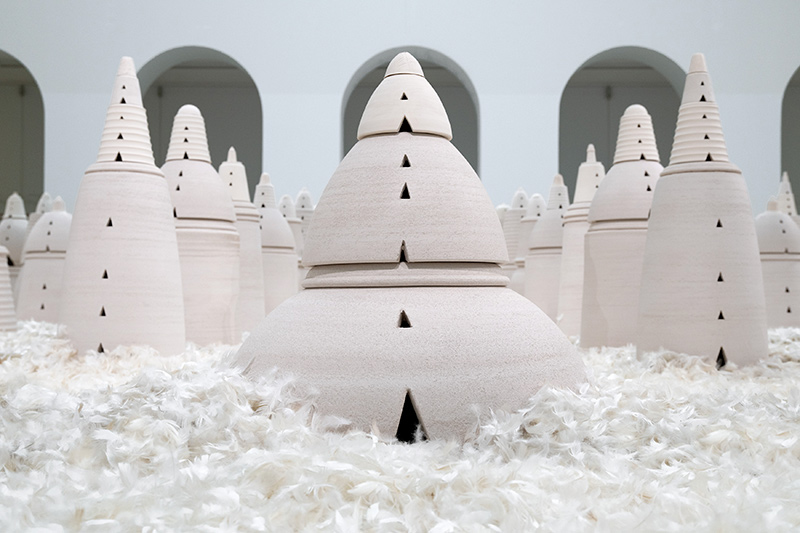
Nantes (Loire-Atlantique). With City of ShadowsAnne and Patrick Poirier offer a new mythology to the viewer. In the vast patio surrounded by arcades of the Museum of Arts, they are offering a monumental installation that summons both intimate memory and collective history. Great travelers, they have always explored sites and remains; nourished by architecture, archaeology, anthropology and psychoanalysis, their works become metaphors of time and memory, placed under the sign of oblivion and the fragility of civilization. A sentence handwritten in white neon, borrowed from the writer John Edgar Wideman (1), unfolds on the walls like a luminous meditation: “The story is a vanished city, razed by a war, a flood, a fire, an earthquake. » (In silence and oblivion2026)
It was during their stays at the Villa Medici in Rome, where they were residents for three years, that the form of their work crystallized. The Poiriers keep walking logs and make casts of the walls of ruined villas. In 1971, as if all these scattered elements had to come together into a single object, they created Ostia Anticaa terracotta reconstruction of the ancient port town, whose toponymy they modify according to memories. They were the first to resurface, in the context of the avant-gardes, the mythical foundations of our culture – even before postmodernity was fashionable.
View of the exhibition by Anne and Patrick Poirier, “Odyssey of Oblivion” at the Nantes Museum of Arts.
© C. Clos
© Adagp Paris 2026
Ruin as a method
Fifty years later, City of Shadows repeats this gesture by lightening it. Or a city reduced to its whites, made of ceramics, wool, feathers. The stone has withdrawn; the imprint and the trace remain. This whiteness, that of the ashes as much as of the shroud, has nothing decorative: it is the color of erasure, of the moment when the ruin ceases to be a monument to become a memory.
In the patio, the effect is immediately physical. The visitor does not face the city: he enters it, he overlooks it, he surveys its tiny streets with his gaze. The scale works against him – what appears immense from a distance reveals, up close, a goldsmith’s delicacy. We revolve around an absence, like in a museum whose windows have been replaced by tombs.
We think of the whole tradition of ruin, but then immediately move away from it. For the Poiriers, it is not a subject, it is a method: no longer what we look at, but what we look through. “Allegories are, in the realm of thought, what ruins are in the realm of things.” wrote Walter Benjamin (2). From there comes the fertile ambiguity of this city. It does not exist, and yet we recognize it: its names have slipped, its plans have become blurred in the sleep of memory, and it is this very imprecision which makes it universal. Contrary to American land art, when Robert Smithson watched the coming ruin in the factory, the Poiriers do not create the future from rubble: they exhume a past that they know is imaginary. Archaeologists of a memory without original, they restore nothing; they invent what we think we remember. And they avoid nostalgia for lost civilizations, by the very fragility of their materials: a city of feathers does not console, it warns.
This whiteness responds to a shadow. In the chapel of the Oratory, plunged into darkness, under the vault and the voice of Alain-Guillaume Poirier carried by the music, reappear Danger Zone (2001), The Great Library Fire (1976) and the books of Domus Aurea (1978) – never shown in France since the Center Pompidou exhibition of 1978. The slow disappearance of the patio here responds to catastrophe: no longer ashes but fire; no longer the oblivion which gnaws, but the fire which erases at once.
More than half a century later Ostia Anticaimbued with poetry and humanity, Anne and Patrick Poirier have denied nothing. They profess that, to speak of what lasts, it was necessary to choose what flies away or what burns. A city of ashes and feathers, a library of flames: nothing more fragile, nothing more tenacious.
(1) Write to save a life, ed. Galimard, 2017. (2) Origin of German baroque drama, 1928.