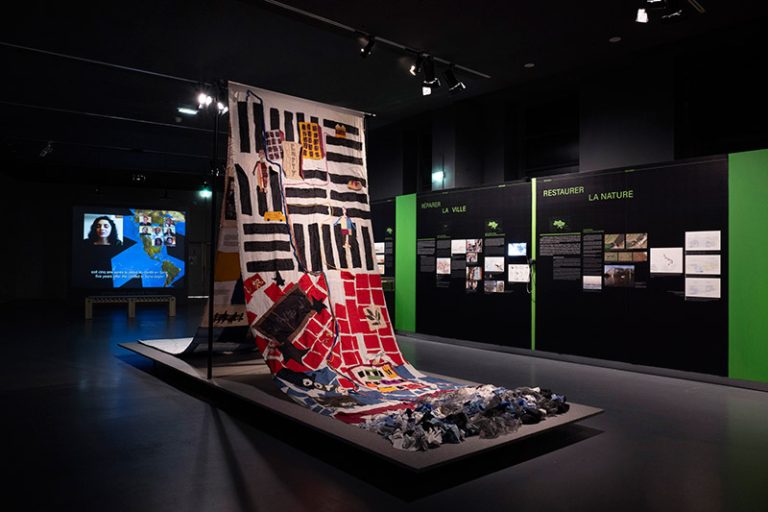
How did the Louvre exhibition “Primordial water, lessons from Mesopotamia” emerge, where archeology draws our attention to current issues?
The Louvre collections had a lot to tell about water. In Mesopotamia, water is at the heart of everything: from the birth of cities to agriculture, from political power to the sacred. By embarking on this exhibition, we very quickly understood that this ancient subject also resonated with very current concerns: resource management, urbanization, conflicts linked to water or even environmental disruption. The idea was not to focus our contemporary debates on Antiquity, but to show that certain questions cross the centuries.
How did you establish these bridges?
We worked with a bridge, water and forests engineer from the Ministry of Energy Transition, Agathe Chave-Lucas. It allowed us to identify resonances between current issues and certain ancient objects or texts, while requiring us to remain very vigilant in never making Antiquity say what it does not say. We also collaborated with the team from the UN water division, whose perspective helped us to give the most accurate discourse on these complex relationships between past and present.
Statue known as the Gudea with the gushing vase. Neo-Sumerian period, Paris, Louvre Museum.
© RMN Grand Palais / Franck Raux
Does this exhibition change the way we look at certain works in the collections?
Yes. The Code of Hammurabi (c. 1750 BC) is usually presented as one of the first codes of law. The exhibition focuses on water law. Moreover, its 4,000-year-old provisions greatly challenged the UN official with whom we were in dialogue, as our current water law remains embryonic. As for the Stele of the Vultures (around 2,450 BC), which opens the route to Oriental Antiquities, everyone knows it as an artistic masterpiece. But it is also the first conflict told in text and images, and one of the first water wars recorded: a conflict where water exacerbates territorial tensions. The exhibition gives it back all this dimension.
What role can a museum’s archaeological collections play in the face of contemporary issues?
The Louvre is not an environmental observatory! But it can offer keys to understanding and raise visitors’ awareness of current issues through its collections. What strikes me is this “so far, so close” aspect of the ancient Orient: we still have not resolved the questions of salinization, regulation of water rights, protection of biodiversity. Through the exhibition, we want to remind you that human societies have always had to negotiate with their environment: archeology sheds light on our contemporary crises.
It was around this date that the Vulture Stele was created, the first historically engraved stele, commemorating the victory of the city of Lagash over its enemy Umma around 2340 BC. This conflict, which lasted 150 years, was the first “water war” in recorded memory.
“The class, the work! »
Fifteen classes, from first grade to second grade, worked with the Louvre teams to create the labels for a children’s journey. A way to raise students’ awareness of Oriental Antiquities as well as the question of water.
“Ancient Mesopotamia, even in its very name (“the country between the two rivers”), is defined by its link to water, whether it is considered as a resource, necessary for the irrigation of crops and the development of cities, or as a symbolic element in its own right, playing a fundamental role in myths, religion and the exercise of political power. » Christophe Leribault, president and director of the Louvre (catalogue)