
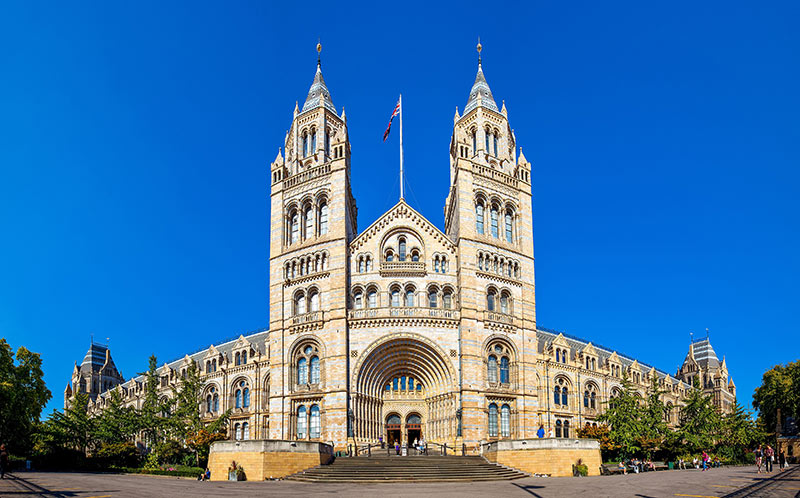
For the first time, the British Museum is no longer the busiest museum in London. In 2025, the Natural History Museum will take the lead with 7.1 million visitors, ahead of the 6.4 million of its neighbor in Bloomsbury. This change comes in a British cultural sector still below its pre-pandemic levels. Member sites of the Association of Leading Visitor Attractions (ALVA) totaled 165 million visits, up 2% year-on-year, but still below the 170 million recorded in 2019.
In this context, the progression of the Natural History Museum appears continuous and atypical: 4.65 million visitors in 2022 (+196%), 5.69 million in 2023 (+22%), 6.3 million in 2024 (+11%), then 7.1 million in 2025 (+13%). The Tate Modern is in decline (-3%), while the Victoria and Albert Museum and the Science Museum are stagnating or declining. The performance questions: how does this free public institution manage to outperform its counterparts?
Like major London institutions, the museum has maintained free access to its permanent collections, which constitutes a primary factor of attractiveness. But temporary exhibitions cost money. Those with high visibility, such as “Titanosaur: Life as the Biggest Dinosaur” (345,000 tickets sold between March 2023 and January 2024), ensure revenue. Added to this are paid offerings, such as “Lates” evenings, nights at the museum (Dino Snores), silent discos in the Hintze Hall or yoga sessions.
Furthermore, very recently the museum has expanded. Opened in July 2024, the Urban Nature Project has transformed five acres of gardens into a space that is both landscaped and experiential. Frequented by more than 5 million visitors in one year, these developments directly contribute to the overall increase (+20.9%), with a peak in August 2024. The whole is not limited to an open-air scenography. Environmental sensors, DNA analyzes and acoustic devices make it a field for observing urban biodiversity, presented as one of the most studied in the world.
The strategy defended by its director, Doug Gurr, is based on a combination of attractiveness and scientific discourse. On the one hand, the emblematic figures – dinosaurs, spectacular specimens, competitions Wildlife Photographer of the Year – ensure stable attendance. The museum capitalizes on a childhood fascination (dinosaurs, fossils, meteorites), which few institutions match, while maintaining a high level of scientific standards. On the other hand, the galleries dedicated to climate and biodiversity bring the route into contemporary concerns.


