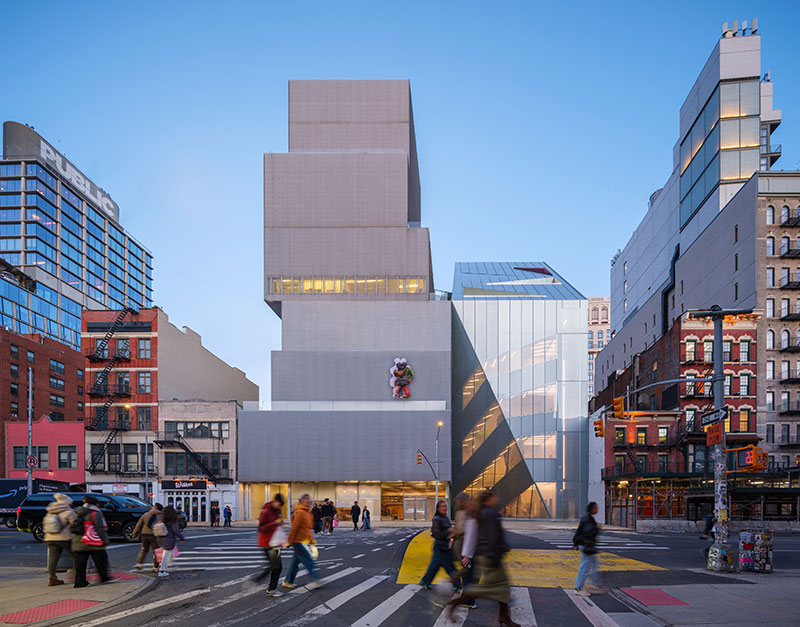
New York. On one side, an aluminum metal mesh covers a building composed of blocks stacked offset in an introspective, light-absorbing elevation. On the other, a surface of smooth, angular glass panels reflects light onto a building reminiscent of a sculpted crystal with inclined planes opening onto a square. After two years of closure, the New Museum, a contemporary art museum installed since 2007 in New York on the Bowery, in the Lower East Side, reopened on March 21 in a redesigned, transformed and considerably expanded space, combining the initial mesh tower by Japanese architects SANAA with a geometric block with open angles from the OMA firm, directed by the Dutchman Rem Koolhaas and the Japanese Shohei Shigematsu. Correcting the limits of a building often considered too closed and impractical, the museum has doubled its surface area, going from 5,500 to 11,000 m², which allows horizontal circulation from one side to the other. It also had a large staircase whose verticality and openness were lacking in the previous one.
“The floors are becoming more and more crazy”
Furthermore, with a clear desire to project this institution born in 1977, which originally consisted of only a simple room on Hudson Street, into the future, the New Museum intends to be more in line with what is expected of a museum today. Now organized over seven levels, it has new reception spaces at the top of the building for artists and the local community, including the “New Inc” incubator, a studio, a training center and a forum. “As you go up, the floors become more and more crazy, with touches of color and humor,” observes Lisa Phillips with a smile. The departing director of the museum adds that the architects describe this bright pink and bright blue summit “like the brain of the building”. Faithful to its history, the museum recalls having accompanied great names in contemporary art in their beginnings in New York, from Ana Mendieta to Jeff Koons, including Martin Puryear and Theaster Gates. The work, she specifies, will have cost a total of around $82 million (a little less than €80 million).
Designing the new extension of the New Museum “was a major challenge”, recognizes Shohei Shigematsu, the chief architect of OMA in New York. “Usually in this type of museum expansion, the buildings span a period of fifty years or more and are old enough to create an interesting contrast or dialogue. But here, it’s contemporary versus contemporary. » This idea of a “pair”, of a necessarily imperfect “couple”, “As in a marriage or partnership, first involves recognizing the differences. Everyone has their own story, their own philosophy. We must also respect each other and be connected on a mental level” with “a good level of connection and independence”. To nourish this reflection, the architects worked from around twenty images of heterogeneous duos, from a performance by Marina Abramovic and Ulay to technical couples like a rocket and its launch pad, inspiring figures where proximity, ambiguity and autonomy coexist.
Even though the two entities remain very distinct when viewed from the outside, the circulation in the heart of the galleries, from the first to the fourth floor, is fluid and seamless on widened platforms, to the point that the visitor sometimes no longer knows whether he is in the old or the new wing. A continuity which echoes the very functioning of the museum, without a permanent collection, conceived as a space of experimentation and production rather than conservation. New public spaces have thus been designed to accommodate artist commissions, such as the atrium, the “plaza”, the south elevators and even the exterior spaces. From the opening, on the facade, an aluminum sculpture in situ by the artist Tschabalala Self, approximately 4 m high, representing an embracing couple, welcomes the visitor. Installed at the junction of the two buildings, the work materializes what the architects describe as a “meeting point”, or a ” kiss “ architectural between the two entities.
“Opening a new museum constitutes, in a certain way, an act of confidence in the future,” confides Massimiliano Gioni, the artistic director of the New Museum, to Arts Journal. Indeed, “Building a new building in 2026 does not have the same meaning as it did in 2007, when we inaugurated the first one. The notions of growth, expansion, or even the idea of a future and a world to come have profoundly evolved, especially after the pandemic and in view of what we are still going through today.from ongoing wars to the acceleration of the environmental crisis or the rise of artificial intelligence.
With the pharaonic inaugural exhibition “New Humans: Memories of the Future”, occupying the entire museum with more than 700 pieces by more than 200 artists, “we therefore wanted to explore different visions of the future, through history as well as through the work of contemporary artists”, he continues, and propose a global reflection on the future of humanity by approaching this new page in the history of the institution.
Cyprien Gaillard and Otto Freundlich
Along the route, not far from theGeopolitical child observing the birth of the new man (1943) by Dalí, or Newborn in polished bronze by Brâncusi (1920/2003 (cast iron)), certain works structure the space, like The Angel of the Home (2019) by Frenchman Cyprien Gaillard, a circular holographic sculpture where a fragmented figure, in bright colors, swirls in the void, between appearance and disintegration to the rapid rhythm of its mechanical device. “This work is remarkable for the way in which it combines references, notably a surrealist imagination, through the animation of Max Ernst,” underlines the director, who made it an anchor point of the exhibition. Thinking as a device “both hologram and robot”she dialogues with The New Man by Otto Freundlich, a sculpture destroyed by the Nazis and which became a symbol of the excesses of the 20th century.
At the border between the old and the new building, a Red Sculpture2017-2024), by New Yorker Jordan Wolfson, a sort of suspended and dislocated Pinocchio, seems to question the visitor about the human obsession with the creation of life, while a “extreme model” by Congolese Bodys Isek Kingelez, Ghost town (1996) capturing the sad utopias of dictators, is hovered over by the colorful jellyfish of Anicka Yi (In Love with the World2021/2025), as fragile as they are threatening, in a world haunted by the obsession with surveillance. An experience that Massimiliano Gioni summarizes by borrowing from Umberto Eco the image of the museum as “gym for the mind, soul and eyes”, a place where we come less to find answers than to practice coexisting with what we don’t understand.