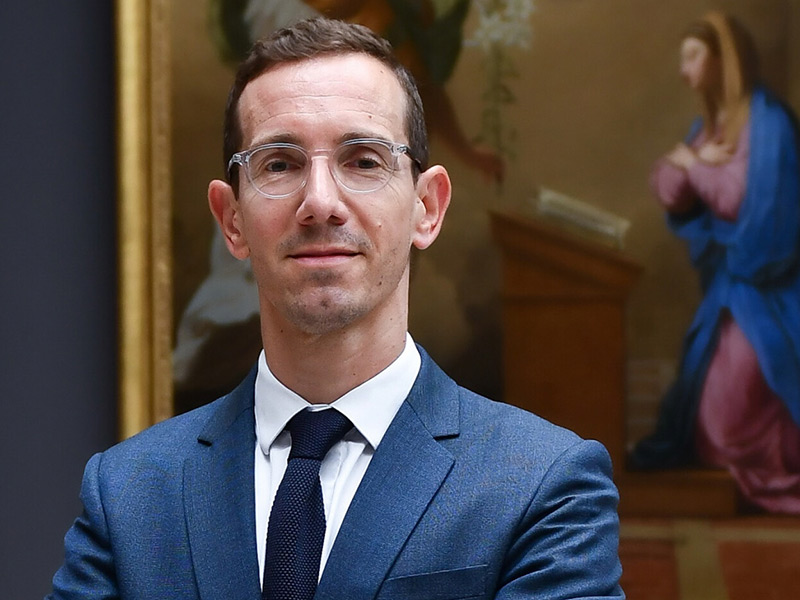
Vincent Delieuvin was appointed director of the Paintings department of the Louvre Museum by an order from the Minister of Culture dated September 7 and published on September 11. He is appointed for three years, renewable. Aged 48, the chief heritage curator succeeds Sébastien Allard, who had headed the department since 2014 and whose mandate was not renewed in the spring. This is the third appointment to head a conservation department since the arrival of Christophe Leribault as president of the Louvre in February, after Stéphanie Deschamps-Tan in Sculptures and Ketty Gottardo in Graphic Arts.
Vincent Delieuvin has worked in the Paintings department since 2006, where he was responsible for 16th century Italian painting. A former student of the National Heritage Institute, he began his career in 2004 at the National Museum of the Château de Compiègne, in charge of historic apartments. He conducted research in Rome on Federico Barocci before being welcomed in 2016 to Yale for work on the posterity of Leonardo da Vinci and Leonardo painters.
A specialist in the Italian Renaissance, he has built a significant part of his career around Leonardo da Vinci. At the Louvre, he was notably curator of “Titian, Tintoretto, Veronese… Rivalities in Venice” in 2009, of “Saint Anne, the ultimate masterpiece of Leonardo da Vinci” and of “Raphael, the last years” in 2012, then, with Louis Frank, of the retrospective “Leonardo da Vinci” in 2019-2020. This brought together 163 pieces and welcomed more than a million visitors. In THE EYEin 2019, he explained that the scientific examination of the tables made it possible to obtain “a global and coherent vision of the artist”.
The department for which he is responsible covers European schools from the 13th century to the mid-19th century and preserves nearly 12,000 paintings, some of which are deposited in museums in France. However, the function goes beyond the management of the Louvre collections. As director of a “large heritage department”, Vincent Delieuvin will, at the request of the French Museums Service, provide advice and expertise to French museums, participate in scientific commissions and examine requests for export certificates.
His appointment comes at a time when the “Louvre Nouvelle Renaissance” project is undertaking a profound reorganization of spaces and routes. The job offer published in the spring assigned the future director the definition of a new strategy for presenting paintings: redesign of the route, rapprochement with the collections of other departments, development of mediation and increased circulation of works in museums in the region. The department is directly concerned by the future “Mona Lisa route”, the resumption of the rooms of the Sully quadrilateral and the technical renovation of the palace.