Malta. Until recently, Malta had no permanent public places dedicated to contemporary art. The paradox is all the more surprising given that Valletta was “European Capital of Culture” in 2018. The Muza, inaugurated in 2024, is dedicated to classic Maltese fine arts, while the Valletta Contemporary is a private place. In the absence of a permanent collection, the Malta International Contemporary Art Space (Micas) presents itself more as a temporary exhibition space installed in a restored historic site than as a contemporary art museum in the strict sense.
The initiative was born in 2015 under the leadership of Phyllis Muscat, executive president of the museum’s board of directors. Attached to the Valletta 2018 heritage program, the museum was due to open in 2021, then in 2022, before being further delayed by the Covid-19 pandemic and the consequences of the war in Ukraine. The Micas is finally inaugurated in October 2024, after nine years of maturation. During the first two inaugural years, the program devotes exhibitions to Joana Vasconcelos, Milton Avery, Reggie Burrows Hodges and Ray Pitrè. Each exhibition lasts four months.
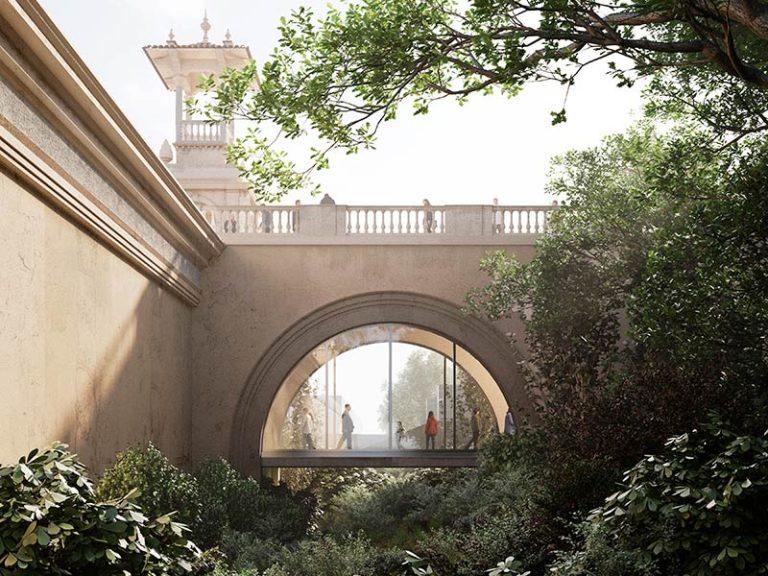
Micas occupies the Ospizio de Floriana, built in 1667 as part of the Lines of Floriana designed by military engineer Pietro Paolo Floriani. The whole is made up of several defensive elements: San Salvatore bastion, La Vitoria bastion, Polverista curtain, Piazza Bassa and Ritirata; they are connected by the Barbara arch. In the 18th century, the complex became a hospice for the destitute and mentally ill before part of it was converted, under British rule, into a warehouse for the national electricity company. The site was gradually abandoned during the 20th century and fell into ruin, before being reinvested in the 2010s as part of heritage rehabilitation policies, a prelude to its transformation into a museum.
Four centuries of transformation
The restoration project is entrusted to the Maltese Directorate of Restoration in collaboration with the Florentine studio Ipostudio and the architect Hermann Bonnici. The budget reaches 32 million euros, including 23 million financed by the Maltese state and more than 9 million by the European Regional Development Fund (ERDF).
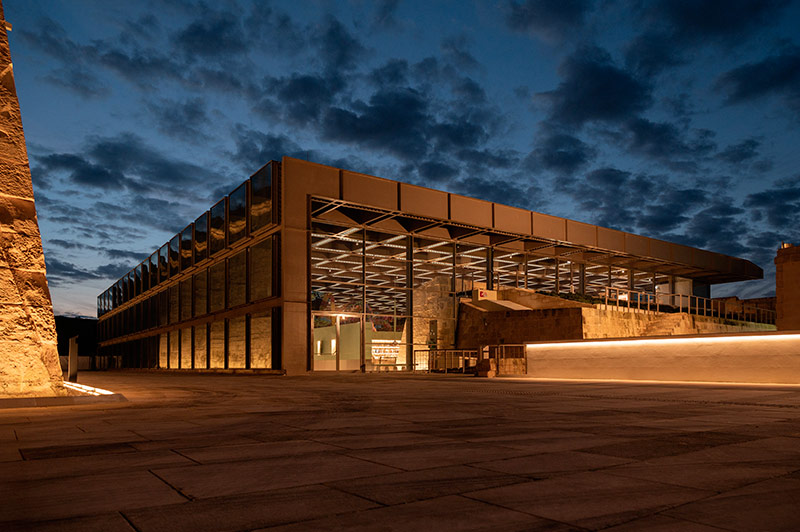
The architectural choice consists of a monumental roof of welded steel beams covering the historic fragments in one piece. “The contemporary building does not alter the fortress; the two architectures remain perfectly legible in a form of reciprocal autonomy“, underlines Guillaume Dreyfuss, exhibition manager. The voids between the beams are used to drain rainwater; a glass roof diffuses Mediterranean light into the galleries. The roof supports the hanging and lighting systems, avoiding any perforation of the historic walls. The complex covers an area of 8,360 m², including 1,400 square meters of galleries spread over four levels, with a ceiling height of 18 m at its lowest point.
The space surprises with its scale and its cantilevered levels. The irregular limestone walls, hollowed out by old loopholes, prevent any museum neutrality. The monumental installations find a form of evidence there. For the opening, the Portuguese artist Joana Vasconcelos made full use of the volumes. Tree of Life (“the Tree of Life”) crosses the four levels, Valkyrie Mumbet deploys in suspension, Garden of Eden (“Garden of Eden”) sinks into darkness. The place thus favors immersive and three-dimensional devices.
Concerning painting, the exhibition “Colour, Form and Composition, Milton Avery and His Enduring Influence on Contemporary Painting” (Oct. 25, 2025-Apr. 4, 2026) highlighted the limits of the place. Scenographer Cécile Degos had to use curved rails in order to recreate stable hanging surfaces where the stone and military geometry prevent them. The solution remains effective but reveals a structural inadequacy. Exhibiting the painting here supposes rebuilding a museum within the museum.