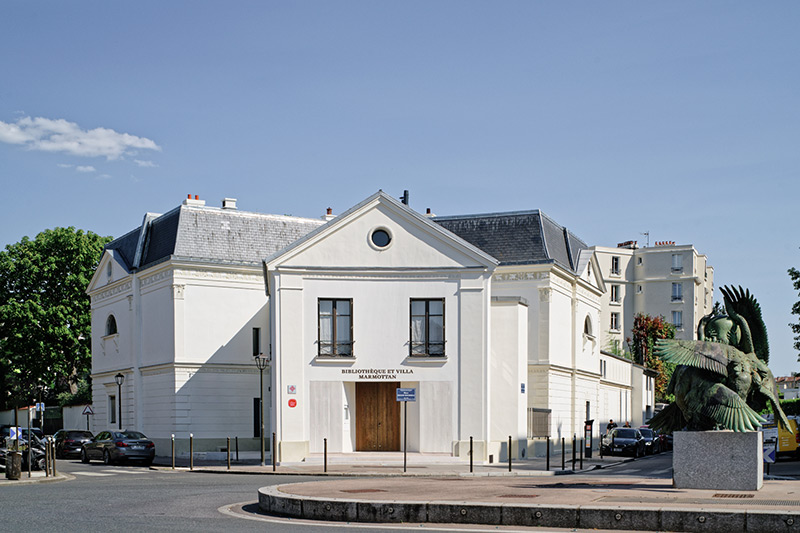
Boulogne-Billancourt (Hauts-de-Seine). Inside, everything is gilded, old books and sparkling chandeliers. However, in the beautiful Empire style residence, heritage has never coexisted so closely with contemporary creation. It is precisely this dialogue that underlies the entire project carried out under the aegis of the Academy of Fine Arts, owner of the premises. Five years of construction and 10 million euros invested made it possible to reopen, on October 6, the library and villa Marmottan to the public, but also, before this date, to research and creation. “Restoring a building also means restoring its function. And that’s what we do here by organizing concerts and conferences, by encouraging researchers and artists, by making this site a place of life! “, rejoices Adrien Goetz, art historian and academician, who has served as director there for six years.
When the Academy took over management of the place from the City of Boulogne-Billancourt in 2018, it was with a double ambition: to restore the library, with its 20,000 books, to its former splendor, while giving a new dynamic to the adjoining villa. “The buildings were still looking pretty good, we had no idea they were in danger. But they really were! testifies Adrien Goetz. There were wood-eating insects under the parquet floors, mushroom growth in the basement storage rooms, humidity was seeping into the walls and many elements of the decor were disappearing, like these stone-cardboard griffins that fell with the rain. » The restoration of the old decorations, entrusted to the architect Jennifer Didelon, is then guided by one principle: to restore a “Paul Marmottan state”, or the spirit of the place at the time of its founder.
Interior of the Villa Marmottan with furniture and paintings from the end of the 19th century.
© Daniele Rocco
A little-known residence
Paul Marmottan (1856-1932) is best known for his private mansion at La Muette (Paris-16th), today the Marmottan Monet Museum. Much less this residence located in Boulogne, both a working library and a showcase for his collections, the construction and layout of which the patron and collector had carefully supervised. “Marmottan decorated it to make it a sort of laboratory, a history of taste, a manifesto of the “Empire style” of which he was passionate,” explains the director. Parquet floors, woodwork, wall decorations, furniture: every ornamental detail has been carefully restored. Patient sampling work also made it possible to restore the original colors of the walls, layer after layer. In the little blue living room, the wall silk from the factories of Caroline Murat (1782-1839) has regained its shine. The “Empire green” velvet of the study once again matches the sea green paint in a bold contrast. And in the study lounge, the large stripes that punctuated the walls have given way to a subtle pale blue.
Behind the desire to rediscover the period atmosphere, the site responded to current requirements. New elevator, upgrading to standards for people with reduced mobility, better equipped auditorium, thermal and hygrometric regulation of the exhibition gallery… So many interventions which expand the programming possibilities, from concerts to temporary exhibitions. “We plan to alternate historical exhibitions with contemporary art exhibitions, specifies Adrien Goetz on this subject. Until now, we’ve mostly focused on history. From now on, we open ourselves to today’s creation. » An inflection which will materialize from the first exhibition planned for spring 2027 and dedicated to around ten artists former residents of the Villa Marmottan.
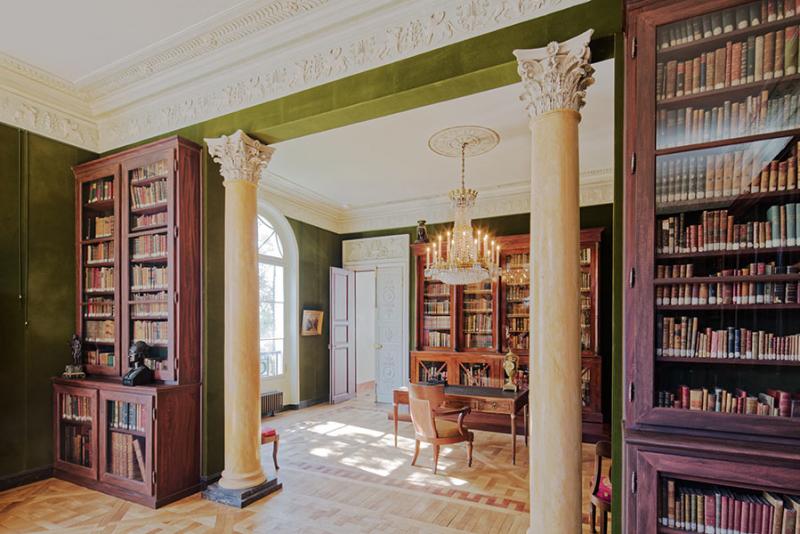
Interior of the Villa Marmottan with furniture and paintings from the end of the 19th century.
© Daniele Rocco
Already nearly forty residents welcomed
In addition to the heritage restoration, the Academy has in fact undertaken a vast rehabilitation of the villa to accommodate artists and researchers from all over the world. During the first phase of the project, five housing workshops were built on the site of the director’s former accommodation and that formerly occupied by Paul Marmottan’s driver. “This building was completely collapsing. Its floor was becoming dangerous, the wooden staircase was rotten. So we transformed everything, restored everything. » From 2021, even before the end of the construction site, the villa was already welcoming its first residents. Nearly forty have since stayed in a completely renovated setting. Selected by a jury made up of members of the Academy, they are either researchers specializing in the first half of the 19th century, or artists from various fields of creation. In addition to the studio-housing made available to them, each person benefits from a monthly grant of 1,500 euros, to which is added assistance for the production of work or publishing in the amount of 5,000 euros. Enough to give Villa Marmottan the appearance of a “little Villa Medici”. All that remains is to create a garden designed by landscaper Louis Benech to complete the metamorphosis.