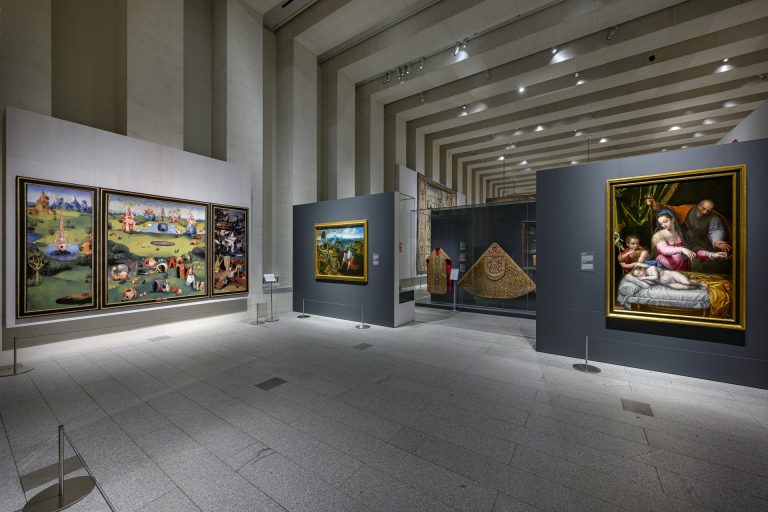
Two years after its presentation at the Musée d’Art Moderne. MAM in Paris, and now updated and adapted to the Spanish context, to the facilities of the Center de Cultura Contemporània of Barcelona and to the usual diversity of languages in which it presents its exhibitions, the space directed by Judit Carrera hosts the exhibition “The Atomic Era.”
It represents the first collaboration between the CCCB and the MAM and comes a year after we remembered the eight decades that have passed since the dropping of the atomic bombs on Hiroshima and Nagasaki, a catastrophe that, in the words of the German philosopher Günther Anders, marked the beginning of “the era of infinite insecurity”, which has also been, according to Carrera at the start of the exhibition, of the awareness of planetary risk and the interdependence of the world. It is also inaugurated twenty years after this Catalan center hosted another production around the causes and consequences of the Chernobyl accident.
“The Atomic Age”, however, addresses a larger time frame: it offers a possible cultural history of nuclear energy and its political, social and cultural drift from the end of the 19th century to the present, analyzing how the discovery of radioactivity and its multiple applications has had an evident impact on art and creative manifestations and, in return, how these have helped us understand the paradoxes of the atomic world. Works from the past and others made specifically for the exhibition will highlight how the gradual discoveries in this matter came to us associated with a great promise (that of the viability of having an inexhaustible source of energy that would reaffirm contemporary confidence in science as an engine of supposedly unlimited progress), but also with a bad dream (that of irreversible contamination and the possibility of total destruction). The artistic proposals that are part of the tour largely oscillate between these two poles: between fascination with indisputable advances and anguish over their possible long-term effects.
Anniversaries aside, this project also opens in a period in which the nuclear issue is once again gaining weight in the public debate as a result of the escalation of war (Ukraine and Iran), climate challenges, efforts directed towards the energy transition and the accelerated emergence of Artificial Intelligence. Its purposes are to analyze the phenomenon in all its complexity and review the future role of both technical and scientific research and creation; a role in which, it is noted, the importance of imagination in the face of threats will not be less.
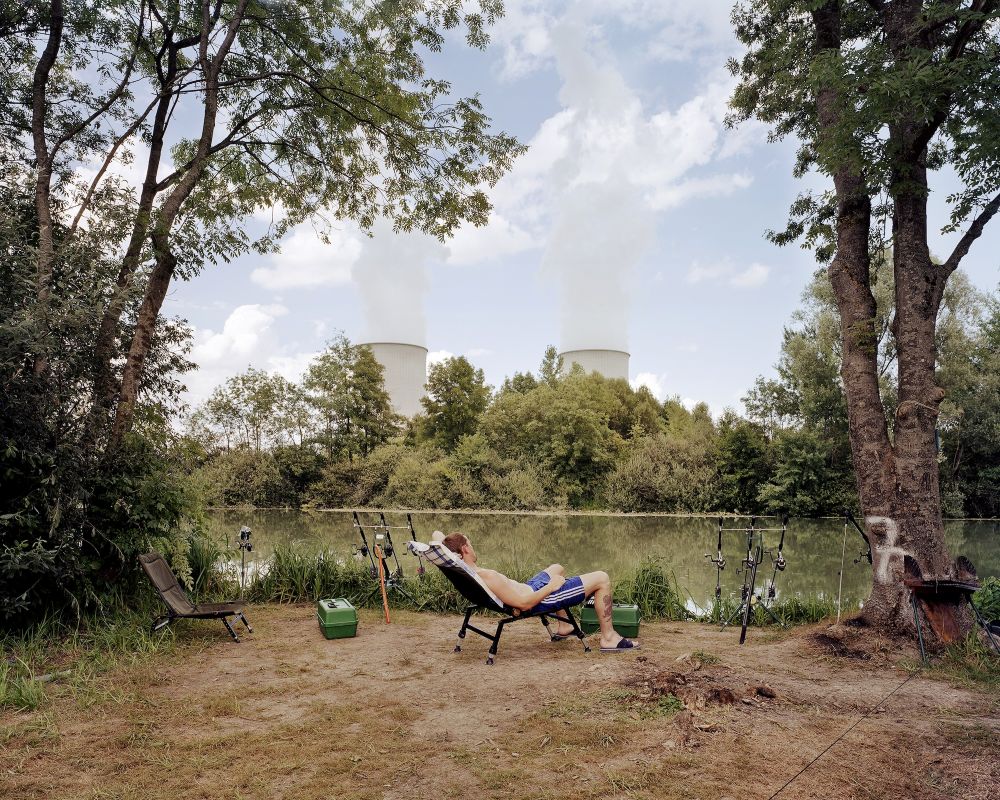
Jürgen Nefzger. Nogent-sur-Seine nuclear power plant, France. Series Fluffy Clouds2003. Courtesy Galerie Françoise Paviot, Paris
“The Atomic Age”, curated by Julia Garimorth, Maria Stavrinaki and Maria Ptqk, is structured in three sections, the first focusing on those discoveries that, in the final stages of the 19th century, would make possible the subsequent appearance of the atomic bomb: the basic one is that of the aforementioned radioactivity; Having knowledge of this spontaneous process by which an unstable atomic nucleus loses energy and emits radiation to become a more stable nucleus transformed our understanding of the world and surely expanded our perceptual framework.
Scientific materials from this time have arrived at the CCCB, some of them loans from the Musée Curie and others from the Institute of Radioactivity in Madrid, a kind of sister institution to the Curie Laboratory in Paris: both exchanged information and techniques.
The artists who worked in parallel to these findings – highlighting the Swedish pioneer of abstraction, Hilma af Klint, so interested in the invisible forces that determine movement and energy (and perhaps aware of them) – could not help but be attracted by this news. When authors like Klint tried to distance themselves from nature as a model, the awareness that the atom was not the ultimate constituent element of matter, but that it can be crossed by invisible rays or be impregnated with radioactivity, seemed to endorse what were only intuitions: those that material reality might not be completely solid or impenetrable.
The dancer Loie Fuller was inspired by the Curie studies to devise her radio dancegranting a personal dynamism to those radioactive substances whose scope could not yet be glimpsed, but which already at the beginning of the 20th century extended to agriculture, medicine and some consumer products.
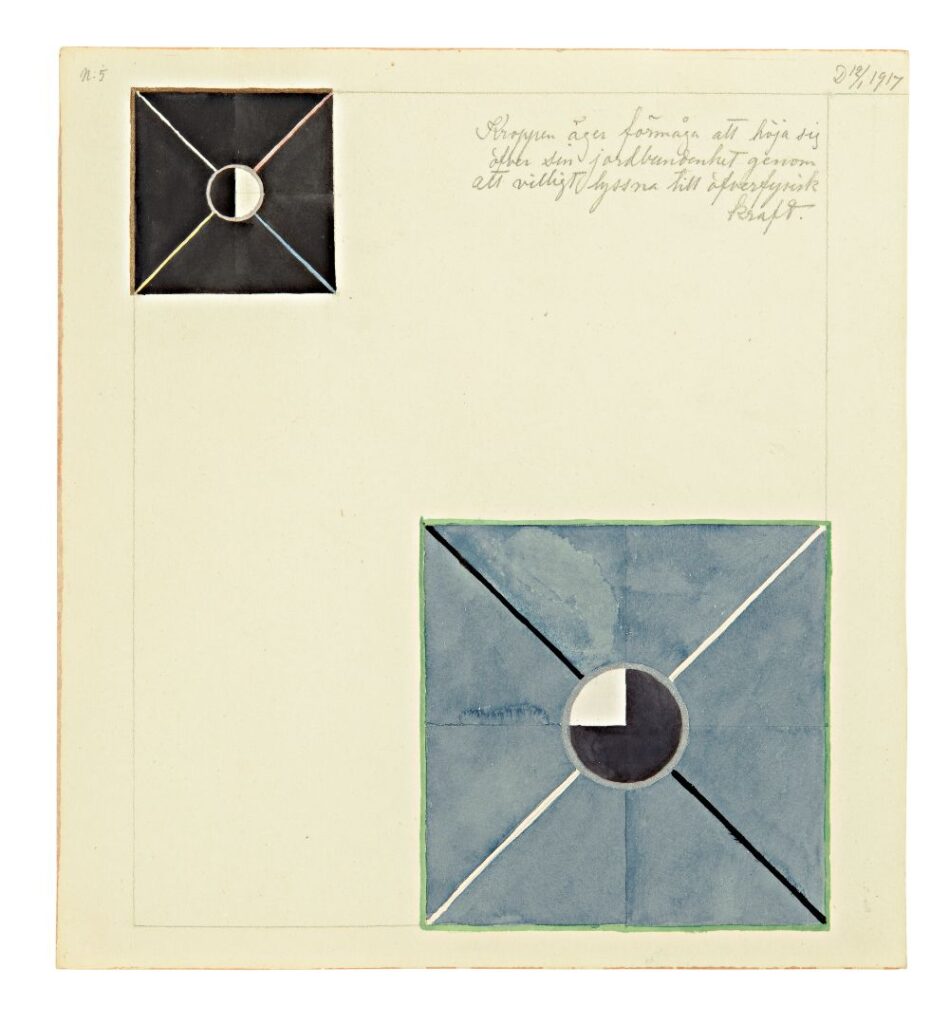
Hilma af Klint. The body is capable of rising above its earthly ties by listening to supernatural energy. The Atom Series1917. Courtesy of The Hilma af Klint Foundation
The second chapter of “The Atomic Age” pivots around World War II and the impact of Hiroshima and Nagasaki. Garimorth referred to the bombing as a turning point in contemporary history: in the Cold War the ties between the development of science and politics became closer and more complex than ever before.
The reaction of the artists to this new reality was plural, ideologically and purely aesthetically: it moved between the reflection of the destruction and horror at the devastating power of the nuclear bomb and the investigation of the formal or plastic possibilities of that conception of energy.
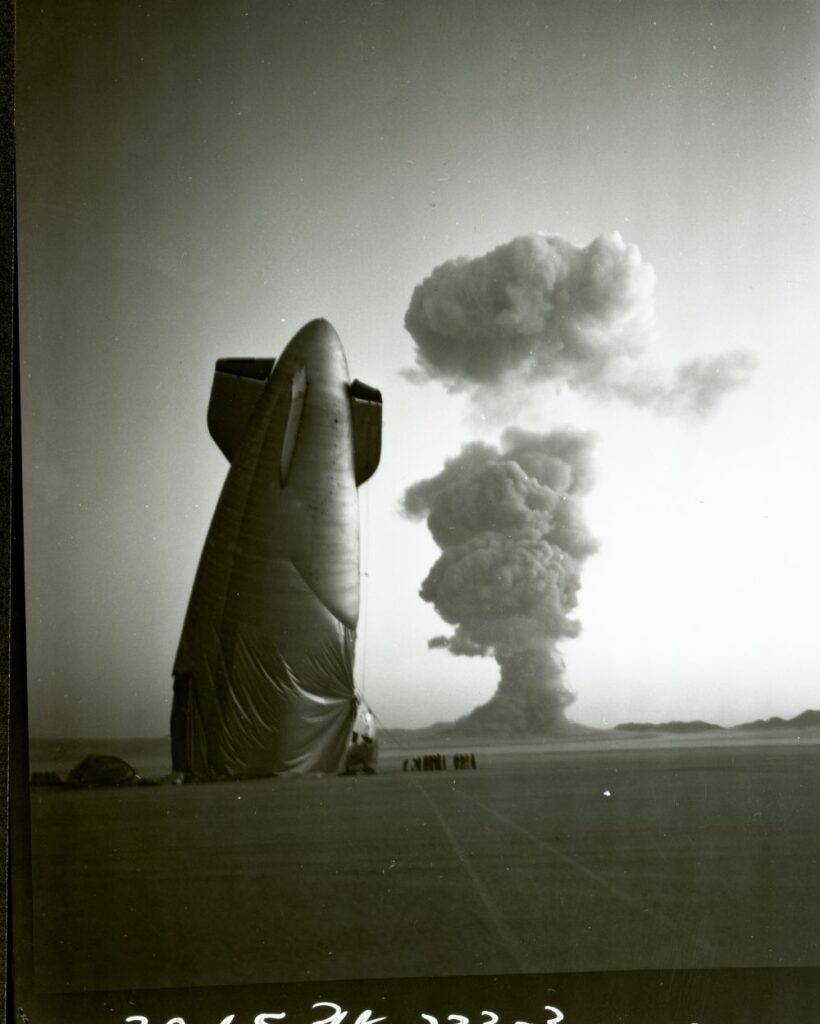
Airship in connection with the “Priscilla” attack, Operation “Plumbob”, at the Nevada Nuclear Test Center, 1957. US National Archives
The extensive dissemination in the media of the atomic mushroom that resulted from the Trinity Test, that first detonation of a nuclear weapon within the framework of the Manhattan Projectturned that mushroom, in the New Mexico desert called Jornada del Muerto, into an icon of visual culture since then and in a form omnipresent in the contemporary imagination. Even David Lynch made him hypnotic in the third season of Twin Peaks.
For a time, everything seemed like it was not: in Las Vegas, the schedules for explosions at a nearby testing ground were announced as if they corresponded to a spectacle to be seen from hotel terraces, and beauty contests were organized Miss Atomic Bomb. With the same purposes of atomic propaganda, promotional exhibitions of nuclear energy were prepared in Europe and the United States, especially following the speech Atoms for peace that Eisenhower delivered at the UN in 1953, in which Ike emphasized its positive uses.
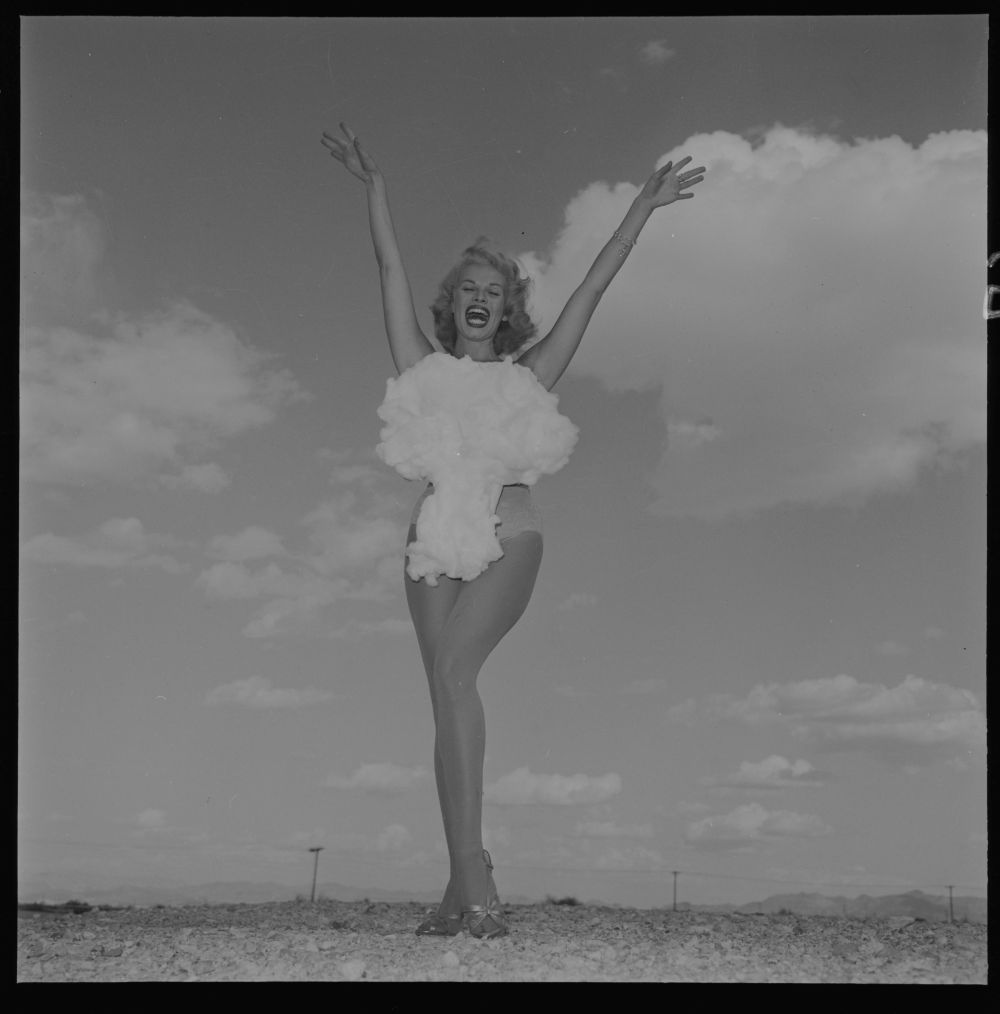
Jack Pepper. Model Lee A. Merlin as Miss Atomic Bomb in the Las Vegas desert. Promotional image of Sands Hotel. LVCVA Archive, Las Vegas
That same year, the Madrid Pacts were signed, aimed at cooperation in this area between Spain and the United States, which would lead to the construction of the first generation of reactors in our country, built with American equipment and financing, and opened the door to the installation of bases. In 1961, the El Encín Gamma radiation field was established near Alcalá de Henares, surrounded by the planting of 18,000 trees in concentric circles that were to serve as a containment barrier against radiation; This complex was to promote familiarization with the use of technologies linked to nuclear energy.
And five years later, in 1966, the Palomares plane crash occurred, which caused the fall of four thermonuclear bombs, one of them in the sea of Almería. Precisely the first of the three specific productions that the CCCB has developed for this exhibition in collaboration with Tabakalera is the one made by María Elorza around this episode, using archival material; it’s about the video Palomares: We fly to Moscow.
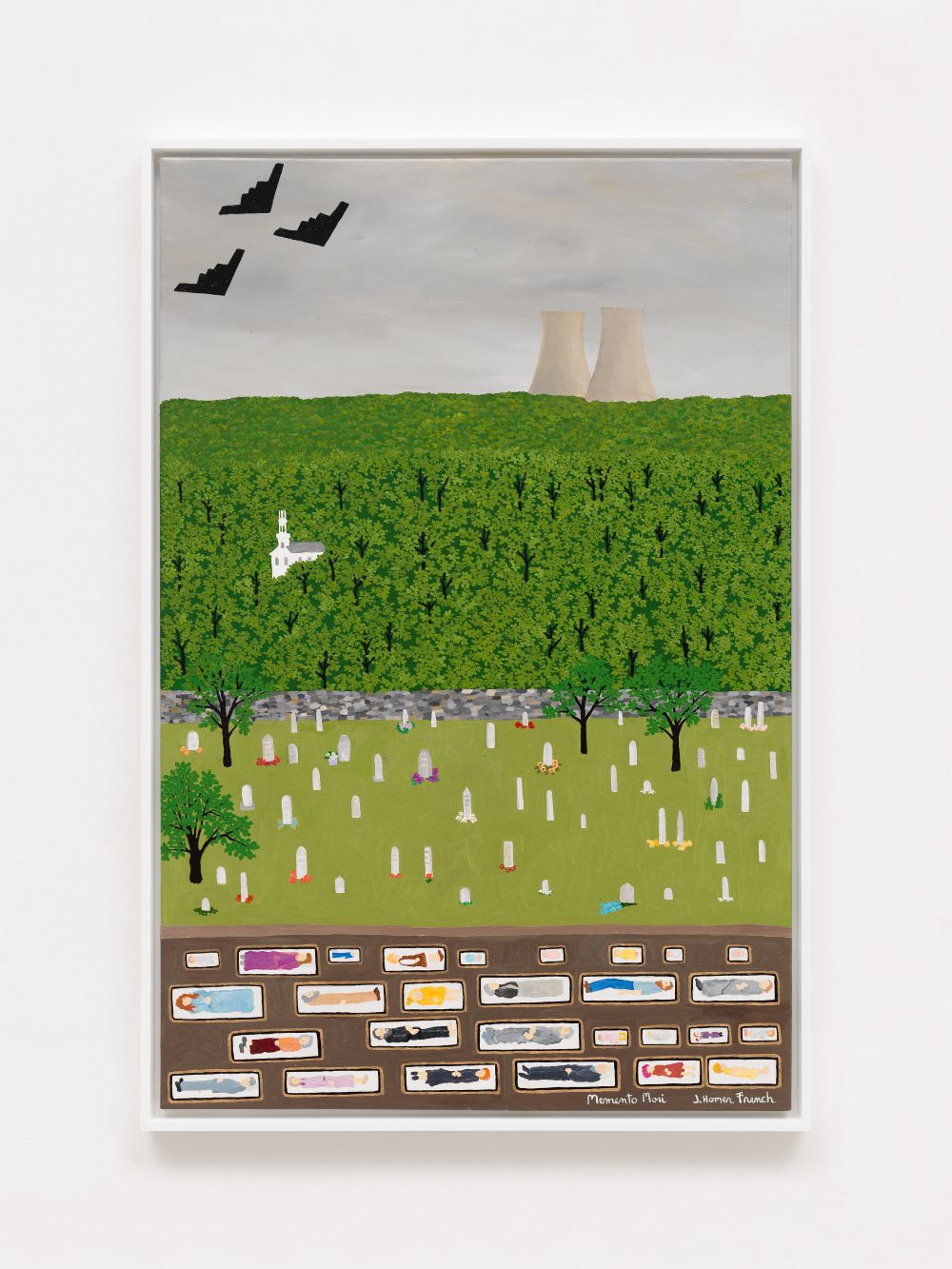
Jessie Homer. French Memento mori2022. Private collection
The third and final section of the exhibition, related to the nuclearization of the world, explores how the nuclear extended to all dimensions of our existence until it became, at times, an almost trivialized reality. In parallel, we are witnessing, for Garimorth, a shift in perspective: the threat was no longer limited to the prospect of an atomic explosion, but rather to a more diffuse and extended reality, that of radioactive contamination that could affect living beings without distinction.
The creators who have addressed these challenges have done so, again, in a diverse way: making visible the effects of this contamination, focusing on the colonial dimension of the nuclear industry due to the location of its tests or emphasizing the implementation of power plants, contested, especially since the sixties and in the Transition, by broad-spectrum social movements.
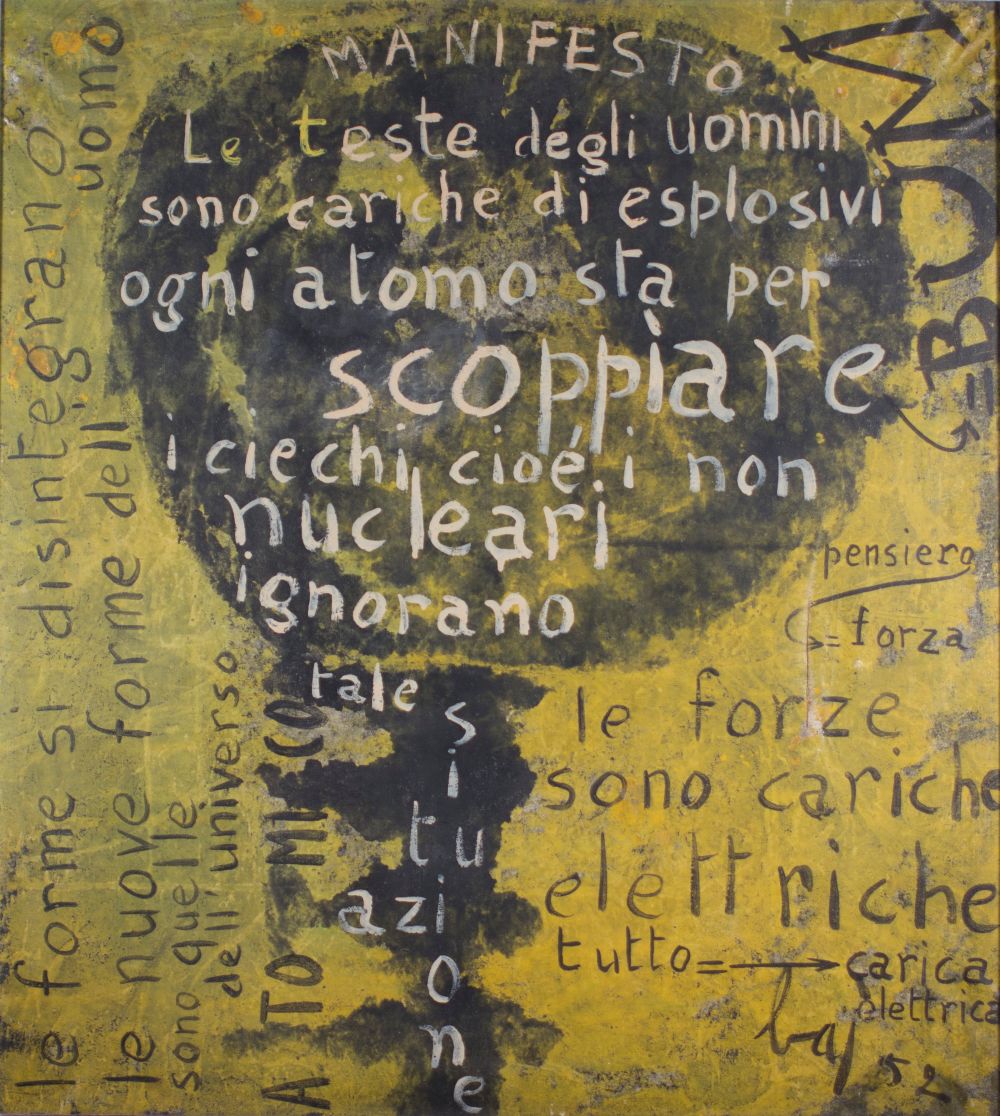
Enrico Baj. Nuclear Bum Manifesto1952. Luca Belenghi Collection, Milan
There is no shortage of allusions to the challenge of waste (Jordi Bernadó) or to the future of Chernobyl (Fernando Cremades) and the fit of nuclear in the new green energy direction (Toni Curcó has brought together expert voices in a short documentary). Also on the itinerary will be the inevitable Joseph Beuys, R. Buckminster Fuller, Lucio Fontana, Dalí, Chillida, Dominique Gonzalez-Foerster, On Kawara, Asger Jorn, Piero Manzoni, Roberto Matta, Sigmar Polke, Joan Rabascall, the photos of Miserachs and Manolo Laguillo documenting the construction of the Spanish power plants, Francesc Torres and Nancy Spero.
The Japanese writer Yōko Ōta, a survivor of Hiroshima, stated that one could not write about that horror without creating a new terminology, a new vocabulary. This exhibition asks, in part, whether this language already exists or is yet to be invented.
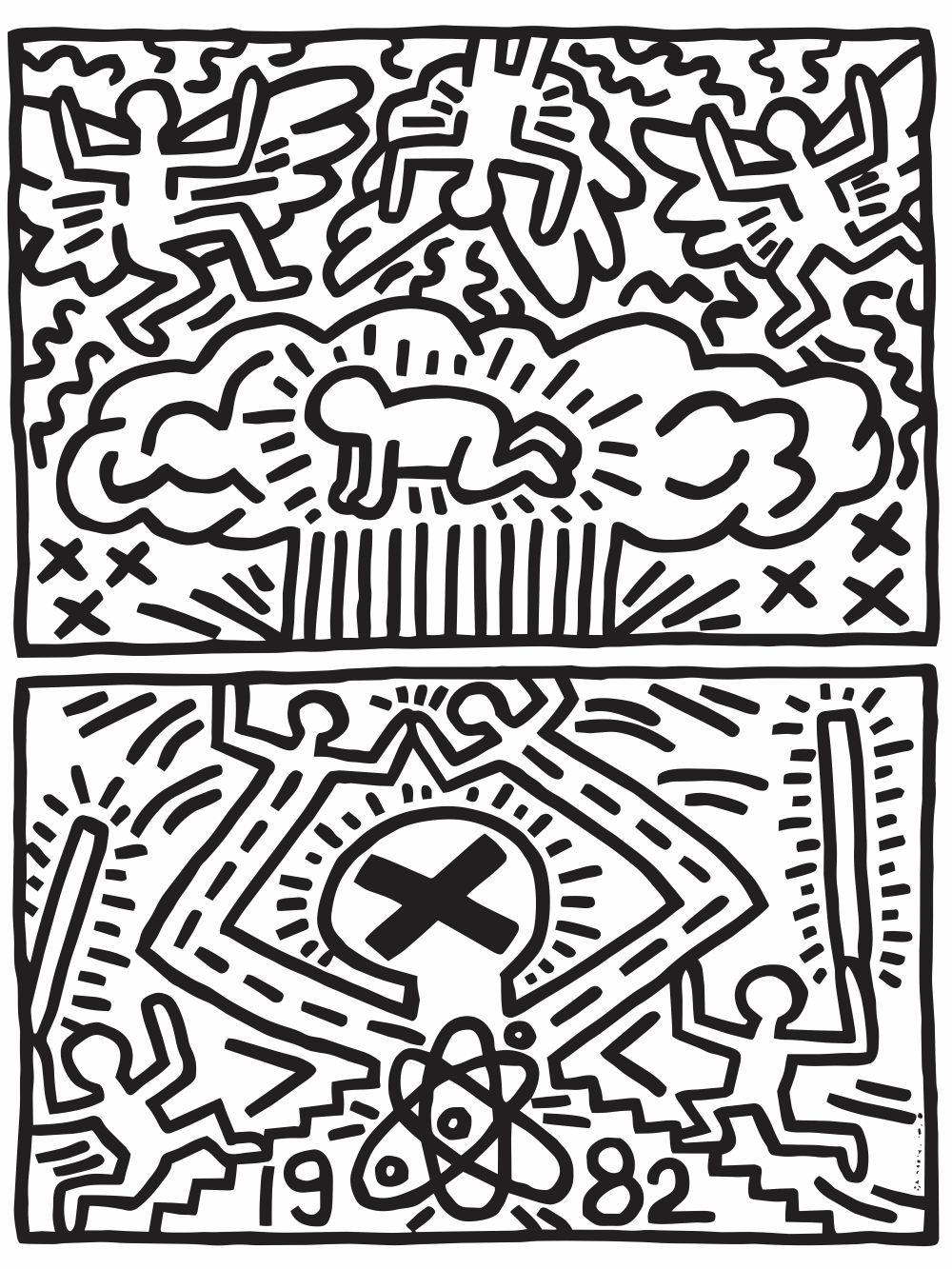
Keith Haring. Antinuke rally1982. Keith Haring Foundation, New York
“The Atomic Age”
BARCELONA CONTEMPORARY CULTURE CENTER. CCCB
c/ Montalegre, 5
Barcelona
From November 26, 2026 to May 17, 2027